
Every building you have ever walked into was held up by some mix of steel and concrete. That has been the deal for about a century, ever since steel framing let cities grow up instead of out, and there has never been a serious reason to question it. A company in Maryland is now shipping a product that does, and it is made of wood.
The company is InventWood, the product is called Superwood, and the pitch is exactly as strange as it sounds. You take ordinary timber, boil it, crush it, and you end up with a material the company says has 50% more tensile strength than steel and a strength-to-weight ratio roughly ten times better. A year ago that was a viral headline and a lab sample. As of 2025 it is a real product coming out of a real factory in Frederick, Maryland, with a reservation list, a distribution partner, and a price.
What it does not have yet is the one approval that would let it do the job the headlines promised. That gap is the whole story.
It Starts by Boiling the Wood, Then Crushing It
Regular wood is mostly two things: cellulose, the fibrous part that does the structural work, and lignin, the natural glue that holds the fibers together and makes wood, well, woody. Superwood is made by getting rid of most of the lignin and keeping the cellulose. The first step boils the boards in what CEO Alex Lau has called “food industry” chemicals, which in plainer terms means sodium hydroxide and sodium sulfite, to strip out most of the lignin and hemicellulose.
The second step hot-presses the softened board at a fairly mild temperature, around 65°C, which collapses the cell walls and packs the cellulose fibers tight against each other.
The density goes up about four times. The strength goes up closer to ten, and that jump is the part that surprised even the people making it. You would expect four times the density to mean four times the strength, since you have four times the fiber in the same space.
Speaking to TechCrunch, Lau explained that crushing the fibers together creates a mass of new hydrogen bonds between the cellulose molecules, so you get “more like 10 times stronger because of all these extra bonds.” The same process works on fast-growing softwoods like pine, and it works on bamboo, which turns out to matter for reasons that have nothing to do with strength.
One side effect of compressing wood that hard is that it concentrates the color. The finished material comes out looking like a dense tropical hardwood, the walnut-and-ipe look that usually means a rainforest got involved. Here it came from a pine board and a press.
Stronger Than Steel Is Doing Some Work in That Sentence
A lot of the coverage last year ran with “ten times stronger than steel,” and that number needs an asterisk. It is a strength-to-weight figure, not a raw one. On pure tensile strength, measured at the same cross-section, Superwood is about 50% stronger than structural steel. Meaningful, but not ten times anything. The ten times shows up only once you account for weight, because Superwood is up to six times lighter than steel.
That weight number is the actual point. A beam that carries the same load while weighing a fraction as much is easier to ship, faster to lift into place, and puts less strain on a building’s foundation. It is also Class A fire rated, the top rating, the same class code officials already hand to gypsum board and masonry, and the company says it resists rot, pests, and moisture once it is sealed with a polymer for outdoor use. For a material whose entire family tree is “the stuff that burns and rots,” that is the harder trick than beating steel on a stress test.
Right Now It’s Siding, Not Skyscrapers
Here is where the steel comparison gets ahead of itself. The first Superwood products are not load-bearing anything. They are skin: siding, cladding, decking, the outer layer of commercial and high-end residential buildings. The structural use, the beams and columns Lau calls “the bones of the building,” is the long-term plan and the place the whole carbon argument actually pays off. But that use is gated on building-code certification, and Superwood does not have it yet.
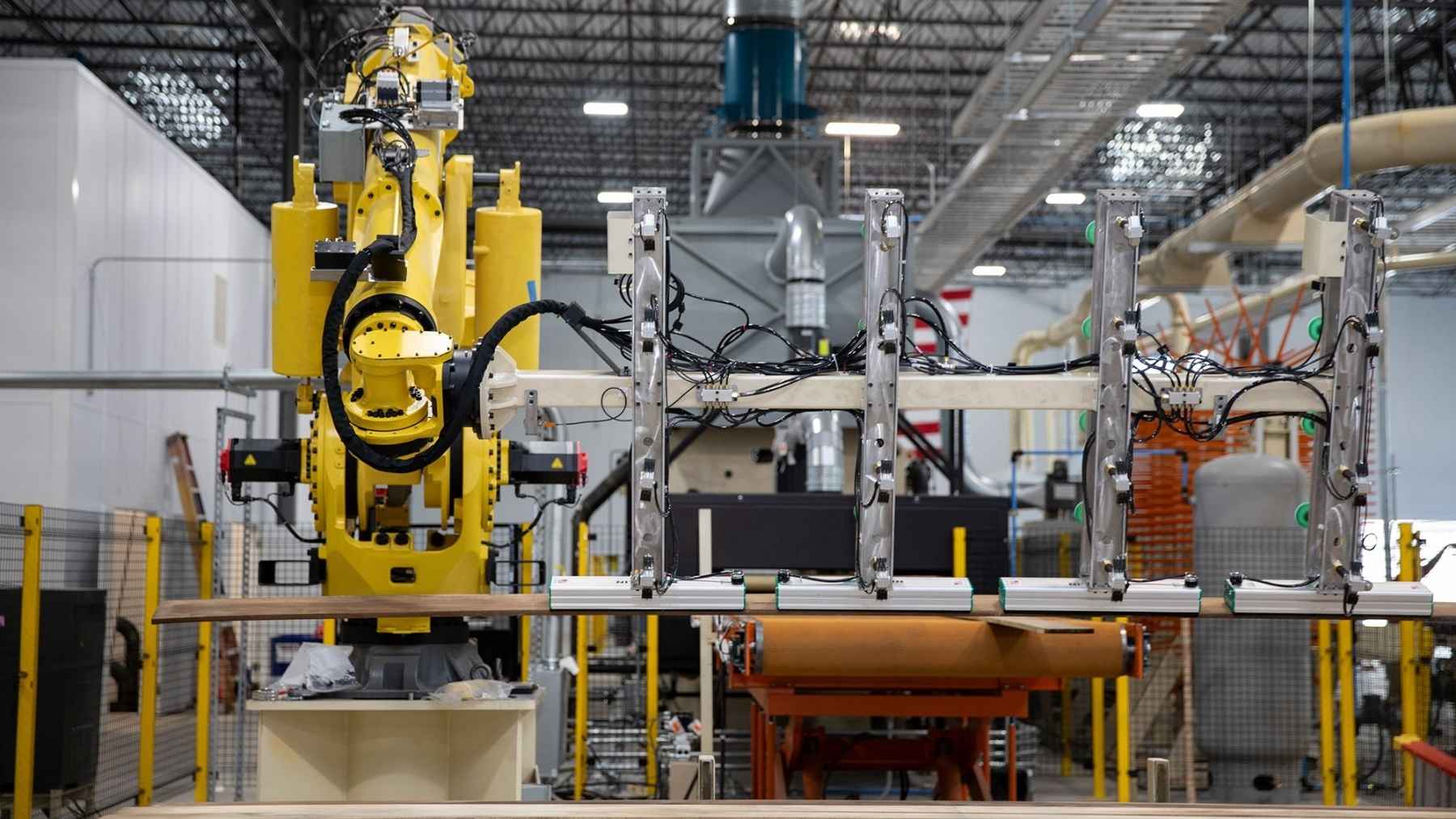
Lau has been straight about this. The Frederick plant is, in his words, a “first-of-a-kind commercial plant,” a smaller facility focused on skin applications to start, with the structural stuff coming later. The company shipped its first commercial batches in 2025 and, according to its own reservation page, is now taking deposits for 2026 orders, shipping to the U.S. and Canada only. A distribution partner called Intectural, which moves architectural materials across North America, is handling the sell-in. So the thing is genuinely on the market. It is just on the market as a premium exterior finish, which is a long way from replacing the steel frame.
Steel Still Costs About a Dollar a Pound
The number that never makes the brochure is price, and it is a big one. Steel runs roughly $1 to $2 a pound. Superwood, by the independent accounting at ZME Science, currently runs north of $12.50 a pound and as high as $25. That is not a rounding error. That is a different category of material.
InventWood does not really dispute it. The company’s own framing is that Superwood is “competitively priced against premium hardwoods” today, positioned as a high-end sustainable material rather than a steel replacement on cost, and that cost parity with steel only arrives once production scales to more than 30 million square feet a year. That is a long way from a first-of-a-kind plant with around twenty people on staff.
The honest version of the pitch, then, is that this is a luxury cladding material that wants to become a structural one, and a luxury-priced material that wants to become competitive. Both of those are scale problems, and scale at construction volumes is precisely the thing nobody has proven here yet.
Why the Pentagon and a Climate Fund Are Both Writing Checks
The money behind Superwood is a strange mix, and it tells you what the material is actually for. The $15 million Series A that closed in 2025 was led by the Grantham Foundation, a climate philanthropy, and pushed InventWood’s total funding past $50 million. But the backer list also runs through the U.S. Department of Energy, which gave the company a $20 million SCALEUP award back in 2022, and the U.S. Department of Defense. A climate fund and the Pentagon do not usually want the same product. Here, three separate arguments line up behind the same block of wood.
The first is carbon. Making steel is responsible for somewhere around 8% of global carbon dioxide emissions, and Lau says concrete and steel together account for roughly 90% of the carbon in a typical building’s construction. Wood pulls carbon out of the air as it grows and locks it into the finished material, and InventWood puts the emissions reduction at about 90% versus the materials it replaces. It is the same fight a green-steel tower near the Arctic in Sweden is picking from the opposite end.
There, the bet is on making the steel itself clean by stripping iron ore with hydrogen instead of coal. Here, the bet is on not using the steel at all. Both are aimed at the same enormous pile of mass, the kind that goes into the 22,000 tons of steel China just strung across a canyon to build the world’s highest bridge.
The second argument is supply chain. The Frederick plant runs on American timber processed entirely in the U.S., which reads very differently in a moment when steel and aluminum tariffs and import dependence are a live national fight. The factory also feeds on low-value wood chips and smaller timber pulled from forest-thinning work, the same overgrown brush that otherwise sits in a forest waiting to become a wildfire. The third argument follows from that. Superwood’s Class A fire rating arrives at a point when California requires fire-resistant materials in high-risk zones and insurers are increasingly walking away from combustible construction. A fireproof building material made from forest-thinning waste is, conveniently, a fire-prevention story and a construction story at the same time.
It’s Still Waiting on One Signature
So a year after the “wood stronger than steel” headlines, the honest scorecard reads like this. The material is real, it ships, and it is going onto buildings as their skin and not their skeleton. The strength numbers hold up as long as you read “ten times” as a weight-adjusted figure and “fifty percent” as the raw one. The carbon case is genuinely strong. The price is genuinely steep. And the structural version, the one that would actually let wood take a real swing at the steel and concrete it lost the skyscraper to a hundred years ago, is still sitting behind a building-code certification that has not landed.
InventWood has the factory, the funding, a Pentagon-and-climate-fund backer list, and a reservation queue full of people who want it. The one thing it does not have yet is the signature that turns a premium siding into a load-bearing beam. Until somebody official signs off that you can build the bones of a building out of crushed pine, Superwood is the most impressive cladding on the market and not much more. The interesting part is how close it is to being a great deal more than that.