
Megaprojects are usually late for construction reasons. The ground turns out softer than the survey promised, the steel bill doubles, or a boring machine grinds to a halt somewhere under a river and everyone quietly updates the timeline.
The Gordie Howe International Bridge managed something rarer. The structure was finished in early June, inspections and all, and the six-lane crossing between Detroit, Michigan and Windsor, Ontario then sat there, complete and closed, while Washington and Ottawa argued over who gets the toll money.
That argument is now settled. Canada and Michigan announced on July 10 that the bridge will open on July 27, with the support of the United States government. So the record-setting machine finally gets to do its job. Here’s what CA$6.4 billion buys, why it sat idle for nearly seven weeks, and what it will cost you to drive across.
The ribbon-cutting was scheduled. Then it wasn’t.
Invitations were out for a June 12 ceremony on the Windsor side of the river. On June 11, one day before the event, the Windsor-Detroit Bridge Authority called it off and put the opening on hold with no new date.
Chuck Andary, the authority’s interim CEO, said in a statement that the two countries were “taking the necessary time to resolve any outstanding issues.” Officials on both sides made a point of saying the holdup had nothing to do with the structure itself. The bridge was built. The problem was the business model.
President Donald Trump had threatened back in February to keep the crossing closed unless the U.S. was compensated, folding the bridge into wider trade negotiations with Canada. Prime Minister Mark Carney spent June telling reporters there was “no big drama.” Big or not, the drama took another month to sort out.
Two 722-foot towers and the longest cable-stayed span in North America
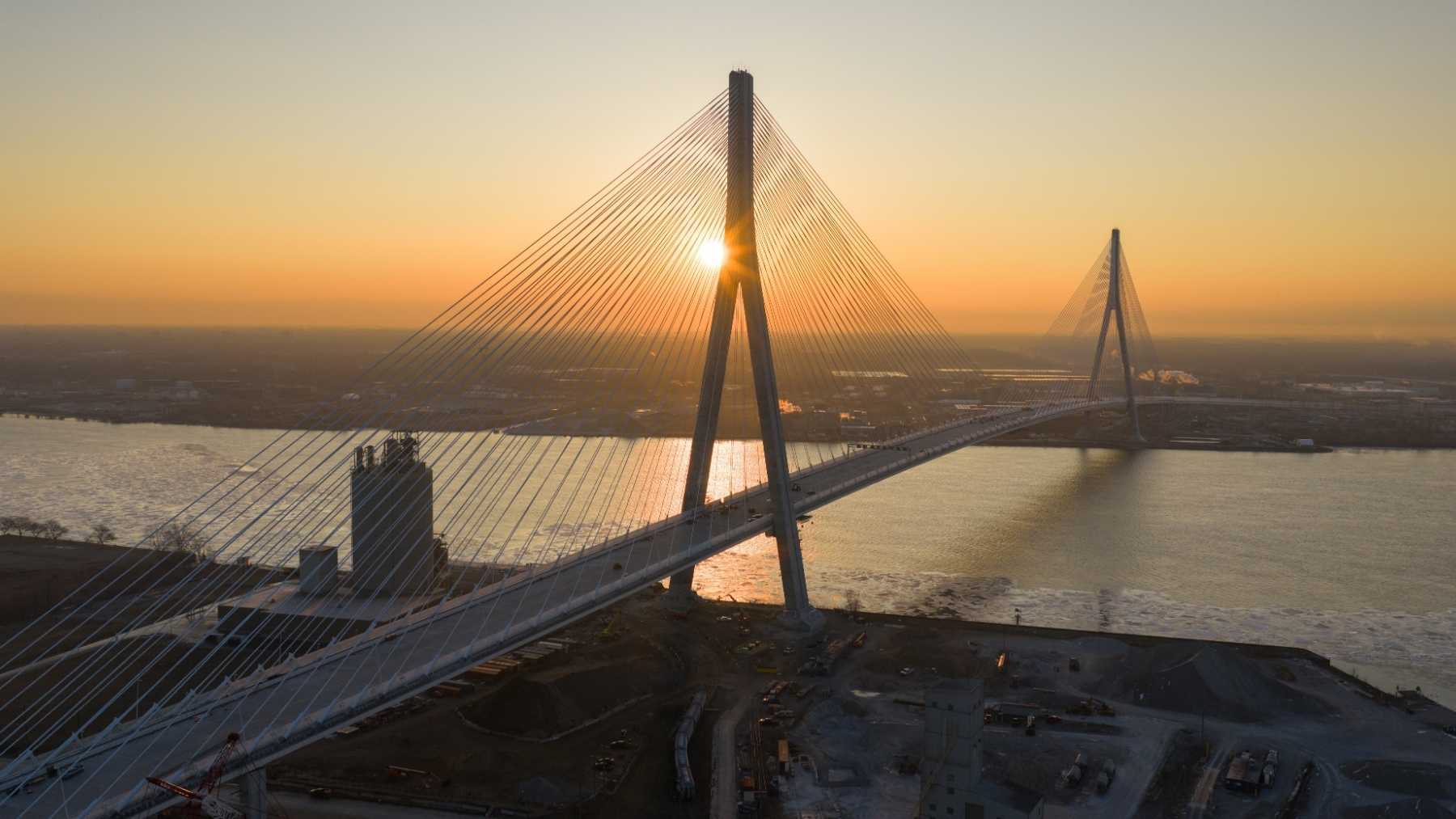
The crossing runs about 1.5 miles (2.5 kilometers) over the Detroit River, six lanes wide with three in each direction, plus a separate path for pedestrians and cyclists. The centerpiece is an 853-meter main span, just shy of 2,800 feet of deck with no piers touching the water beneath it. According to the bridge authority’s own numbers, that makes it the longest cable-stayed span in North America and the tenth-longest anywhere on the planet.
Holding it all up are two A-shaped concrete towers, 722 feet (220 meters) each, one per bank and both built on dry land. The Canadian tower is the tallest structure in Windsor. The American one stands roughly eye to eye with the 73-story center tower of the GM Renaissance Center, the tallest building in Detroit.
Each tower weighs about 30,000 metric tons, which the authority likes to translate as 165 jumbo jets. That’s the kind of math you end up doing after pouring 10,000 cubic meters of concrete around 4,500 metric tons of rebar, twice. Below ground it gets more serious: every tower sits on 12 shafts drilled 118 feet into bedrock, each filled with roughly 69,000 gallons of concrete.
The road deck hangs 138 feet above the river from stay cables anchored inside the towers, a system rated to carry nearly 34 million pounds. And because this bridge is named after Gordie Howe, who spent 25 seasons scoring for the Detroit Red Wings, the towers were shaped to echo the curve of a hockey stick mid slap shot. That detail comes straight from the official spec sheet, not from me squinting at concrete.
Shovels went in back in 2018, with a consortium called Bridging North America handling the build. It includes Fluor, Dragados and Aecon on construction, AECOM on design, and the group will operate and maintain the crossing for 30 years. The project says it created around 2,500 jobs.
If it feels like 2026 keeps producing this exact genre of story, it does. Denmark is sinking 73,500-ton concrete tunnel boxes onto the Baltic seabed, Norway just funded a tunnel for ships through a coastal mountain, and New Jersey has a pair of 1,680-ton boring machines waiting in a trench across from Manhattan. The Gordie Howe is the rare one that’s actually finished.
So who actually gets the toll money?
The original arrangement was simple. Canada agreed back in 2012 to cover the cost of the crossing after Michigan’s legislature declined to put up money, and the bill eventually landed at CA$6.4 billion, roughly $4.7 billion in U.S. dollars. In exchange, every toll collected would flow to Canada until the country made its investment back. Only then would profits be split with Michigan, which co-owns the bridge.
The new arrangement changes that. Under the deal announced July 10, both governments signed up for cooperative measures on toll governance and a 15-year economic development fund fed by a share of bridge profits. The bridge authority will also need U.S. agreement for certain toll changes.
The plainer version arrived over the weekend. The U.S. will receive 50 percent of net toll profits and must approve any toll increase above 10 percent, terms that Infrastructure Minister Gregor Robertson’s office confirmed to The Globe and Mail on Sunday. Robertson called it “a good deal for businesses and workers on both sides of the border.” Reuters reported the terms were negotiated between U.S. Commerce Secretary Howard Lutnick and Dominic LeBlanc, Canada’s minister in charge of U.S. trade.
Trump, who in February had demanded compensation before he would let the bridge open, announced on Truth Social that he had cut a “much better deal” for America. The Canadian Taxpayers Federation read it differently, arguing that Canadians paid for the bridge and are now watching part of the return cross the river. Federal Conservatives are demanding the full agreement be published before opening day.
The auto industry, for its part, mostly wants the lanes. Flavio Volpe, president of Canada’s Automotive Parts Manufacturers’ Association, told The Globe and Mail that exporters on both sides have been waiting on a crossing that is two lanes wider than the Ambassador Bridge, with automated tolling and direct highway access. Michigan Governor Gretchen Whitmer says the bridge will “speed up auto production, lower costs, ease traffic” on a corridor her state’s factories depend on.
What you’ll pay to cross, starting July 27
A regular car, SUV, minivan or motorcycle pays $5.75 U.S. or CA$8.00 per crossing, according to the official toll schedule. Sign up for the bridge’s Breakaway electronic tolling program and that drops to $4.35. Commercial trucks and anything taller than 7.5 feet pay $8.75 per axle, or $6.90 with the discount.
Tolls are collected on the Canadian side in both directions, which was always the plan, since Canada fronted the construction money. The multi-use path is free, and it becomes the first legal way to cross the Detroit River on foot outside of special events.
For drivers, the practical pitch is the plumbing. The bridge ties Interstate 75 directly into Ontario’s Highway 401 with no city streets in between, which the nearly century-old Ambassador Bridge can’t offer on its Canadian end. Roughly a quarter of all trade between the U.S. and Canada moves through this one gateway, and the ports of entry were sized accordingly: 36 primary inspection lanes on the American side, 24 on the Canadian side, plus 16 toll lanes.
What’s still open
A few loose ends remain. There’s still no date for the actual ribbon-cutting, the ceremony that got scrapped in June. And Ottawa hasn’t publicly explained how a 50-50 profit split reshapes the timeline for recovering its CA$6.4 billion, a payback that was already measured in decades under the old plan.
Gordie Howe was a Canadian who spent 25 seasons producing for Detroit. The bridge with his name on it was paid for by Canada and will now send half its profits to the American side. At least the naming committee saw it coming.
 @jacquesppag ROOKIE2 months ago