
A productive day for most working tunnel boring machines is measured in the low double digits, in meters. The 2,000-ton borer digging Montreal’s metro extension manages up to 15 meters of rock on a good one. These are careful, crawling machines, and the ground usually gets a vote.
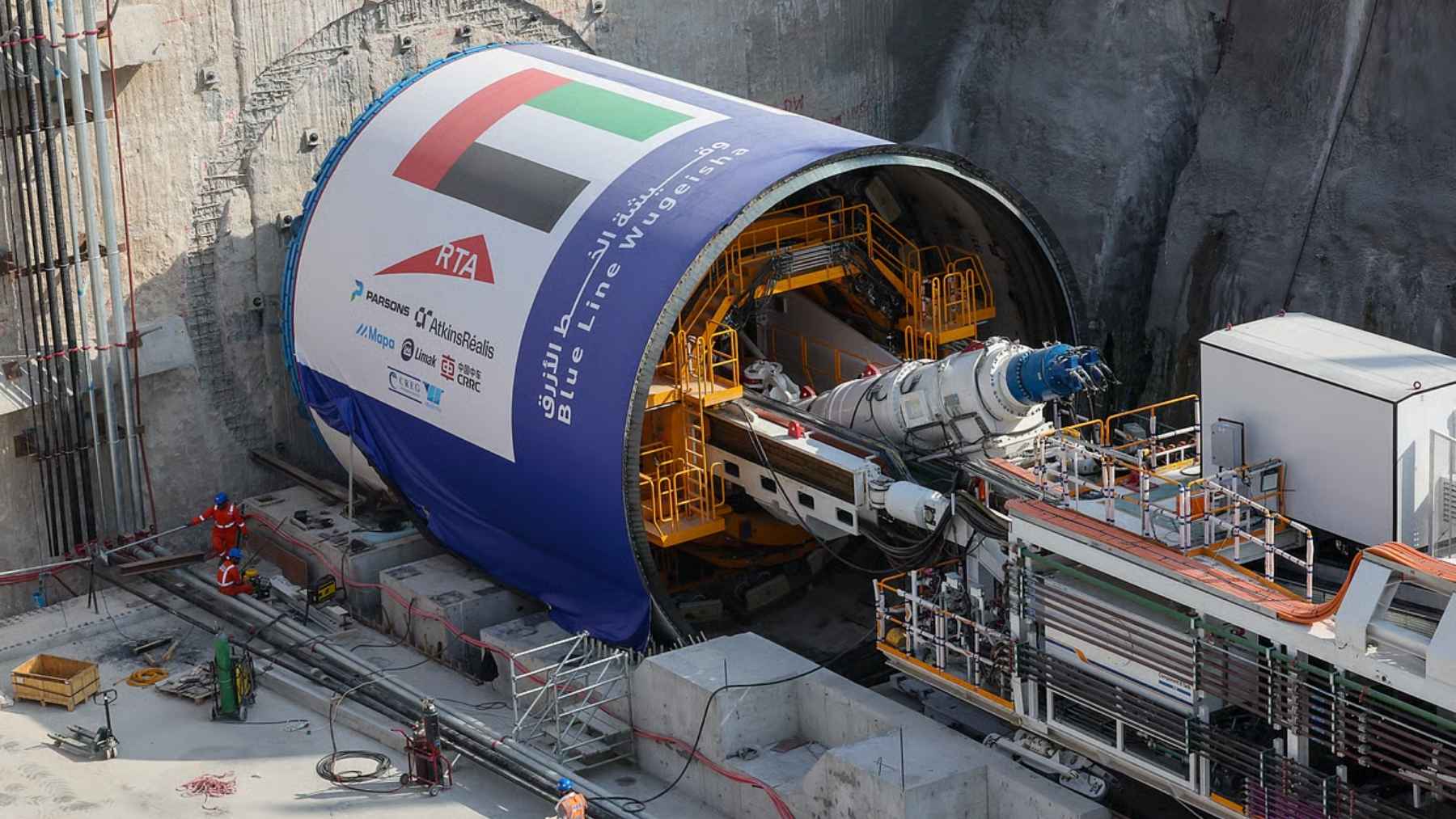
Which is why the number out of Dubai last week reads like a typo. The city’s Roads and Transport Authority says its new metro borer, Al Wugeisha, has reached a record production capacity of 30 meters (98 feet) a day. That’s more than double the pace of the machines that dug Dubai’s original metro tunnels back in 2007.
The speed shows up in the calendar, too. The entire first phase of tunneling on the new Dubai Metro Blue Line is already finished, two months after the machine started turning. Arabian Business reports the original metro tunnels took around seven months, per the RTA.
The Blue Line itself is a serious piece of infrastructure: 30 kilometers (18.6 miles) of new track, 14 stations, and a $5.58 billion (Dh20.5 billion) budget, all due to open on September 9, 2029. So a tunneling machine running ahead of schedule matters to a lot of people who will never see it.
Dubai has dug this ground before, just much slower
Dubai’s tunneling story starts in 2007, when the first boring machines went underground for the original metro. Those borers averaged about 12 meters (39 feet) a day, and at the time that counted as a breakthrough for the region.
Al Wugeisha started its run on May 3, when Sheikh Mohammed bin Rashid Al Maktoum, Dubai’s ruler, gave the signal to launch tunneling on the Blue Line. The official expectation back then, reported by Engineering News-Record from state media, was an advance rate of 13 to 17 meters a day.
Two months later the machine had blown past its own spec sheet. On July 8, the RTA announced the first phase of tunneling was complete and put the machine’s record capacity at 30 meters a day, saying Dubai has “set new standards in tunnel engineering.” Beating the 2007 borers was expected. Beating your own May press release by nearly double is the fun part.
About that name. Gulf News says Al Wugeisha is named after a small desert rodent known in the UAE for its burrowing ability. The National says the name comes from the Arabic word for a pearl diver’s basket. Either way, the theme checks out.
Al Wugeisha is a rolling factory, not a drill
The machine stretches 163 meters (535 feet) and weighs more than 2,000 metric tons, and it runs around the clock. It’s one of three borers assigned to the Blue Line’s underground section, though the other two haven’t been publicly named, per ENR.
Calling it a drill undersells the job. The RTA describes Al Wugeisha as an integrated underground production system: it excavates the ground, hauls the spoil out the back, and installs the precast concrete lining segments behind the cutterhead, all in one continuous process. By the time the machine has passed through, the tunnel behind it is structurally done.
ENR identifies it as a double-shield design, a configuration built to keep advancing through changing ground while placing those lining rings at the same time. Add the digital guidance and monitoring systems the RTA credits for the precision, and you get a machine that doesn’t have to stop to check its own work.
The launch site tells you something about the ambitions here. Tunneling runs out of Dubai International City 1, the future home of the network’s largest underground interchange station: over 44,000 square meters (473,000 square feet), designed to handle up to 350,000 passengers a day, according to Gulf News.
The ground under Dubai does not cooperate
Before anyone starts ranking boring machines like ballplayers, a caveat: advance rates only mean something in context, and the context is dirt. RTA geotechnical investigations reviewed by ENR show the Blue Line corridor runs through unconsolidated marine sands and sabkha deposits, laced with gypsum lenses and underground voids.
It gets better. The groundwater table sits just 3 to 4 meters below the surface, and it’s hypersaline, which raises corrosion and water-inflow risks. The loose deposits also carry a liquefaction risk under load. So the machine is essentially threading wet, salty, occasionally hollow ground while a city sits on top.
That’s why comparing Al Wugeisha to other famous borers is a sucker’s bet. The 4,350-ton machine under Sydney Harbour is fighting sandstone below open water, and the German borer grinding under the Potomac in Washington was built for hard bedrock. Different ground, different machine, different math.
The one comparison that holds up is Dubai against Dubai. Same city, similar geology, same operator, 19 years apart. And on that scorecard, the 2026 machine is running at more than double the 2007 pace.
The Blue Line is a $5.58 billion bet on nine districts
The Blue Line will be the third major corridor of the Dubai Metro, and slightly more than half of it, 15.5 kilometers (9.6 miles), runs underground. The design-build contract went to a consortium of Turkish contractors MAPA and Limak with China’s CRRC in December 2024, with CRRC supplying 28 driverless trains, per ENR.
Progress is not limited to the tunnels. The project stood at 20 percent complete when tunneling launched in May, with ENR reporting a target of 30 percent by the end of the year. Crews have also started the piers for a 1.3-kilometer (0.8-mile) viaduct over Dubai Creek, the first elevated metro crossing of the waterway.
The line is designed to serve around one million residents across nine districts and to cut traffic congestion by 20 percent, according to Arabian Business. Around 10,000 engineers and workers are on the job.
When it opens, the Blue Line will push the Dubai Metro to 131 kilometers of track, 78 stations and 168 trains, per The National, and the city has already unveiled a roughly $9 billion Gold Line for 2032. And no, this is not the same project as the Dubai Loop, the Boring Company tunnel network that just started casting its concrete rings across town. Two different tunnel programs, one city, same summer.
That September 9, 2029 date is not an accident either. It falls exactly 20 years after the original Dubai Metro carried its first passengers. Dubai gave itself a deadline with a birthday attached.
Two months of tunneling is a great headline, but it’s the first phase of a job that runs to 2029, and most of those 15.5 underground kilometers are still ahead of the cutterhead. The machine has won its first comparison, the one against 2007. The one against the calendar is just getting started.
Image Credit: Gulf News