
Building an offshore wind farm usually ends the same boring way. You sink your turbines into the seabed, string a tangle of cables along the bottom, and haul all that electricity back to a substation sitting on dry land somewhere on the coast. Belgium ran into a wall with that last step. Its slice of the North Sea is one of the busiest shipping lanes on the planet, its coastline is short and already crowded, and the next batch of wind farms it wants to build sits 45 kilometers offshore. So rather than drag everything back to land, the country decided to build a place out there to collect it first. Not a steel platform on stilts. An actual island, made of 23 concrete boxes dropped onto the seabed.
It is called the Princess Elisabeth Island, and Elia, the company that runs Belgium’s high-voltage grid, calls it the world’s first artificial energy island. It is about as literal as that description sounds, and the way they are putting it together is the genuinely interesting part.
Belgium Is Building an Island Out of Sunk Concrete
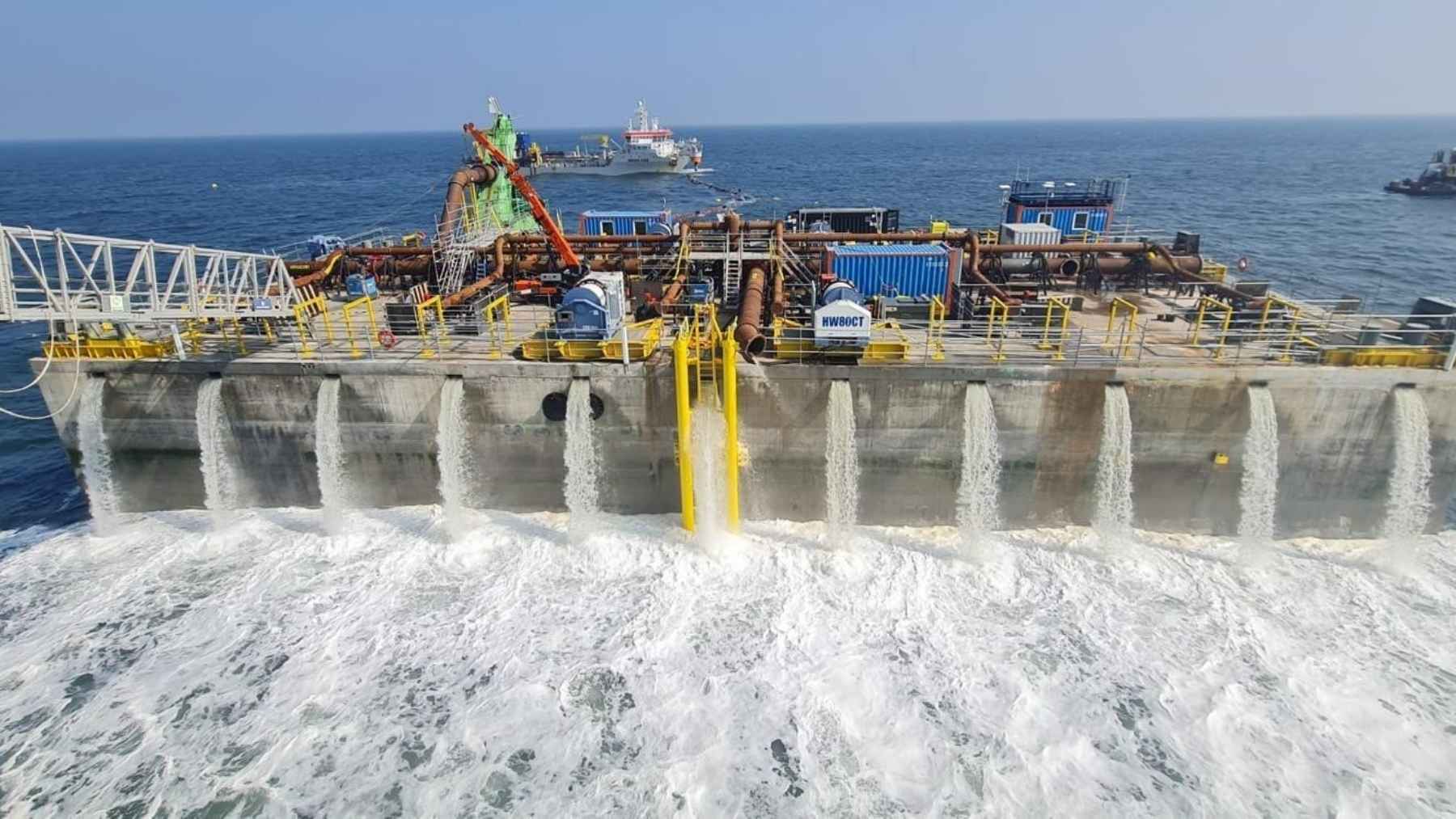
There is no natural land under this island. Its outer ring is made of 23 hollow concrete caissons, each one weighing up to 22,000 tonnes and standing taller than most apartment buildings. Every box runs 58 meters long, 28 meters wide, and somewhere between 23 and 32 meters tall, depending on whether it carries a storm wall on top. They were cast on dry land in Vlissingen, in the Netherlands, then floated and towed roughly 98 kilometers through the Western Scheldt and out into the Belgian sector of the North Sea.
Once a caisson reaches its spot, it gets lowered onto a prepared bed of rock and filled with sand until it settles onto the foundation and stops moving. Do that 23 times in a ring, fill the middle with more sand, compact it, and you have land where there used to be open water. The finished island covers about six hectares, which is roughly eight soccer fields, with a small harbor built in so crews can dock and step onto the island safely.
None of this happens whenever the calendar says so. By the consortium’s own rules, the offshore work only goes ahead when waves stay under 1.5 meters and wind stays below 5 on the Beaufort scale, and the North Sea does not hand out many days like that. The first two caissons went down in April 2025, the last of that year’s batch was in place by September, and the 2025 season alone ran with more than 300 people and a fleet of 15 specialized vessels. By January 2026, all 23 caissons had been built and floated out of the Vlissingen yard, parked at a terminal for final finishing while the remaining ones get lowered into place across 2026.
How You Pour a 22,000-Ton Concrete Box on Schedule
Casting a single one of these is its own small factory job. Jan De Nul, one half of the TM Edison consortium building the island alongside DEME, runs the caissons through a slide-through system with five workstations, which means five boxes can be in production at the same time. Each one moves through five stages: bottom plate, walls, cable entries, top plate, and storm wall. The full sequence takes about 85 days per caisson.
The walls go up using slipforming, which is exactly as relentless as it sounds. The concrete is poured continuously, 24 hours a day, seven days a week, without stopping, using Holcim’s low-carbon ECOPlanet cement. The supplier says the mix cuts the project’s CO2 footprint by more than 40% against standard cement, and the caissons are engineered to last a century while shrugging off storm waves and salt. That is the sort of over-engineering that looks excessive right up until you remember the thing has to sit in the open North Sea for 100 years.
Before any concrete touches the seabed, the bottom has to be made flat and solid. A trailing suction hopper dredger levels the terrain, fall-pipe vessels lay down a rubble-mound foundation along with scour and toe protection to stop storms from undermining the structures, and a rock installation vessel called the Simon Stevin places the stone bed each caisson lands on. Only then does a box get walked out and sunk.
The Island Is a Junction Box for Up to 3.5 Gigawatts of Wind
The point of all this concrete is to give Belgium’s offshore wind somewhere to converge before it heads for shore. The island sits inside the Princess Elisabeth Zone, a 285-square-kilometer patch of sea that Elia says will eventually produce up to 3.5 gigawatts of wind power. Instead of running each wind farm’s cables separately all the way back to the coast, the island gathers them together and sends the electricity home over 165 kilometers of high-voltage subsea cable rated at 220 kilovolts.
If you have been following how differently offshore wind is being treated on the US side of the Atlantic, the contrast is hard to miss. Belgium is sinking 22,000-ton boxes to push its grid out to sea while several American offshore projects sit suspended. And the instinct to put infrastructure into the ocean is not unique to Europe either. China recently took the same idea in a stranger direction and sank an entire data center off Shanghai to run it on offshore wind and seawater cooling.
On paper, the island was meant to be more than a collection point for Belgian wind. The original design had it doubling as an international landing point, with interconnectors planned to the United Kingdom (the Nautilus project) and Denmark (TritonLink), which would have made it the first hub to combine high-voltage direct current and high-voltage alternating current in one place. That was the plan, anyway.
The Bill Roughly Doubled, and the UK Link Got Pushed Back
The engineering held up. The budget did not. Elia told the trade publication Gas Outlook that the project’s cost roughly doubled, from 3.6 billion euros to somewhere between 7 and 8 billion, which the grid operator pinned mostly on “unpredictable external factors” and a global crunch in high-voltage equipment prices. The European Investment Bank has committed 650 million euros toward the first phase of the island’s transmission infrastructure, but the math on the rest moved fast.
So in early 2025, Elia postponed signing the HVDC contracts for the island, pointing to the soaring price of the direct-current gear, and the project is now going ahead with its alternating-current infrastructure first. The HVDC converter, and with it the hybrid interconnector to the UK, has been pushed down the road rather than canceled outright. Belgium’s grid will still get its offshore junction box. The multi-country super-hub version is now a question mark.
The timeline reflects all of that. The concrete island is on track to finish around 2026. Elia is tendering and building the electrical equipment on top of it across the rest of the decade, and the company is aiming to have the wind farms fully connected to its onshore grid by 2030, a date that also leans on two big mainland reinforcement projects, Ventilus and Boucle du Hainaut, coming online. Belgium’s current government has signaled it wants to review the terms for the later wind farms before committing further.
The concrete was never going to be the hard part. Twenty-three boxes built to outlast a century of salt and storms, poured on a conveyor belt in the Netherlands and walked out to sea one at a time, is an impressive job, but it is a solved one. The open question is what the finished island ends up being. Right now it is on course to become a very expensive, very durable AC junction box for Belgian wind. Whether it grows into the cross-border hub it was drawn up as comes down to HVDC prices and how much appetite a government has for the bill. Either way, it will be sitting out there 45 kilometers off the coast, waiting to find out.