
Four specialist tunneling crews, pulled from Poland, Austria, Germany, Slovakia, Romania, Croatia and Italy, worked around the clock for nearly three weeks in a pit on the southwest edge of Łódź. No breaks in the pour. No shift where the site went quiet.
What they built is a curved slab of concrete. That is it. A semicircular saddle sitting at the bottom of a hole, and the reason it took seven nationalities and 20 straight days is that everything downstream depends on it being right to the millimeter.
New Civil Engineer reported on August 18 that the cradle at the Retkinia launch chamber is finished and the first tunnel boring machine components are already being bolted together on top of it.
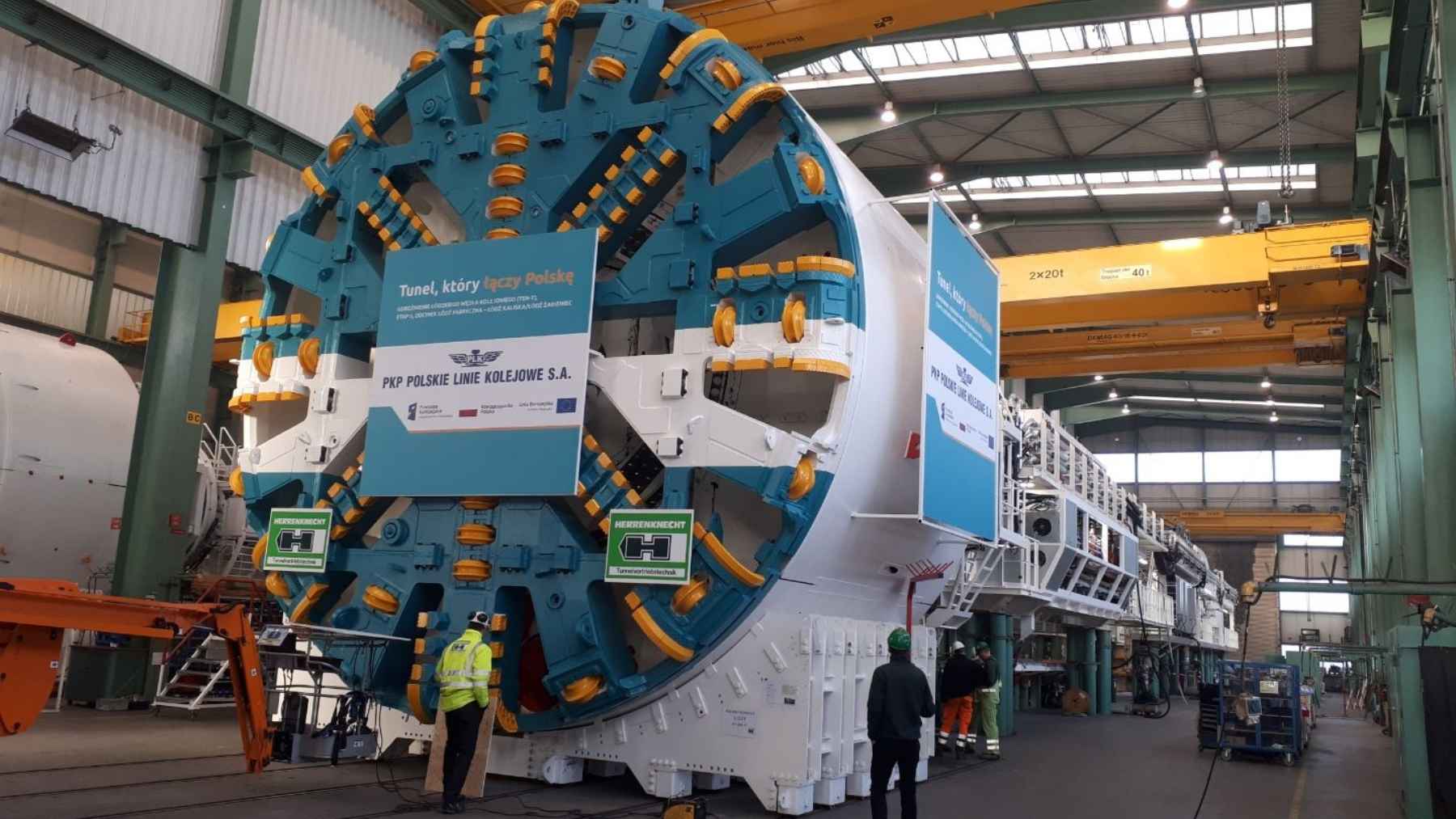
The machine that sits on it weighs about 3,500 tons and is going to spend 2027 and 2028 cutting a 46-foot hole under an occupied European city.
The cradle is where a tunnel goes wrong before it starts
A TBM steers badly at the beginning of a drive. It has nothing behind it to push against, no completed rings to brace on, and the shield has not yet found the ground. Whatever alignment it leaves the chamber with is roughly the alignment it commits to.
So the cradle does one job: hold the shield in exactly the right attitude and feed it into the opening cut in the chamber wall at exactly the right angle.
Engineers on the project have been blunt that even small geometric deviations at this stage would affect the machine’s trajectory through the early part of the bore. Get it wrong by a few millimeters and the correction runs the length of the drive, under buildings that were not consulted.
The continuous pour is not machismo either. A cradle that cures in stages develops cold joints, and cold joints are where a structure carrying 3,500 tons of moving machine decides to behave unpredictably.
The hole took 110,000 cubic yards of soil out of the city
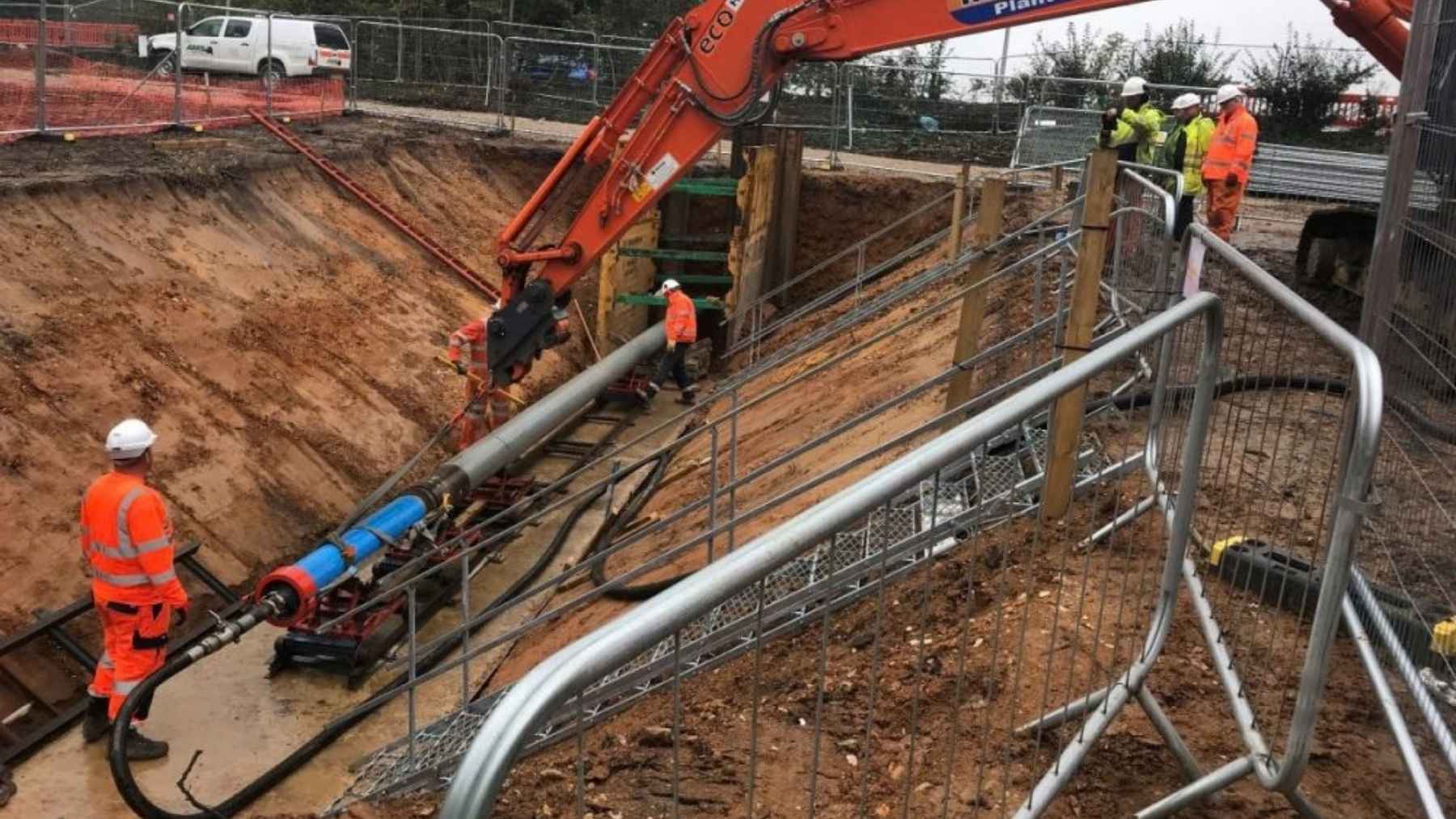
The Retkinia chamber is a serious structure in its own right. Roughly 590 feet long, up to 75 feet deep, with diaphragm walls driven down to 143 feet. It has two underground levels, one for technical systems and one for the track bed.
Building it meant excavating around 110,000 cubic yards of soil, placing close to 39,000 cubic yards of concrete and installing about 3,300 tons of steel, with something near 100 workers on site at peak.
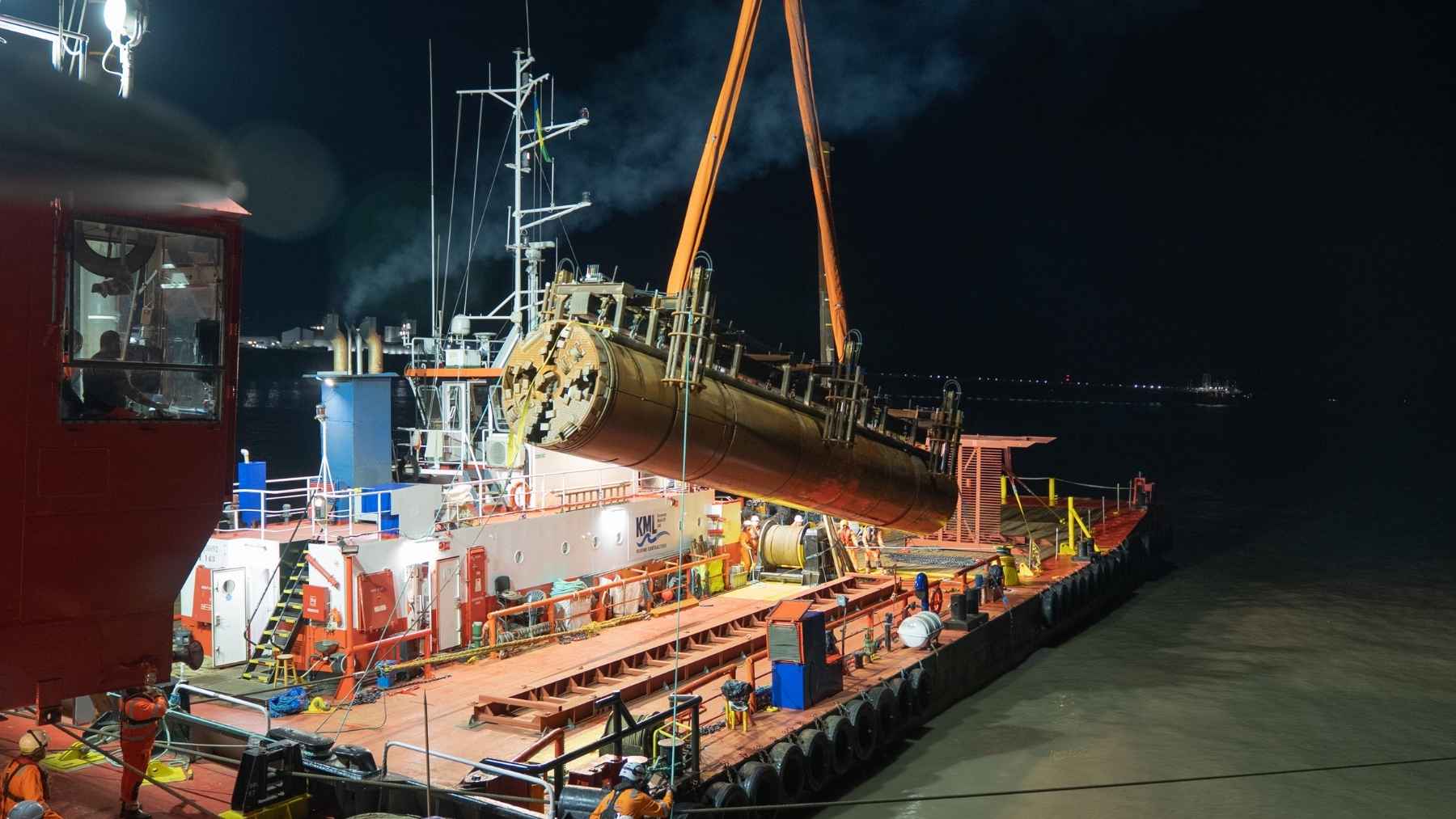
The TBM goes in piece by piece. Sections roughly 62 feet long weighing about 235 tons each are being handled by a gantry crane rated at 500 tons.
One number worth flagging, because it appears everywhere without explanation. Operators describe components being lowered around 148 feet below ground level, while the chamber itself is quoted at up to 75 feet deep. Those are two different measurements, not one contradiction: the hook travel from an elevated gantry is not the same thing as excavation depth, and the diaphragm walls go far deeper than the floor. Worth knowing before you try to reconcile them.
Assembling a machine this size at the bottom of its own shaft is standard practice for urban drives now, and it is the same logic that put a 1,000-foot borer together inside a Lesotho mountain. You cannot drive a completed TBM anywhere. It gets born where it starts working.
The crane test was a legal requirement, not a precaution
In early July, crews ran load tests on that gantry crane using water-filled ballast bags totaling roughly 550 tons, which is 110% of the crane’s rated capacity.
The reason is the cutterhead. At about 460 tons it is the single heaviest component, it gets assembled at the surface, and then it goes down in one operation. There is no version of that lift where you find out mid-descent.
Coverage has tended to frame the test as engineers being careful. It is more specific than that. Overload testing is a standard part of the technical acceptance procedure for lifting equipment across the European Union, and this one was inspected by Poland’s Office of Technical Inspection. The crane could not legally be used for the real lift without it.
Łódź already has tunnels underneath it
This is the part that makes the geotechnical work interesting rather than routine.
PKP PLK has been boring a cross-city rail tunnel under Łódź since the late 2010s, using Herrenknecht machines at 28.7 feet and 42.8 feet in diameter, running as deep as 79 feet. So the new 46-foot high-speed bore is not arriving in virgin ground. It is threading a bigger tube through a city that already has rail tunnels in it.
The mitigation program is aggressive to match: diaphragm walls, jet grouting and load-transfer elements along the alignment to limit settlement. At the historic Łódź Cultural Centre, crews installed roughly 1,400 micropiles and jet grouting columns to stabilize the soil under the building and added steel bracing to its northern wing before anything gets bored nearby.
At the far end, contractor Budimex built the receiving chamber near Łódź Fabryczna station: five-foot-thick diaphragm walls forming a structure about 72 by 98 feet, excavated 85 feet down, with a jet grouting wall separating the future high-speed tunnel from the existing PKP PLK commuter infrastructure.
Mateusz Kura, project manager at the Łódź–Sieradz Portfolio Department at Port Polska, put the case for a TBM plainly, saying it allows the work to happen beneath the city while “limiting their impact on existing buildings and urban infrastructure.” The alternative was cut-and-cover through central Łódź, which nobody was going to authorize.
Boring under live infrastructure without disturbing it is now the whole discipline, the same problem a Herrenknecht Mixshield solved under the Panama Canal with ships moving overhead the entire time.
100 mph in the tunnel, 217 mph once it is back outside
Naming first, because the coverage is a mess on this. The project is delivered by Centralny Port Komunikacyjny, the state company, under an investment program now branded Port Polska. Same organization, newer label.
The tunnel is part of railway line No. 85, the high-speed “Y” corridor linking Warsaw and the planned new airport to Łódź before splitting toward Wrocław and Poznań. On the open sections, trains are meant to run at up to 217 mph, putting Warsaw about 15 minutes from the airport and roughly 40 minutes from Łódź.
Inside the bore the design speed drops to 100 mph. Two tracks in a single tube, bidirectional. That is the price of going under a city core rather than around it.
For scale, the whole CPK railway and airport program has been estimated at over 150 billion złoty, somewhere north of $35 billion. Against Alpine work like the 35-mile Gotthard or the 40-mile Brenner base tunnels, a 2.9-mile bore is small. What is unusual is the cross-section: a 46-foot single tube carrying twin high-speed tracks is not a common shape outside mountain crossings.
The start date already slipped once
Excavation is now scheduled for the first quarter of 2027, per the program set by main contractor PORR.
A year ago the target was the fourth quarter of 2026, with the Warsaw to Łódź section opening in 2032. So the machine is starting a quarter or two later than planned, which on a job like this is unremarkable, and worth writing down anyway because the machine has not cut anything yet.
After launch, the bore is expected to reach the Fabryczna receiving chamber during 2028. Fit-out, systems integration and safety testing then run through 2029.
Meanwhile the intermediate shafts are moving. Preparatory work is under way at the K5 shaft near Atlas Arena, and main construction has started at K6 with diaphragm-wall excavation support going in. Those shafts handle ventilation and emergency evacuation, which is what makes the tunnel legal to run trains through once it exists.
None of that happens if the concrete saddle at Retkinia is off. It is finished, it is buried at the bottom of a 75-foot hole, and unless something goes badly wrong nobody will ever mention it again.