
When a railroad closes a main line for months, the picture in most people’s heads is new rail. Steel, cranes, welding sparks, a lot of orange safety vests.
Germany has come off two of those closures in the last seven weeks, and on both of them one of the heaviest machines on site never took the track apart. It worked underneath it. A chain of steel scraper plates threads below the crossties, hauls the stone out sideways, runs it through a screen and drops the clean stone back in behind itself, with the rails still bolted together the whole time.
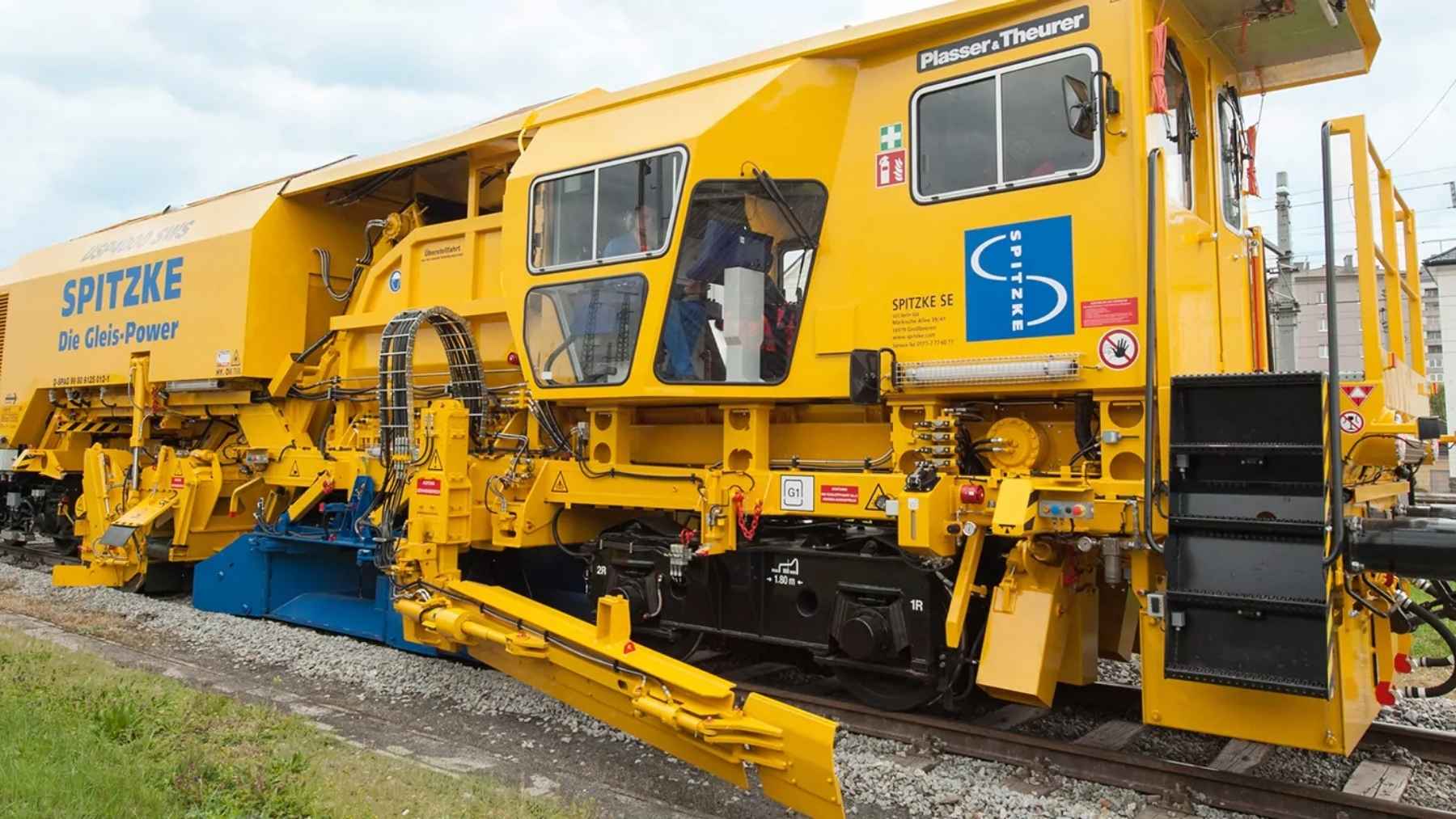
The line between Nuremberg and Regensburg went back into service on July 31 after being shut to trains since February 6, according to infrastructure owner DB InfraGO. The Hamburg–Berlin main line, the busiest city-to-city link in the country, reopened on June 14 after ten and a half months. Contractor Spitzke had its RM 900 S ballast cleaner on both corridors.
The rails stay bolted together
The RM 900 S weighs 345 metric tons, or 380 US tons, measures 335 feet over the buffers and rides on 21 axles, according to Spitzke’s published data sheet. Engine output adds up to 1,500 kW, a little over 2,000 horsepower. It gets hauled between jobs at up to 62 mph and moves itself at 37.
None of that is the interesting part. The interesting part is the excavating chain, which gets fed through a slot cut under the track and then runs like a chainsaw laid flat, dragging fouled ballast out from under the ties and up into the machine.
Inside, oscillating screens separate stone from dirt. The reusable ballast goes straight back into the track right behind the chain. The waste rides out on conveyors into hopper wagons trailing along behind.
Spitzke rates the screening at up to 900 cubic meters an hour, about 1,180 cubic yards, with forward progress of 300 to 390 meters an hour depending on how wide the cut is. The top figure works out to roughly 1,280 feet of railroad an hour. That’s about a quarter of a mile an hour, so a slow walk would leave it behind, and it’s still the quickest way anybody has found to do this.
Depth is set by laser. The data sheet lists a maximum cleaning depth of 1,000 mm measured down from the top of the rail, which is 39 inches from railhead rather than 39 inches below the ties, and clearing widths of 13 to 16 feet, stretching to about 19 with the side shields fitted.
The track itself does shift a little while this is going on. The machine can raise it by up to 10 inches and swing it sideways by up to a foot to hold the cut where it wants it, and it will work curves down to a 650-foot radius. What it never does is take the assembly apart.
That tolerance is the whole trick. Heavy plant is usually allowed to be crude, which is how a 198-ton cable excavator gets away with swinging a 4.4-ton steel ball at the shell of a German reactor building. This one is working to inches with a railroad still assembled overhead.
There is also a continuous tamping unit built into the consist and a sweeper, so the new bed gets packed under the ties in the same pass rather than waiting on a second machine and another closure.
Ballast wears out by being ballast
The stone under a railroad is doing real work. It spreads the weight of a train down into the subgrade, keeps the ties from wandering, and has to stay springy enough to absorb what a locomotive does to it several hundred times a day. It is also the reason the strip between the rails looks like dead space, and why the Swiss startup that has been laying removable solar panels along a live line had to design them to come straight back out for track work.
Plasser & Theurer, the Austrian manufacturer behind most of these machines, sets out the failure mode without much drama. Normal traffic knocks the sharp edges off the stones. They settle, they grind against each other, fine material migrates up from the subsoil underneath, and more of it arrives from outside.
What you end up with is a bed choked with fines. It drains worse, it flexes less, and the track starts settling unevenly along its length.
Tamping pulls the geometry back for a while. Past a certain point, by the manufacturer’s own account, it is cheaper to take the whole bed out and clean it than to keep chasing the settlement.
Buying and hauling fresh stone is the other half of the argument. Plasser says screened ballast often comes back with a smaller share of fines in it than new ballast has, which is a claim from a company that sells screening machines, but it is also why a contractor would rather wash 16 miles of stone than order 16 miles of new rock.
Hamburg to Berlin was the big one, and it ran long
The Hamburg–Berlin corridor is 173 miles long and carries as many as 470 trains a day. It hadn’t had a full renewal in two decades.
DB InfraGO and its contractors replaced 103 miles of track and 249 turnouts, put in seven new crossovers so faster passenger trains can get past freight, built six new signal boxes, modernized 19 more and rebuilt 28 stations, Railway Gazette International reported in June.
Spitzke and consortium partner Leonhard Weiss had lot 2, the 57-mile section from Büchen to Dergenthin. The contractor’s own project page lists 25.9 km of ballast cleaning in that lot, 16.1 miles, alongside 16.7 miles of track renewal and 37 sets of turnouts. Its log has the RM 900 S working near Dergenthin on August 6, 2025, six days into the closure, with reporters watching.
The track work is not what people remember about this job. The line closed on August 1, 2025 against an original six-month idea, was rescheduled to nine, and ended up shut for ten months and two weeks, reopening in two stages on May 15 and June 14.
DB InfraGO chief executive Dr Philipp Nagl put the overrun down to “extended construction work due to the harsh winter”, as quoted by the same magazine, and thanked passengers for their patience. German rail freight association Die Güterbahnen was less generous, arguing that shutting one percent of the national network for well over 300 days had exposed serious planning problems and that the whole corridor-blockade model had flunked its first real exam.
In Bavaria the track was ready and the signaling was not
The Nuremberg–Regensburg job was the tighter one: 55 miles, closed February 6, handed back July 31, with up to 2,000 people a day on it at peak.
DB InfraGO’s closing statement on July 31 counts more than 62 miles of new track, more than 62 miles of overhead line on 1,300 new masts, 74 turnouts, 20 rebuilt stations and the interiors of eight signal boxes overhauled along with the signals and the axle-counting system, to an ETCS-ready standard. Spitzke ran the 38-mile Regensburg–Neumarkt section as main contractor and had the RM 900 S crew starting on day one.
Reopening was supposed to happen on July 10. Track, turnouts and overhead line were finished, DB said. What took longer was the safety approval of the new interlocking equipment, and that pushed trains back another three weeks.
Nagl said the line went back into service with a cost forecast that has come down by a three-figure million-euro sum, and apologized for the delay in the same breath. Ulrich Lange, parliamentary state secretary at the federal transport ministry, said the schedule slips on these corridor jobs are a heavy load on freight operators and that DB InfraGO has to get better at this.
The line carries more than 350 trains a day and sits on the Rhine–Danube axis, so three extra weeks of replacement buses isn’t a rounding error.
Where the machines went next
They didn’t go into a shed. Machines at this scale get shipped from job to job the way two 1,490-ton tunnel borers were trucked from Sydney to Brisbane in pieces and rebuilt at the other end. The right-bank Rhine route between Troisdorf and Wiesbaden closed at 9pm on July 10 and stays shut until December 12, and Spitzke has lot 2 there, 25.7 miles from Kaub to Oberlahnstein, with 12.5 miles of tamping and just under three miles of complete ballast bed renewal on the list.
That one is awkward in a way the flat north German plain never was. The line runs with the Rhine on one side and rock face on the other, inside a UNESCO World Heritage valley, and the contractor has already flagged that there is almost nowhere to put spoil, stone or plant. A second Bavarian corridor, Obertraubling to Passau, has been under way since June 14.
Spitzke announced an order in February for another high-capacity Plasser & Theurer ballast cleaner, plus five material conveyor and hopper wagons to feed it, which tells you roughly how much of this work the contractor thinks is coming.
Germany means to run 40 of these corridor jobs by 2036, and each one is sold on a promise of five construction-free years afterwards. Hamburg–Berlin reopened without the full ETCS signaling fit that was originally part of the pitch, deferred to the 2030s to avoid paying for two sets of trackside equipment, which means somebody will be back out there closing tracks long before those five years are up. The stone, at least, is not the part anyone is arguing about.
 michaelcruise ROOKIE1 month ago