
Most road projects have one easy out. If the work gets in the way, you close a lane, put up a sign and let everybody sit in it for a year.
Virginia never had that option at the Hampton Roads Bridge-Tunnel. The water sitting on top of that job is the front door to Naval Station Norfolk, and the only American yard that builds nuclear aircraft carriers sits upriver at Newport News. Closing the channel was not on the table. Neither was slowing it down.
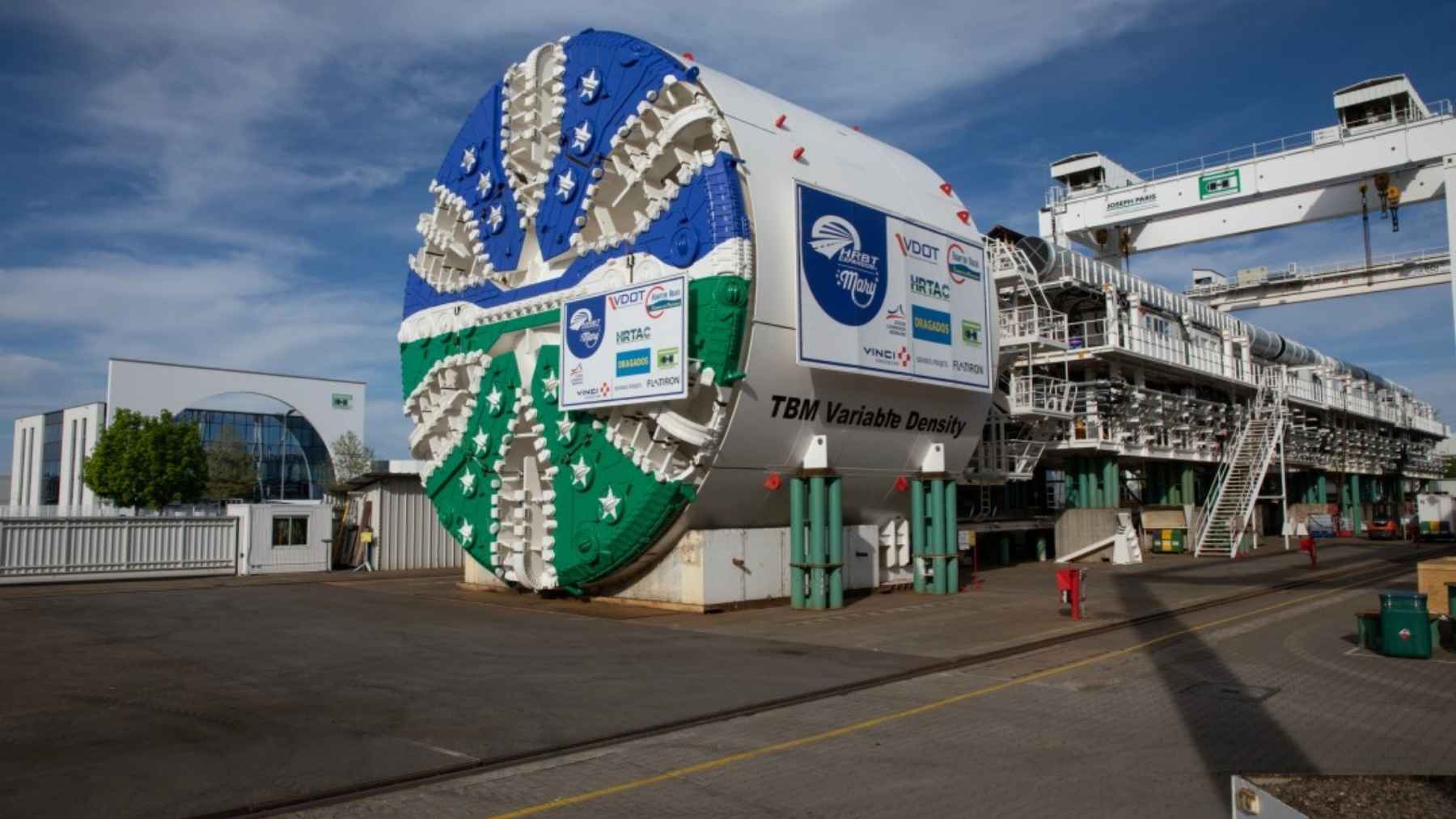
So the state went underneath it. A 4,700-ton machine built in Germany, named Mary, spent two and a half years cutting two tubes about 50 feet below the tunnels that were already down there, and the ships overhead never had to stop for any of it.
Mary finished her second and final tube on September 24, 2025. The last piece of her shield came out of the ground on January 14, 2026. What is left now is the part nobody makes a video about: turning two bare concrete pipes into something you can actually drive a car through.
The Navy is the reason this got bored instead of dug
All ten existing tunnels in Hampton Roads were built the same way, and it is the way you would probably guess. You dredge a trench across the bottom, sink prefabricated tubes into it, connect them and bury the whole thing again. That is the immersed tube method, and the original HRBT used it in 1957.
The problem is what that trench does to the water above it. VDOT put the immersed option at a deep trench roughly a mile long straight across the Hampton Roads waterway, which happens to be one of the busiest navigation channels in the country.
The U.S. Navy and the Port of Virginia were both stakeholders in the decision. Boring won.
A boring machine works from underneath, so the channel above it never gets touched. VDOT says flatly on its tunnel boring page that the approach eliminated disruption to the federal channel.
There is a catch, though. You cannot park a bored tunnel just under the harbor bed the way you can drop an immersed tube into a trench, because a sealed tube sitting in saturated ground wants to float. You have to bury it deep enough that the weight of the dirt on top holds it down.
That is why the new tubes sit about 50 feet lower than the ones from the fifties and seventies, and why Mary reached 173 feet below the surface on her second run.
Mary weighed 4,700 tons and still had to make a U-turn
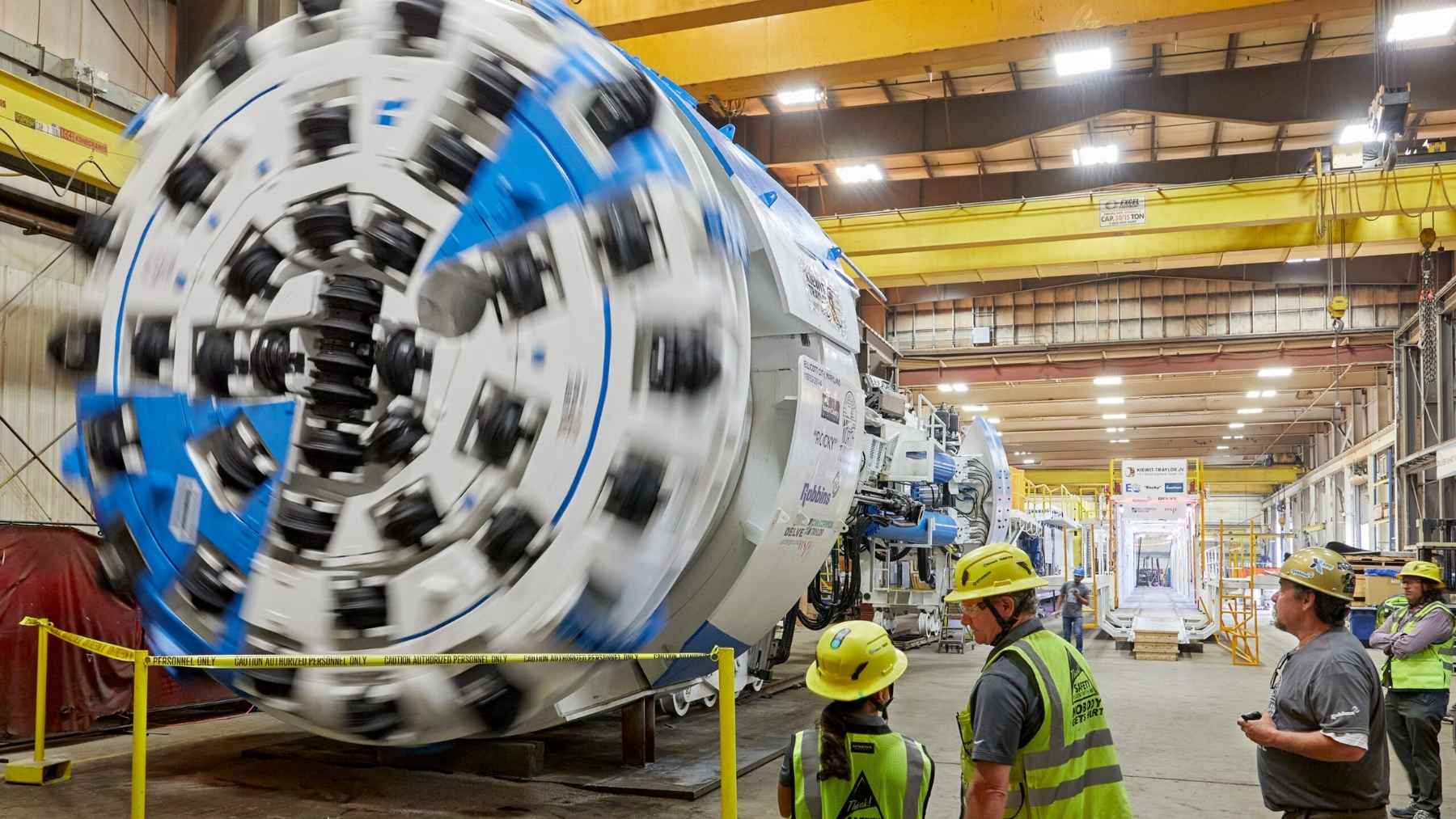
Herrenknecht built her in Germany and passed her factory acceptance test in May 2021. She was then taken apart into 170 components, loaded onto three ships and delivered to the Port of Virginia in December 2021.
VDOT lists her at 46 feet tall, more than 430 feet long and over 4,700 tons, which the agency likes to convert into ten fully loaded 747s. Tunnel Business Magazine ranks her as the second-largest boring machine ever used in the United States, behind the one that dug the SR 99 tunnel in Seattle, and the HRBT as only the fourth TBM-bored highway tunnel in the country.
She launched from the South Island on the Norfolk side in April 2023 and broke through on the Hampton end on April 17, 2024. That first tube took 51 weeks. She averaged around 50 feet a day and managed 113 on her best one.
Then came the awkward part. Mary was now pointed the wrong way, sitting at the bottom of a 65-foot pit, with a cutterhead and shield weighing 2,500 tons on their own.
Crews used nitrogen skates to slide that assembly around. FlatironDragados, one of the joint venture contractors, says it was the first time the friction-reduction method had been used in the United States and only the second time anywhere in the world. The full U-turn took six months.
She started back toward Norfolk on October 17, 2024. According to the governor’s office, she broke through on the South Island at 12:30 in the afternoon on September 24, 2025, three weeks quicker than she had managed the first tube. Governor Glenn Youngkin and U.S. Transportation Secretary Sean Duffy both turned up to watch a concrete wall fall over.
Digging the hole was the easy part
Two finished bores are not two finished tunnels. They are two concrete pipes with a curved floor, and everything that makes a road tunnel legal has to go in afterward.
The July 2026 project update lays out where that stands. One tube will carry the high-occupancy toll Express Lanes, the other carries general-purpose traffic, and they are at different stages.
In the Express Lanes tube, the egress corridor walls are in along the full length and barrier walls are going up on the opposite side. Fireboard is being installed on the vertical walls and the arched section. Pumping, ventilation and lighting come after that, and fire suppression and sprinkler testing is scheduled to begin later this summer.
The general-purpose tube is behind it. Crews finished the first phase of ballast placement in July, which is what unlocks structural concrete along all 7,960 feet of it.
Ballast and fireboard are never going to trend anywhere. They are also the difference between a hole and a tunnel you are allowed to run 100,000 vehicles a day through.
Both tubes get an egress corridor, which VDOT confirmed in April: a protected, labeled walkway behind sliding doors, with its own air supply, running out to either island.
Eight lanes, and a deadline that already moved once
The finished corridor gets two free general-purpose lanes, a full-time Express Lane and a part-time shoulder Express Lane in each direction. Across the water that means eight lanes instead of four.
“We are creating two new tunnels beneath the harbor for a total of eight lanes,” project director Ryan Banas told WAVY this week.
The math behind that is not complicated. The crossing was designed for around 70,000 vehicles a day and it currently moves more than 100,000.
The schedule has already slipped once. An 18-month extension was negotiated and announced in March 2024, pushing substantial completion into 2027. VDOT’s own annual financial plan for the project lists a contractual final completion date of August 27, 2027, and Banas says the team is on track to be substantially complete sometime in 2027, which is the point where drivers actually get to use the new tubes.
The price tag is $3.9 billion, 92% of it covered by the Hampton Roads Transportation Accountability Commission. It is the largest highway construction project Virginia has ever attempted, and roughly 2,000 people work on it on any given day.
The old bridge is going to the bottom of the bay
As the new trestles come online, the old approach bridges get cut up and barged out. About 100,000 tons of that concrete is being donated to the Virginia Marine Resources Commission, which drops it on artificial reef sites in the Chesapeake Bay.
Two deployments have gone out so far, to Bluefish Rock Reef off Hampton and Back River Reef near Poquoson. The commission runs 23 reef sites, a program that started in the 1960s with surplus World War II Liberty ships.
Placement is fussier than it sounds. Everything has to sit low enough to preserve a 15-foot vertical clearance so it never becomes a navigation hazard, which means somebody is running 3D imaging on a barge load of highway rubble.
“You just put it down, and nature does the rest,” Hunter Smith, the commission’s artificial reef specialist, told WHRO.
If you want the other end of the same story, Washington has its own German machine named Mary grinding under the Potomac, New York just finished a bypass under the Hudson that has never held a drop of water, and the Gateway project in New Jersey is assembling a borer built for rock so abrasive its cutters wear out every two days. The machine you get is dictated by the ground, every time.
Mary went home to Germany in pieces, gantries included, possibly to be used again on something else. What she left behind is still a long way from being a road, and the work that gets it there is ballast, fireboard, pumps and lighting.
The part that already worked is the part nobody saw. Carriers, container ships and everything else kept crossing over the top of a 4,700-ton machine for two and a half years, and the channel never closed once for it.