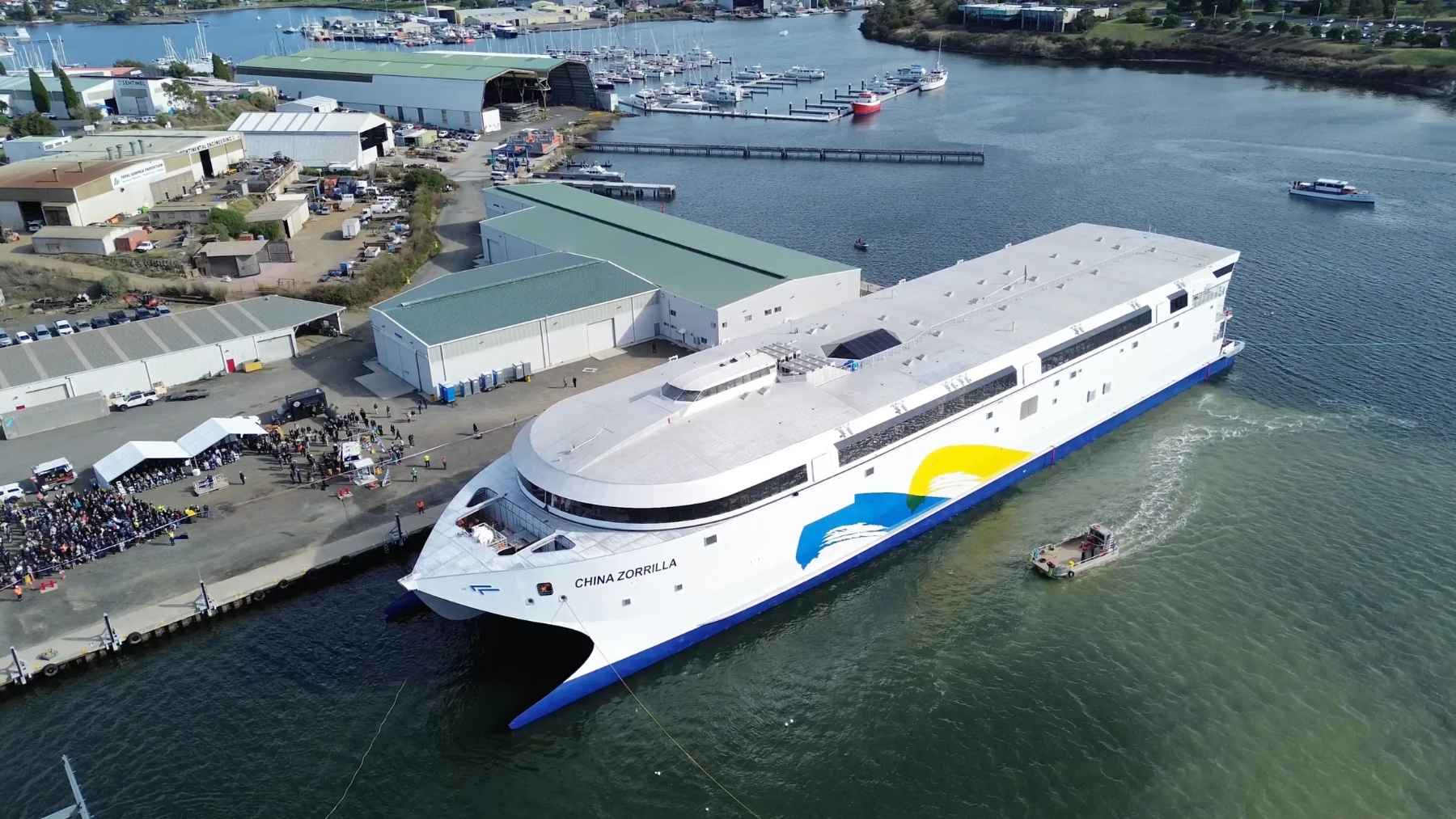

When you think “biggest electric vehicle,” your brain probably jumps to a Tesla Semi, a Cybertruck, or one of those house-sized electric haul trucks that crawl around open-pit mines. None of them are close. The largest electric vehicle ever built doesn’t have wheels, and it never touches a road. It’s a 130-meter (425-foot) ferry called the China Zorrilla, it carries more than 250 metric tons of batteries, and it was built by Tasmanian shipbuilder Incat in Hobart, Australia.
That alone would be a good story. What pushes it over the edge is what’s happening right now. The ship is finished and floating in Hobart, and a separate, even bigger vessel has set out to come pick it up and haul it most of the way around the planet to South America, where it will eventually go to work. The biggest EV on Earth is about to ride piggyback across the world, because it’s too valuable, and the trip too long, to simply sail it there itself.
The world’s biggest “EV” is a ferry, not a Cybertruck
Incat didn’t bury the claim. In its launch materials, reported by New Atlas, the company called Hull 096 not just the largest electric ship in the world but the largest electric vehicle of its kind ever built, and one of the most significant single export items in Australia’s manufacturing history. “This ship changes the game,” Incat chairman Robert Clifford said at the launch, in a line that reads like marketing until you get to the spec sheet.
The China Zorrilla is a twin-hull catamaran, 129.68 meters long, built almost entirely from aluminum to keep weight down. That matters a lot when you’re hanging hundreds of tons of battery off the structure. It can carry up to 2,100 passengers and around 225 vehicles per crossing, it cost roughly $200 million, and it’s the ninth ship Incat has built for the South American ferry operator Buquebus. So this isn’t a science project between strangers. The two companies have been working together for years.
Here’s the part almost nobody mentions: it was never supposed to be electric. The ship was originally planned to run on liquefied natural gas. Partway through, Incat and Buquebus tore up that plan and rebuilt it as a full battery-electric vessel instead, which is roughly the maritime equivalent of deciding halfway through building a house that it should be a different house.
One more thing, because it trips people up: the name has nothing to do with the country. The China Zorrilla is named after the late Uruguayan actress and director China Zorrilla. “China” was her nickname. It’s a tribute, not a geography lesson.
5,016 battery modules, and a brand-new factory to build them
The number that makes engineers sit up is 5,016. That’s how many individual lithium-ion battery modules are packed into the China Zorrilla, supplied by Norwegian marine-battery specialist Corvus Energy. Together they store more than 40 megawatt-hours of energy and weigh more than 250 metric tons. For scale, that’s a battery system roughly four times the size of anything previously installed on a ship. “The energy storage system is four times larger than any current installation,” Tom Cooper, Incat’s manager of public relations and corporate affairs, told The Driven.
The scale broke the normal supply chain. According to Cooper, Corvus had to build an entirely new factory just to produce the cells for this one ship, and it ended up making more batteries for the China Zorrilla than it had in its first seven years in business. At the Hobart shipyard, crews were installing 150 to 160 modules a day at peak. If you’ve ever wired up a home battery and felt clever, this is the same job, about ten thousand times over.
All those cells live in four dedicated battery rooms, each wrapped in multiple layers of insulation, because the one thing you do not want on a ship full of people is thermal runaway, the chain reaction where an overheating battery starts generating heat faster than it can shed it. The system watches temperatures constantly from the wheelhouse, and if any battery climbs past 80°C, a staged response kicks in that includes dousing the cells in saltwater. Yes, “drench the batteries in seawater” is a real, documented step in the safety plan. Make of that what you will.
This is the same brute-force battery scaling that’s already reshaping the grid on land, where companies are stringing together utility-scale battery plants like Tesla’s installation in Utah to store renewable power. The chemistry is familiar. The packaging is what’s new.
How you refuel a 130-meter battery
The obvious question with any EV is range, and this is where the ship surprises you. The China Zorrilla isn’t built to cross an ocean on its own power. It’s built for short, high-speed hops across the Río de la Plata, the wide estuary between Argentina and Uruguay. Its flagship route links Buenos Aires with Colonia del Sacramento, a crossing of well under an hour and a half. The battery is sized for those quick runs, not for marathon distance.
Instead of carrying enough energy for a long voyage, it tops up at the dock between crossings. According to CleanTechnica’s breakdown of the project, the plan calls for ultra-high-power DC fast chargers at both Buenos Aires and Montevideo, each delivering several megawatts at once and refilling the battery from roughly 20% to 80%, about 24 MWh, in around 40 minutes while passengers and cars load and unload. Feeding chargers that hungry meant upgrading the local grid and adding buffer batteries onshore to handle the peaks. Overnight, it charges again during cheaper, lower-demand hours.
Once it’s moving, eight Wärtsilä waterjets push it along at a 25-knot service speed, which is seriously quick for a vessel this size carrying this much weight. There’s no engine room full of diesel, no fuel tanks, no exhaust stack. Just batteries, electric drives, and a lot of water going very fast out the back.
A giant ship to carry a giant ship
Which brings us back to that very strange trip. The China Zorrilla is finished, its battery system is installed, and it ran its first sea trials on Tasmania’s River Derwent earlier in 2026. What it hasn’t done is carry a single paying passenger. Before it can, it has to get to South America, and Incat isn’t sailing it there. It’s shipping it.
In early June, Incat confirmed that a heavy-lift vessel called the Black Marlin had set out for Hobart to collect the ferry. The Black Marlin is a 217-meter (712-foot) semi-submersible heavy-lift ship, one of the larger vessels ever to enter the River Derwent, and it’s routing to Tasmania by way of South Africa and Melbourne. Its entire job is carrying things that are too big, too heavy, or too valuable to move any other way.
The loading itself is the kind of thing you’d watch with your mouth slightly open. As a semi-submersible, the Black Marlin floods its ballast tanks and sinks its own cargo deck below the surface. The China Zorrilla is then floated into position directly above the submerged deck. The Black Marlin pumps the water back out, the deck rises, and it lifts the ferry clear of the sea to carry it like freight. A giant ship, in other words, is about to swallow a slightly-less-giant ship and drive it home.
Incat chairman Robert Clifford has framed the Black Marlin’s arrival as the final stage before the China Zorrilla leaves Tasmania for good, and the company says there’s been serious international interest in watching it happen. For a vessel Incat already calls one of the biggest single export items in Australian manufacturing history, the send-off fits.
Electrification is leaving the driveway
The reason a ferry matters to anyone who follows cars is what it signals. For years, “EV” has meant a passenger car, then a pickup, then a delivery van. The China Zorrilla is a 14,000-gross-ton data point that the same battery technology now scales to things the size of a city block. A few years ago, plenty of people in shipping flatly did not believe a fully battery-electric vessel this large was technically or commercially possible. It’s now floating in the water.
It’s not the only clean-power experiment heading out to sea, either. Batteries are one path, and hydrogen is another, as with the hydrogen fuel-cell superyacht Nausicaä, which chases zero-emission cruising with fuel cells instead of a giant battery bank. And it’s no accident that the biggest version of this keeps coming out of Australia, a country that has made a habit of building record-breaking renewable-energy projects on a scale most places only talk about.
So the largest electric vehicle ever built won’t have a frunk, won’t sit in your driveway, and won’t ever show up in anyone’s quarter-mile times. It’s a 130-meter Tasmanian ferry with 5,016 battery modules and a saltwater fire-suppression system, and the next milestone in its life is getting loaded onto an even bigger ship for a weeks-long ride to the other side of the world. Once it reaches the Río de la Plata, it’ll start moving 2,100 people at a time between Argentina and Uruguay on nothing but stored electrons, recharging at the dock like the world’s most over-engineered phone. Not bad for a boat that was almost powered by gas.