
Every kilogram of hydrogen doing useful work in America right now came out of a factory. Most of it gets cooked from natural gas in industrial plants, the cleaner kind gets split from water with electricity, and both routes share the same basic problem: somebody has to build the molecule before anybody can sell it. So the idea that you could skip all of that and simply pump hydrogen out of the ground, the way Texas pumps crude, has spent years living in the “sounds great, call me when it’s real” folder.
It now has a date on the calendar. HyTerra, an Australian-listed explorer drilling in rural Kansas, and Prometheus Hydrogen, an Illinois company that stores the gas in solid form, signed a collaboration agreement in late February to run a complete geologic hydrogen supply chain from one end to the other: out of the rock, through purification, into storage, onto a truck, and into the hands of a commercial end user. The target, according to Hydrogen Central, is completion before December 1, 2026. Nobody anywhere has ever billed a customer for purified hydrogen that came out of the ground. If these two pull it off, that sentence stops being true before New Year’s.
We’ve covered the global scramble for this gas before, from the French deposit that may hold half the world’s annual hydrogen supply to the wells popping up across North America. Those were stories about geology. This one is about an invoice. And the whole thing hangs on a flow test happening in Kansas this quarter.
The gas under Kansas comes out of the ground nearly ready to use
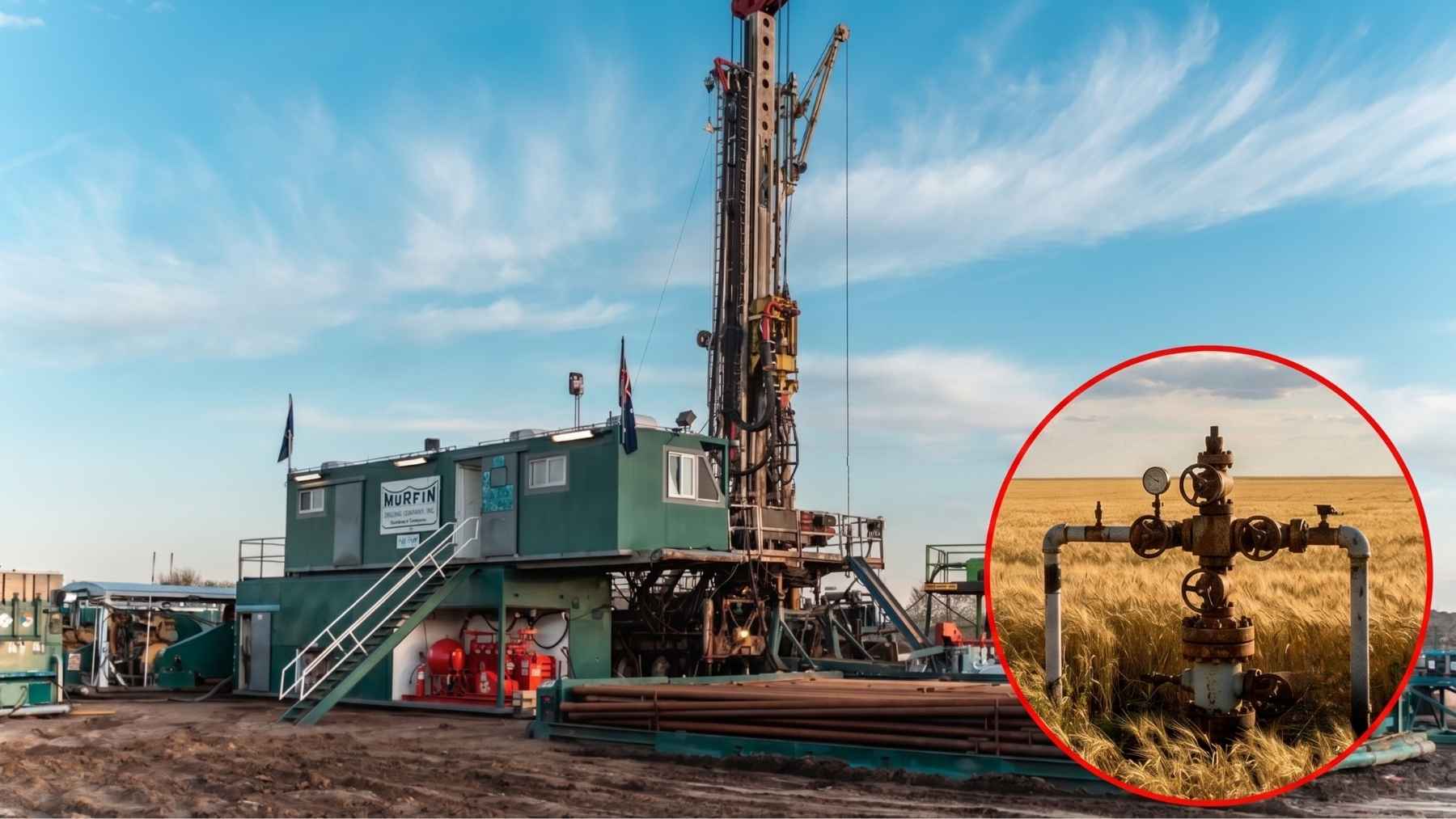
HyTerra’s Nemaha Project sits in eastern Kansas, above the Midcontinent Rift, a buried scar in the continent’s basement rock that the company considers one of the most hydrogen-promising zones in North America. Since April 2025 it has drilled three wells there, fully funded through a A$21.9 million investment from Andrew Forrest’s Fortescue, and all three found hydrogen and helium. The standout was Sue Duroche 3, where mud samples recorded hydrogen concentrations “as high as 96.1%,” per the trade publication Drilling for Hydrogen, a figure the company describes as among the highest measured anywhere on the planet.
Stop and consider what that number means. Gray hydrogen plants exist to strip hydrogen away from carbon atoms it’s chemically attached to. Electrolyzers exist to rip it out of water molecules. This stuff is sitting in fractured Precambrian rock a mile down, already 96 parts in 100 hydrogen, made by the planet on its own schedule at no charge. The remaining few percent even includes up to 5% helium, which in Kansas is less a contaminant than a second product line. The state is America’s top helium producer, and the historic Hugoton field built a decades-long industry on concentrations of 0.25% to 2.5%. HyTerra is logging double the top of that range while looking for something else entirely.
One flow test this quarter decides the whole calendar
Mud samples get geologists excited. Flow rates pay invoices. The gap between those two things is exactly what HyTerra is about to measure at McCoy 1, the deepest well it has drilled, reaching 5,562 feet (1,695 m) through sedimentary cover and into the Precambrian basement, roughly six miles from Sue Duroche 3 in the same fault block and conveniently parked next to Interstate 70. McCoy 1’s own mud samples ran up to 83% hydrogen with that same 5% helium, and real-time monitoring during cleanup picked up elevated flowing gas shows, which is encouraging without being bankable.
In February, HyTerra announced a full production test at McCoy 1 for the second quarter of 2026. That window closes June 30, and no flow numbers have been made public yet. The test is built to answer the questions that actually matter: what the sustained flow rate is, what the gas composition looks like when it’s flowing rather than sampled from drilling mud, and how the reservoir’s pressure behaves over time. Drilling for Hydrogen put it bluntly in April: the live flow data decides whether the December demonstration is viable at all. If the well underdelivers, the date slips and the world-first press release goes back in the drawer. There’s no version of this where a disappointing flow test gets papered over, because the whole point of the exercise is delivering real gas to a real customer.
Prometheus exists to skip the worst part of hydrogen logistics
Getting hydrogen out of the ground is only half a supply chain. The other half is the part that has historically murdered hydrogen economics: moving it. The molecule is so small and so light that the standard playbook involves squeezing it into high-pressure tanks or chilling it into a cryogenic liquid, and either way you end up spending serious money on infrastructure before a single customer shows up. Pipelines built for natural gas mostly can’t take it. This is the swamp where decades of hydrogen business plans have gone to die.
Prometheus Hydrogen’s entire pitch is routing around that swamp. The St. Charles, Illinois company stores hydrogen in a solid-state substrate, and it claims its systems need no compression pumps, no cooling, and no external infrastructure, with an expected lifespan north of 30,000 cycles and the ability to sit dormant for 30 years without degrading. Those are the company’s own numbers, not independently audited specs, but the architecture of the Kansas plan follows directly from them: Prometheus handles purification, storage, transport and final delivery, no pipeline network required, no high-pressure compression step. Under the agreement, this is a defined proof of concept rather than a long-term supply contract; HyTerra CEO Riley Kemp has framed it as confirming the pathway works end to end before anyone talks about scale. Which is the correct order of operations for an industry that has occasionally talked about scale first and physics later.
If the model of skipping conventional infrastructure sounds familiar, it should. Seoul is already turning sewage biogas into hydrogen for city buses while American landfills flare the same feedstock. The interesting hydrogen stories in 2026 are mostly about finding shortcuts around the parts of the supply chain nobody wants to pay for.
The Air Force is watching for reasons that have nothing to do with climate
In mid-April, this Kansas experiment picked up a second storyline. Renaissance Philanthropy’s Chimaera Fund, which calls geologic hydrogen “the first new primary energy source discovered in 80 years,” selected HyTerra, Prometheus Hydrogen and Helix Exploration as primary performers for a small-scale demonstration, picked from nearly 30 responses to a request for information. The results will feed the Department of the Air Force’s techno-economic assessment of geologic hydrogen near its bases, with Malmstrom AFB in Montana and McConnell AFB in Wichita, Kansas named as the reference sites.
The driver here is a Congressional requirement that critical military installations reach 99.9% energy availability by 2030. That’s an uptime spec, not an environmental one. A base that can generate power from gas seeping out of the rock beneath it doesn’t care what happens to the regional grid, a diesel convoy or an LNG terminal, and that kind of independence is precisely what energy-resilience planners get paid to chase. The fund’s selection notes that HyTerra brings the only active well test planned within the program’s timeline, meaning McCoy 1’s flow data will pull double duty: deciding a commercial world first and informing a military feasibility study at the same time. To be clear about what this is not: nobody is building hydrogen weapons in Kansas. This is about keeping the lights on at installations that can’t ever go dark.
Exactly one village on Earth has ever run on this stuff
The entire commercial track record of natural hydrogen fits in one paragraph. In 1987, a water-drilling crew in Bourakébougou, Mali hit a dry well that turned out to be venting something odd, and a worker lighting a cigarette nearby set it on fire. Decades later the gas was identified as roughly 98% hydrogen, and since 2012 it has fed a small generator powering the village’s roughly 1,500 residents, with the gas flowing at around 50,000 cubic feet per day. One well, one turbine, one village. That’s it. That’s the industry.
Which is what makes the Kansas attempt a different category of event. Bourakébougou proved the gas exists and burns. HyTerra and Prometheus are trying to prove it can be extracted, purified, packaged, hauled down the highway and sold, the unglamorous sequence every fuel on Earth had to master before it counted as an energy source rather than a curiosity.
So here’s where things stand in June. A flow test with a deadline measured in weeks, a delivery date measured in months, and a fair number of ways for the calendar to slip, because well testing is the kind of activity where calendars exist mainly to be revised. The companies say “targeted” and “aims to,” and they’re right to. But the demonstration doesn’t need to be big to matter. The first barrel of Pennsylvania crude wasn’t big either. A hydrogen train is already hauling commuters in California, so the burning end of this equation is solved. What’s never existed is a paying customer for hydrogen the Earth made by itself. If a truck leaves a Kansas field before December 1 and an invoice follows it, the world’s newest energy industry will have revenue. All of it.