
For most of the last decade, hydrogen trains have been somebody else’s story. Germany dropped them into regular passenger service back in 2018, and the headlines since have rolled in from the UK, India and a handful of other countries that were busy figuring out how to decarbonize their tracks. The US kept showing up as the blank space on that map, which is a little strange given it sits on the largest stretch of unelectrified railroad on the planet.
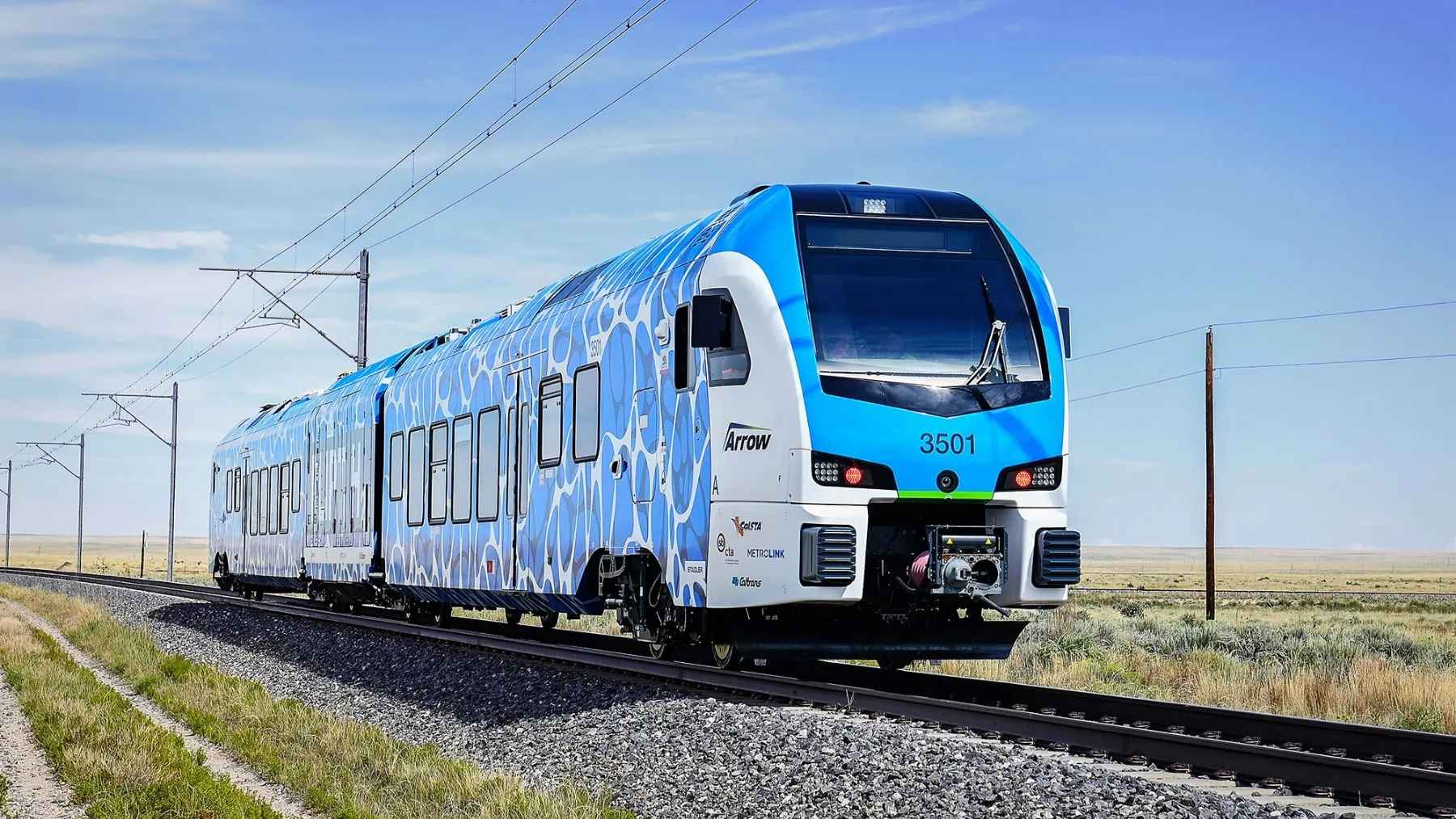
That blank space quietly got filled last fall, in of all places San Bernardino. Since September 13, 2025, a two-car Stadler FLIRT H2 has been running scheduled Metrolink commuter trips on the nine-mile Arrow line between San Bernardino Downtown and Redlands University. According to the San Bernardino County Transportation Authority (SBCTA), it’s the first hydrogen-powered passenger train in the United States, and the first one cleared to operate under U.S. Federal Railroad Administration safety standards. No diesel, no overhead wires, no third rail. The only thing coming out the back is water vapor.
And before it carried a single paying commuter, it went out to the Colorado desert and set a world record that, if you take it at face value, makes the nine-mile Arrow run look almost insulting. There’s a reason for that gap, and it’s worth getting into. So is the much bigger bet California has riding behind this one train.
What’s Actually Running on the Arrow Line
The FLIRT H2 is a Zero-Emission Multiple Unit, or ZEMU, which is rail-speak for a self-propelled train with no separate locomotive dragging it along. Stadler built it at its headquarters in Bussnang, Switzerland, rather than at its usual US plant in Salt Lake City. As a one-off prototype it didn’t have to meet Buy America rules, though Railway Gazette notes it still leans on Stadler’s regular US suppliers for parts.
The specs are deliberately ordinary, which is the point. Two cars, 116 seats, a top speed of 79 mph (127 km/h), and a 30-minute refuel. Stadler rates its range at 460 km, or a bit over 286 miles, on a single fill. On the Arrow line it runs up to 16 trips a day on a route you could drive in fifteen minutes, so range was never going to be the constraint here. SBCTA, for its part, called the launch “a bold leap forward in clean transit,” which is the kind of thing transit agencies say, but the FRA clearance underneath it is the genuinely hard part. Getting a hydrogen train signed off to the same crashworthiness and fire-protection rules that govern American passenger rail took more than a decade of planning and roughly a year of testing on the line itself before anyone was allowed aboard.
Canada Got There First, Sort Of
Here’s where the “first in the US” wording earns its keep, because you’ll see plenty of coverage that quietly upgrades it to “first in North America” or “first in the Americas.” That part isn’t true, and it’s worth being precise about. Back in summer 2023, Alstom ran its Coradia iLint, the German-built train widely billed as the world’s first hydrogen passenger model, on the scenic Réseau Charlevoix tourist line along the St. Lawrence River in Quebec. By the time the demonstration wrapped at the end of September, Alstom reported it had carried more than 10,000 passengers over 130 trips. Canada beat California to the continent by a full two years.
The distinction is in the fine print, and it actually matters. Quebec’s run was a seasonal, summer-only demonstration on a tourist railroad. San Bernardino’s is a scheduled, year-round, FRA-compliant commuter service that shows up in a real timetable alongside the low-emission Stadler diesel units that have worked the Arrow line since 2022. So the honest version of the headline is the narrow one: this is the first hydrogen train in regular passenger service in the United States. Which is a smaller claim than “first in the Americas,” and a more defensible one.
About That 2,803-Kilometer Record
The record is real, and it’s genuinely impressive, but it needs context or it’s misleading. During testing at the Transportation Technology Center in Pueblo, Colorado, the FLIRT H2 covered 1,741.7 miles, or 2,803 km, on a single hydrogen fill without refueling or recharging. Guinness World Records logged it as the longest distance ever run by a hydrogen fuel cell multiple unit, and it’s Stadler’s second alternative-propulsion record after its battery-only FLIRT pulled off something similar in Germany.
Now line that 1,742-mile figure up against the 286-mile range Stadler quotes for everyday service and the obvious question is which number is lying. Neither is. Stadler’s own sales chief, Ansgar Brockmeyer, described the record as establishing the “ideal performance range” of the train, which is a polite way of saying it’s a best-case lab result. Pueblo is a flat, controlled test loop with no fare-paying passengers, no aggressive HVAC load, and a driving profile optimized to sip hydrogen as slowly as physics allows. Real commuter service in Southern California means heat, climbing, frequent stops, and air conditioning that has to actually work. The 286-mile number is the one that holds up in the field. The 1,742-mile number is the flex.
The Hydrogen Lives in a Box Between the Two Cars
The layout is the clever bit. Instead of bolting fuel cells and tanks onto the roof the way some designs do, Stadler put everything in a central modular unit it calls the PowerPack, sandwiched between the two electrically driven end cars. Inside that box sit the hydrogen tanks, the fuel cells, and a traction battery, with the hydrogen storage walled off entirely from the passenger area. Six 100 kW Ballard FCmove-HD+ fuel cell engines convert hydrogen into electricity, that current charges the battery, and the battery feeds the motors. Braking energy gets recovered back into the battery, which is a big part of why the thing can run a full service day on one fill.
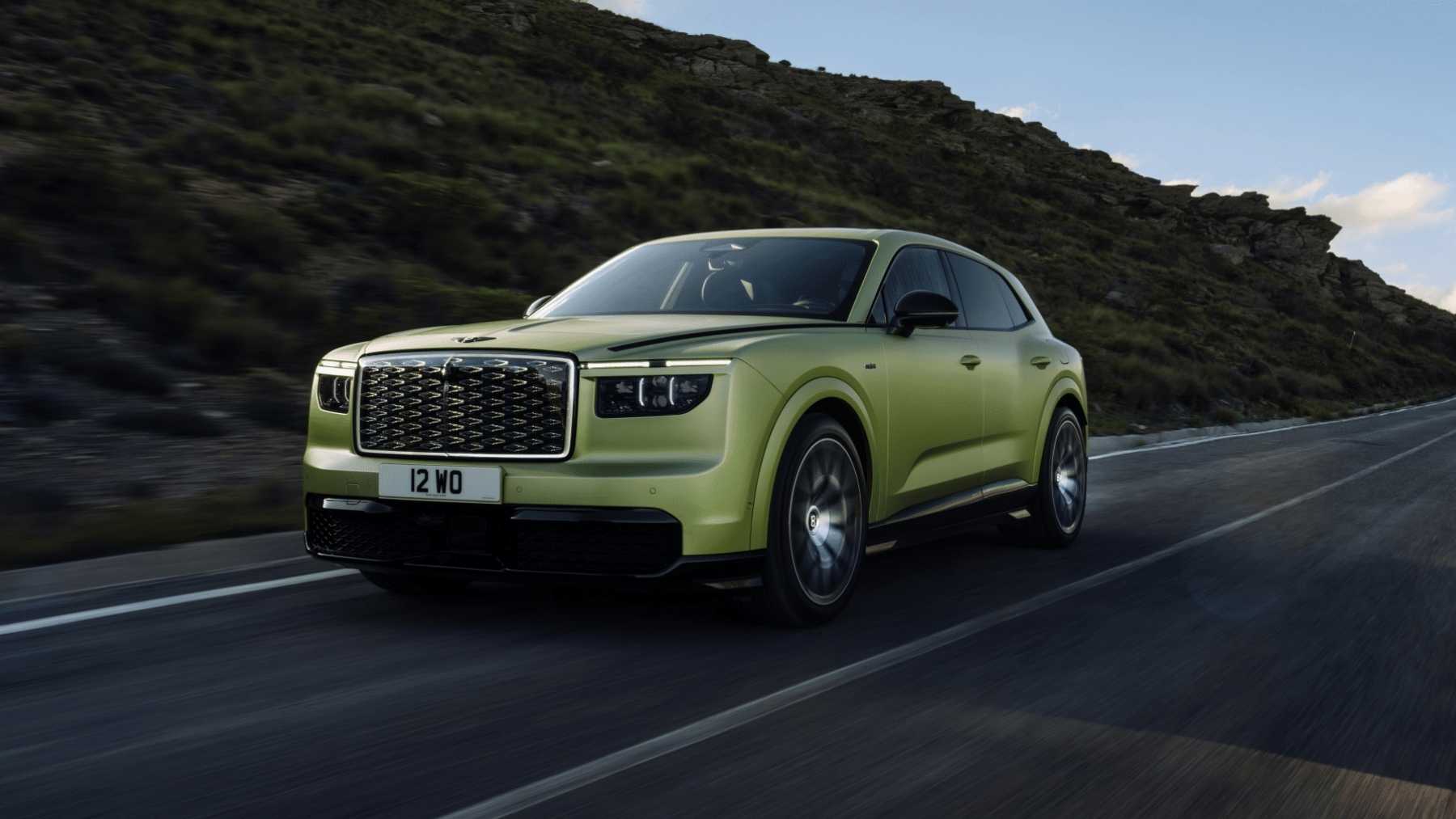
Fuel cell rail isn’t brand new as a concept. Toyota, among others, has been poking at it from the freight side with a hydrogen fuel cell locomotive, and the underlying chemistry has been proven in service in Europe for years. What’s different about the FLIRT H2 is the packaging discipline. It rides on a lightweight aluminum body, uses lithium-titanate batteries built for heavy recuperation, and is designed to handle California’s climate without the fuel cells throttling back in the heat. The end result looks almost identical to the diesel version it runs beside, just a little longer to make room for the tanks, wrapped in a blue-and-white water-vapor livery in case you forget what it runs on.
Why Hydrogen Makes More Sense Here Than in Europe
SBCTA didn’t start out wanting a hydrogen train. The agency first looked hard at a battery-electric trainset, but its own studies concluded the available battery range wasn’t enough for the continuous, all-day operation the line needed, so it ordered the hydrogen version instead in November 2019. That trade-off is the whole argument for hydrogen in American rail, scaled up.
Brockmeyer has made the case bluntly in the past: most European routes have only short unelectrified gaps, the kind a battery can cover, while the US has hundreds of miles of track with no wires anywhere. Stringing catenary across all of it would cost a fortune nobody is going to spend, and batteries run out before the line does. Hydrogen lets an operator pull the diesel out of an existing route without rebuilding the route. That’s a far more compelling pitch in a country where, by most counts, only a tiny sliver of the network is electrified. Stadler says it has now sold more than 150 battery- or hydrogen-powered trains across the US, Germany, Italy, Austria and Lithuania, which suggests the company is betting the same way.
California Already Doubled Down on the Bet
The San Bernardino train is the demo. The real money is up north. Under a framework contract Caltrans signed with Stadler in October 2023, the state ordered four hydrogen trainsets for $80 million, then exercised an option in February 2024 for six more at $127 million, bringing the firm total to 10. Trains reports the original contract leaves room for as many as 29 trains in all, with 19 options still open.
These won’t be two-car runabouts. They’re bigger four-car intercity versions, designed for roughly a 500-mile range, headed for the Central Valley’s planned Valley Rail service between Merced and Sacramento, an expansion of the Altamont Corridor Express and Amtrak San Joaquins that’s eventually meant to tie into the first leg of California’s high-speed rail. The funding comes out of Governor Gavin Newsom’s $10 billion zero-emission vehicle package, $407 million of it earmarked specifically for clean buses and rail. “California continues to lead the way to a cleaner, more connected transportation system,” state Transportation Secretary Toks Omishakin said when the expanded order was announced, framing it as part of the state’s goal to make its passenger rail 100% emissions-free by 2035. As of early 2026, the first of those trains was still on track to enter revenue service in 2027.
That’s the real distance to watch, not the one in Colorado. The gap between a 1,742-mile record and a nine-mile commute is the whole status of hydrogen rail in America right now: proven on paper, barely started in practice. California has decided the Central Valley is where it stops being a science project and starts being a schedule. Whether anyone else in the country follows depends a lot less on the chemistry, which clearly works, than on whether other states feel like building the fueling stations to match.