
Boring machines get a party when they break through. Someone films the cutterhead punching out of the rock face, a politician turns up in a hard hat, and the machine is famous for an afternoon.
Nobody films the part after that. The machine is parked at the dead end of a tunnel it has lined behind itself, several stories underground, and it cannot back out the way it came.
Sydney has spent this year solving that problem twice, directly under its own financial district. Tunnel boring machines Jessie and Ruby, 1,100 metric tons apiece, finished the twin tunnels of Sydney Metro West and stopped under the corner of Hunter and George streets in the CBD. Getting them back to daylight took months of night work.
You can watch that ending happen in the project’s own paperwork. The June construction notice for the Hunter Street site told neighbors that crews would finish pulling TBM Jessie out and take the tower crane down that month. The July notice, published by Sydney Metro on June 25, does not mention boring machines at all. It talks about concrete.
The machines came out through the hole you will eventually walk down
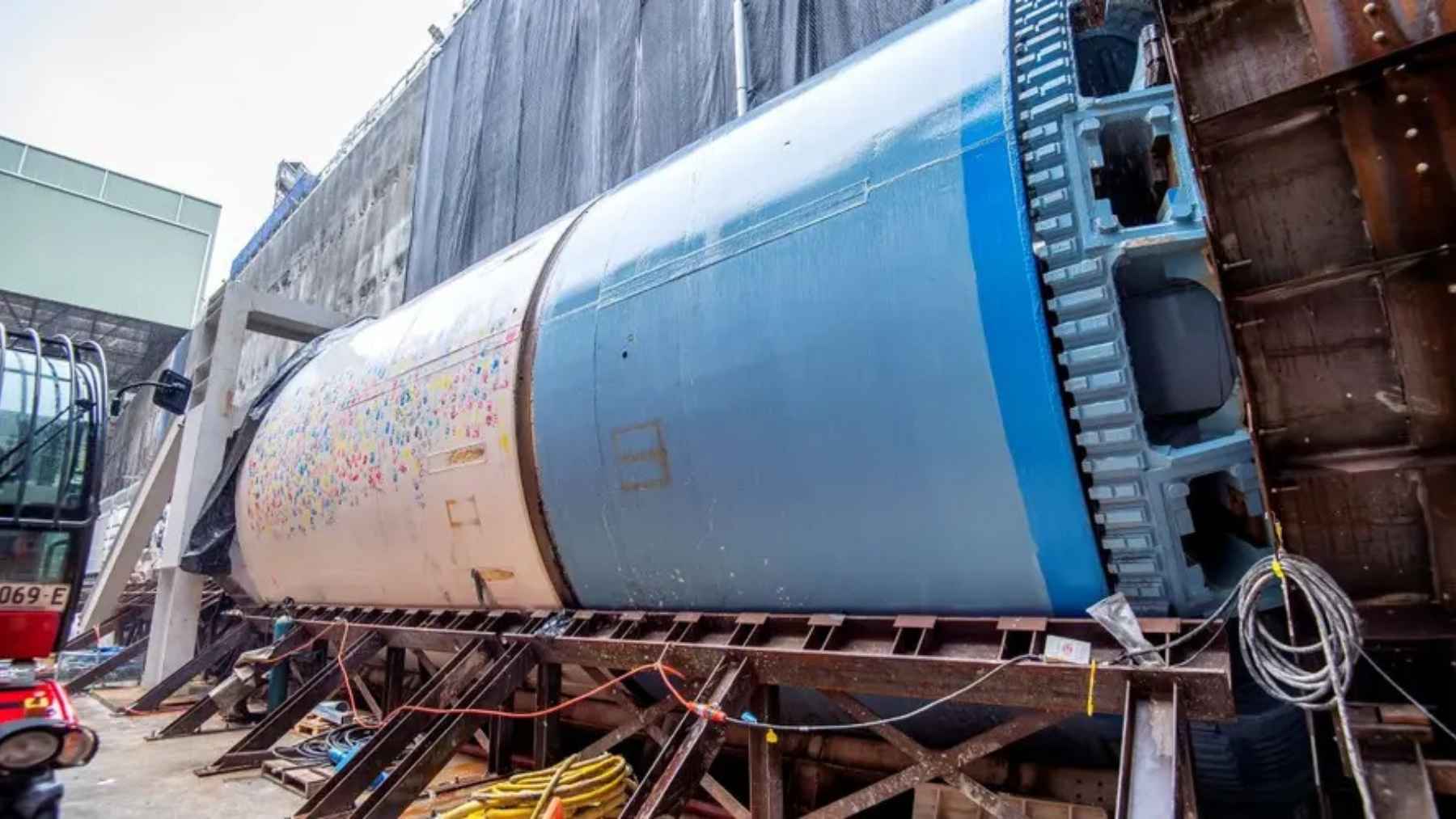
Each machine was cut into roughly 16 major pieces underground, then lifted 27 meters (about 89 feet) up the Hunter Street East shaft. Sydney Metro says that shaft will eventually form part of the passenger access linking street level to the station platforms.
So the last object to leave through that opening was a German cutterhead hanging off a crane, and the next things through it will be commuters carrying coffee.
The pieces went out on trucks, one 68-wheeler per component, at night. Down Elizabeth and Market streets, over the Anzac Bridge, onto the M7 and north to Newcastle. From there, according to Sydney Metro, a selection of parts is being shipped back to Herrenknecht, the German firm that built both machines.
If you were driving through the Sydney CBD at 3am earlier this year and got stuck behind something enormous moving at walking pace, that was a piece of Ruby.
The last mile ran five meters under the floor of Sydney Harbour
Ruby’s final leg was 1.1 kilometers from Pyrmont to Hunter Street, about 37 meters down, averaging 90 meters a week with a crew of 12 operators working 12-hour shifts.
The awkward 250 meters of that run went under Darling Harbour, between the Australian Maritime Museum and King Street Wharf. Sydney Metro put the tunnel 35 meters below the water surface, which left roughly five meters of rock between the harbour floor and the crown of the tunnel.
Five meters. On a route that also passes within 25 meters of the Anzac Bridge and within meters of Wynyard Station and the City East electricity cable tunnel.
Jessie and Ruby were mixed shield slurry machines, specified for the pressurised ground expected under the harbour. The tunnels they built are Sydney’s second rail crossing under that water. The first carries the M1 metro between the north shore and Barangaroo.
And the harbour is still busy. A few kilometers north, a 4,350-ton machine called Patyegarang is boring the Western Harbour Tunnel road crossing, having been assembled inside a cavern dug under a suburban cricket oval because there was no other way to get it underground in one piece.
The cutterheads are too worn out to dig anything else
The 90-metric-ton cutterheads are not going back to work. Sydney Metro says they will be recycled rather than rebuilt, because the steel has reached its wear limits and refurbishment would not guarantee the durability another tunneling job requires.
Which is a blunt end for something that ran for 34 months straight. Sandstone does not negotiate.
Not everything gets scrapped, though. When the two machines at the western end of the line finished at Westmead in December, Sydney Metro said their main drives would be recovered for refurbishment and reuse on other projects, with the remaining parts recycled.
Jessie and Ruby were partly built from older Sydney machines in the first place. Of the 19 boring machines used across the four Sydney Metro projects, several carried refurbished components from earlier ones. The industry runs on hand-me-downs right up until the steel stops cooperating.
That cycle is running everywhere at once. In London, the last two HS2 machines are carving the Euston tunnels under a Victorian cemetery. In South Australia, a 3,500-ton German machine named Mary started digging under Adelaide’s suburbs on July 1. The fleet keeps moving; individual cutterheads do not.
Two of the six machines steered themselves
Six machines dug Metro West, and two of them did a decent share of their own driving. TBMs Betty and Dorothy, 1,200 metric tons each, handled the western leg between Sydney Olympic Park and Westmead, and Sydney Metro describes them as the first autonomous boring machines used in Australia.
The word autonomous is doing less work here than it sounds like. An operator stays in control throughout. What the software takes over is the repetitive end of the job, the steering inputs and the constant small corrections, which the agency credits with better speed and accuracy than a human doing it by hand for twelve hours.
The technology is not Australian. Gamuda, the Malaysian contractor that built the western tunnels alongside Laing O’Rourke, developed the system on the Kuala Lumpur metro and claims it as a world first. Singapore and Sydney got it afterwards.
Dorothy closed out the western leg in early December after nine kilometers (5.6 miles) from Sydney Olympic Park, 788,000 metric tons of spoil and 28,788 concrete segments installed behind her. She arrived in the Westmead station box, which at 39 meters is the deepest on the entire Sydney Metro alignment.
The machines named after Australian women are a Sydney Metro habit by now. Dorothy is Dorothy Buckland-Fuller, the human rights activist. Betty is the sprinter Betty Cuthbert. Ruby is Ruby Payne-Scott, a women’s rights campaigner and Australia’s first radio astronomer.
Twenty-four kilometers of empty tunnel is not a railway yet
The headline numbers are genuinely large. Sydney Metro says more than 22,900 people worked on Metro West, and the tunneling program across all four of its lines ran to 128 kilometers of tunnel, 19 machines, 58 breakthroughs and 14.7 million metric tons of excavated earth, most of it reused on other Sydney projects.
None of that carries a train. What is down there right now is a very long lined hole.
John Holland holds the linewide contract, which covers 60 kilometers of track (roughly 37 miles), the rail systems, and a 38-hectare stabling and maintenance depot at Clyde with 16 buildings serving a fleet of 16 trains. The project factsheet puts about 77,000 cubic meters of concrete into the depot and the tunnels.
Track laying is due to begin before the end of this year. First passengers are targeted for 2032, with Westmead to the CBD in a little over 20 minutes.
Meanwhile the Hunter Street crews are doing the least photogenic work on the whole project: waterproofing, steel and concrete, lining a cavern 27 meters down, seven days a week, with the out-of-hours shift running 6pm to 7am.
So the machines are gone. Most of that steel is either sailing back to Herrenknecht or going to a recycler, and the shaft they were hauled up through is now a large rectangular opening in the middle of the Sydney CBD, waiting for someone to install an escalator in it. It is the quietest thing that has happened on that corner in three years, and it is the only part of the entire job that ordinary people will ever stand inside.