
Every argument about renewable energy ends up in the same place. Solar stops at sunset, wind does whatever the weather tells it to, and something else has to cover the gap. Tides are the exception, because they answer to orbital mechanics instead of a forecast.
France worked that out a long time ago. EDF, the French utility, publishes predicted sea and basin levels for the Rance estuary in Brittany hour by hour, weeks ahead. The table currently posted covers July 25 through August 14.
That table exists because there is a power station buried under the road across that estuary, and it turns 60 this year. The Rance tidal power station was inaugurated by Charles de Gaulle in November 1966 after six years of construction.
Six decades later, EDF’s own 2026 fact sheet on the site is blunt about where it sits: still one of only two tidal power stations anywhere producing electricity from tides on an industrial scale. The other one opened in South Korea in 2011.
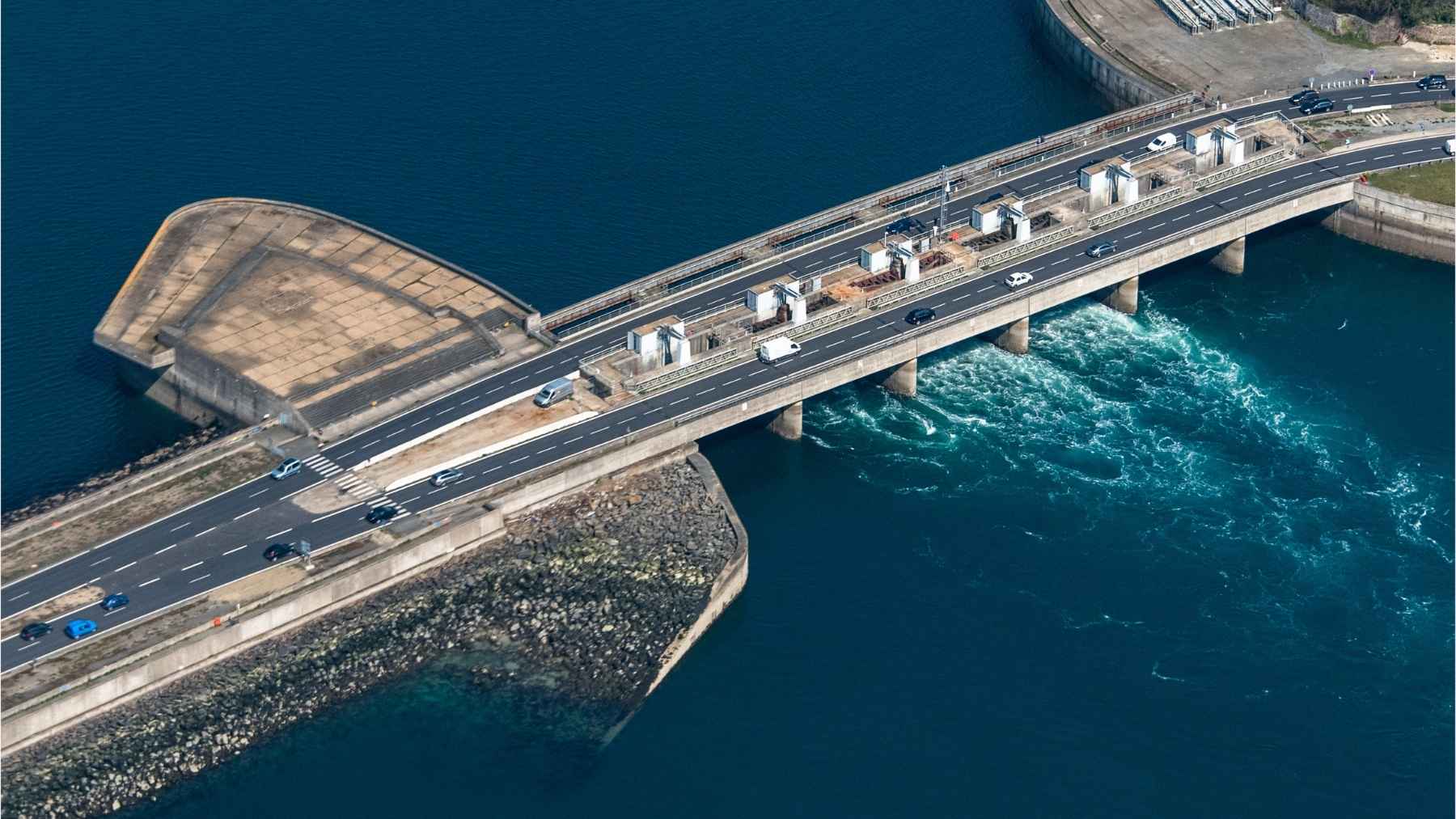
The whole plant is 750 meters of concrete with 24 turbines inside it
The station spans the mouth of the Rance between Dinard and Saint-Malo, on a stretch of Brittany with one of the largest tidal ranges on the planet. EDF puts the maximum swing between low and high water at 13.5 meters.
The development runs 750 meters bank to bank. The powerhouse section is 390 meters long and 33 meters wide, and it holds 24 bulb turbine units rated at 10 MW each, for 240 MW installed.
Behind it sits a basin that stores 184 million cubic meters of water. As the tide fills and empties that basin twice a day, EDF puts the peak flow through the structure at 18,000 cubic meters per second, of which the turbines can take 6,600. The rest moves through six wagon-type sluice gates measuring 10 by 15 meters.
That 240 MW made it the largest tidal power station in the world for 45 years, until South Korea’s Sihwa Lake barrage arrived in 2011 with 254 MW across ten turbines. Two barrages, 45 years apart, and that is the entire global fleet at this scale.
Figures from EDF’s 2026 fact sheet for the Rance tidal power station.
The turbines work in both directions, and that was the entire trick
A conventional hydro turbine expects water to arrive from one side. A tidal barrage does not have one side, because the water leaves and then comes back.
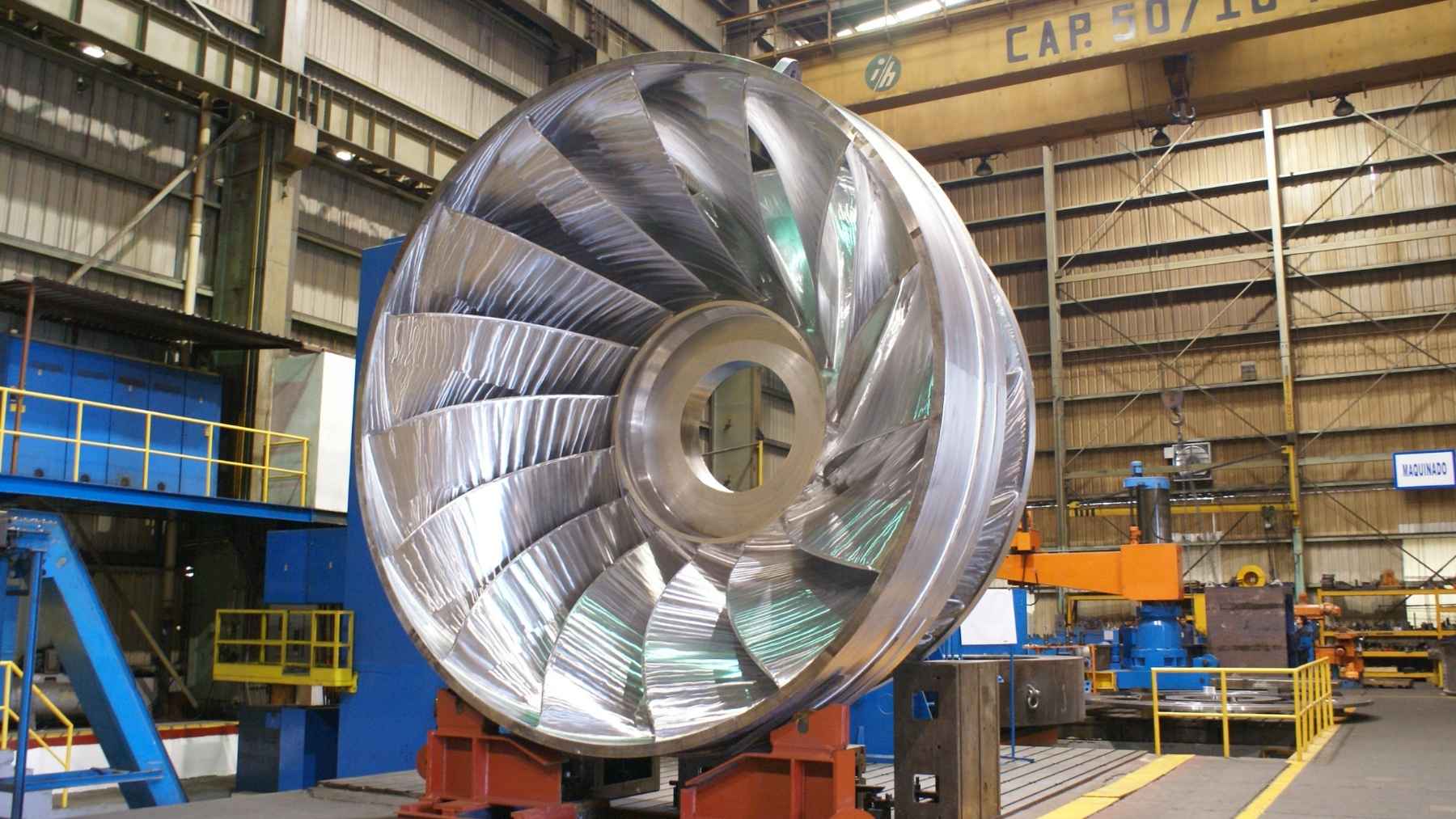
EDF’s answer in the early 1960s was the bulb unit: the generator sealed inside a streamlined casing sitting directly in the flow, with a runner built to work whichever way the water is moving. EDF’s 2026 fact sheet describes the two-way principle as one that extends production time by letting the “turbines operate both during the filling and emptying phases of the basin.”
There is a third mode that gets less airtime. According to the US Department of Energy’s marine energy device database, the Rance units were also designed to pump in both directions, lifting the basin at high tide or dropping it at low tide to add head for the next generating phase.
Which means a 1960s tidal barrage that also behaves like a pumped-storage plant. Cheap power goes in, more valuable power comes out a few hours later, and the moon handles the part in between.
Sihwa does not do this. It generates one way only, on the incoming tide, with sluice gates handling the outflow.
The dam is also a highway, and that was deliberate
Packing the electromechanical equipment inside the bulb casings left room to run a departmental road across the top of the structure. It connects Dinard to Saint-Malo and cuts out a long inland detour.
EDF’s 2026 figures put that road at an average of 32,000 vehicles a day, climbing to 39,000 during the summer season. On the Dinard side there is also a lock, 65 meters long and 13 meters wide, which EDF says passes roughly 12,500 vessels a year.
Add the 30,000-plus people who visit the Odysselec exhibition center annually and you have a power station that generates, carries a highway, locks boats through and runs a museum. Most 60-year-old plants manage one of those.
They switched the estuary off for three years to build it
The turbine is the part that gets remembered. The construction method is the part that actually decided the project.
EDF’s technical and economic studies concluded the dam had to be built dry. Hollow cylindrical caissons were sunk onto the estuary bed and filled with sand for stability, sealing the site off from the sea entirely.
The Rance stopped flowing for three years while crews worked inside. Six years after the first shovel, de Gaulle cut the ribbon.
That approach would be close to unbuildable in most jurisdictions today, which is a decent part of why the tidal industry has spent the last decade putting floating and seabed turbines into open water instead of pouring concrete across estuaries.
Sixty years in salt water is a maintenance schedule, not a miracle
La Rance does not run itself. EDF says it has committed 30 million euros between 2021 and 2026 to keep the site in shape, and the flagship job in that program was a complete overhaul of a single one of the 24 generating units.
That one unit took 19 months. EDF put 16 of its own staff on the dismantling full time, with around 50 partner firms involved, and the runner assembly alone weighed 87 tons, measured 7 meters long and reached 3.2 meters in diameter. It had to be trucked 5 kilometers to a workshop in Dinard on an 18-meter convoy.
On top of that, divers and remotely operated vehicles inspect the concrete and submerged components every year, and the reports go to DREAL, the regional environmental authority that also runs its own inspections.
Compare that to the durability numbers the tidal stream sector celebrates. One of the MeyGen turbines off northern Scotland recently passed seven years on the seabed without unplanned maintenance, and it was treated as a landmark for the industry. That is a real achievement. It is also 1.5 megawatts.
The sea has come up 10 centimeters and nothing has broken
Because the plant has been measuring the same estuary since 1966, it has quietly become a long-baseline instrument. EDF states that sea level at the site has risen 10 centimeters over those 60 years and that the rise has had no effect on operations so far, with a study on projected future rise planned.
The output has held up too. EDF says the station covers the equivalent annual consumption of 225,000 people, roughly the population of Rennes, and accounts for about 8% of Brittany’s electricity production in a region that imports 67% of what it consumes. For 2024 the utility expected 520 GWh out of it.
Sixty employees run the whole thing from the Emerald Coast.
The US has never built one, and the closest attempt is still on paper
Nothing on this scale exists in American waters. The nearest thing to a serious effort is in Alaska, where Ocean Renewable Power Company is working on the East Foreland site in Cook Inlet, a body of water that holds roughly a third of the country’s tidal energy potential.
The Department of Energy’s project notice describes the goal as a pilot demonstration site installing 1 to 5 MW of tidal capacity. ORPC filed a draft pilot license application with federal regulators in March 2025, and development vice president Nate Johnson told the Peninsula Clarion the company was targeting the final application toward the end of 2026, with installation possible in 2028 or 2029.
So the American benchmark is a 1-to-5 MW pilot that may go in the water three years from now. La Rance has been putting 240 MW on the French grid since Lyndon Johnson was in office.
France is not standing still either. Six seabed turbines totaling 17 MW are waiting on paperwork in the Alderney Race, and the country’s latest energy plan opened a 250 MW tidal tender to be awarded by 2030.
The number that matters at La Rance was never 240 MW. It is the fact that a machine sitting in salt water since 1966 still runs on a maintenance calendar you can plan around: one unit at a time, 19 months each, 30 million euros a program cycle, divers in the water every year.
None of that is glamorous, and none of it made the plant obsolete. What stopped anyone from copying it was never the turbine. It was the price of closing an estuary with 750 meters of concrete, plus the ecological argument that comes attached to doing so, and no amount of anniversary coverage changes that arithmetic.
The tides show up either way. EDF just happens to have the only 60-year receipt.