
Every cruise ship you have ever watched pull into a harbor has a funnel, and that funnel is always doing something. Even tied up at the dock with the passengers ashore, a hull that size is burning fuel to run the lights, the galley, the air conditioning and the water treatment plant.
Shore power solves part of it in the handful of ports wired for it. Most ports aren’t.
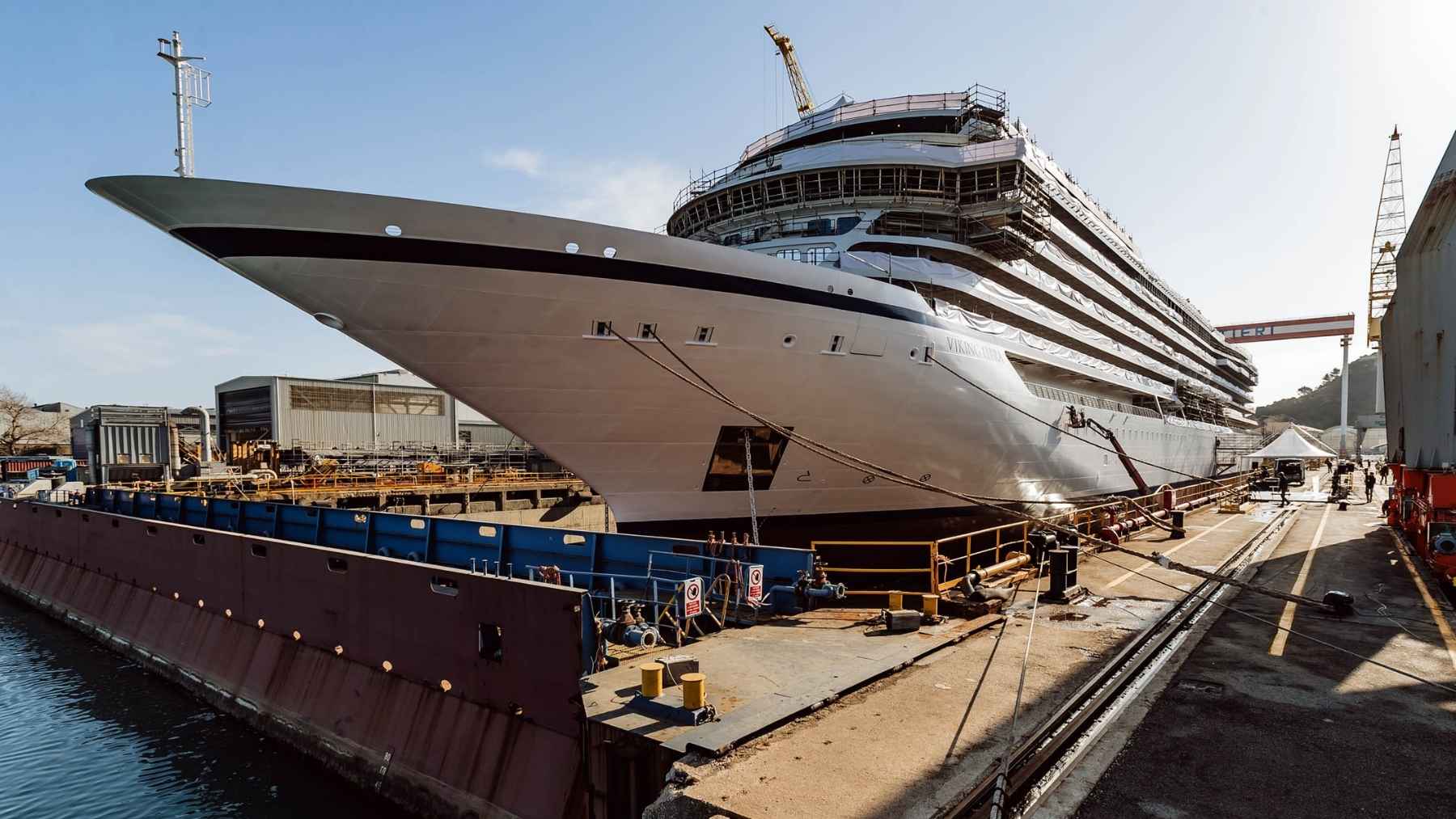
Viking’s attempt at the rest of that problem is sitting at an outfitting dock on Italy’s Adriatic coast right now. The Viking Libra was floated out at Fincantieri’s Ancona shipyard on March 19, and Viking says it will join the fleet in November.
The specs are modest by cruise standards: 239 meters long, roughly 54,300 gross tons, 499 staterooms, 998 guests. What isn’t modest is the fuel. This is the first cruise ship ever built to store liquefied hydrogen on board and run fuel cells on it.
That much got reported everywhere in March. The number that actually tells you what the ship does showed up two months later, on an earnings call, and almost nobody picked it up.
The fuel cells cover about a third of the propulsion
The hydrogen setup on Libra is a bank of proton exchange membrane fuel cells rated at up to six megawatts, built by Isotta Fraschini Motori, a Fincantieri subsidiary in Bari.
Six megawatts is a shade over 8,000 horsepower of generating capacity, which sounds like a lot right up until you remember it’s shifting a 54,300-ton hotel.
On Viking’s first-quarter call on May 14, an analyst asked chairman Torstein Hagen about the unit economics of the propulsion package. His answer contained a figure that has never appeared in a Viking press release: the fuel cells will cover roughly a third of the ship’s propulsion capacity.
The other two thirds are conventional.
Hagen didn’t dress that up, and he didn’t dress up the fuel either, calling hydrogen expensive and not easy to get hold of. He described the ship as “setting a direction of travel for the future of shipping”, which is a more honest framing than most of the coverage gave it.
Viking’s own written language has been careful about this from the start. The float-out announcement describes a propulsion system “based partially on liquefied hydrogen and fuel cells,” and says the ship will be capable of operating with zero emissions rather than doing it all the time.
Those two words, “partially” and “capable,” are carrying the entire claim.
So the accurate version is this: Libra can shut its engines down and run clean for stretches, in the places where that matters most, and then go back to burning what every other ship burns.
Which is still a first, and still worth building. It is not a hydrogen ship in the way an electric car is an electric car.
The hydrogen arrives in a box, because there is nowhere to plug in
The cleverest thing about this project has nothing to do with the fuel cells.
There is essentially no liquid hydrogen bunkering infrastructure at cruise ports. None. You cannot pull alongside in Bergen or Barcelona and take on LH2 the way you take on diesel, because the pipes and the tanks and the trained crews don’t exist yet.
Fincantieri’s workaround is to skip the dockside infrastructure entirely. Libra takes its hydrogen aboard in containers, loaded during port calls, which the shipbuilder has described as a first-of-its-kind solution to get around exactly that supply chain gap.
It’s the same instinct that produced the shipping container in the first place: if the terminal isn’t built, bring the terminal with you. It also means the ship’s clean-running range is capped by how many containers it can carry and how often it can get them refilled, which is not a small caveat.
We have covered the alternative approach, and it’s worth comparing. The Lithuanian port of Klaipėda went the other way with the harbor tanker Rasa, building the hydrogen plant on the dock and letting the ship stay put.
That works beautifully for a 42-meter boat that never leaves the harbor. It does nothing for a ship whose entire business model is going somewhere else.
Nobody has said where the hydrogen comes from
Fuel cells emit water vapor. That is chemistry and it isn’t in dispute. Where the emissions actually live is upstream, in how the hydrogen was made in the first place.
Most industrial hydrogen today comes from steam methane reforming, which means natural gas in one end and CO2 out the other. Green hydrogen made by electrolysis from renewable power exists, costs considerably more, and is not available in the volumes a cruise fleet would need.
As of the float-out in March, the industrial gas trade press noted that Viking had not confirmed where it will source the hydrogen. I haven’t found a supplier announcement since, and Viking hasn’t published one. Until that lands, the ship’s lifecycle emissions are an open question rather than a settled number.
There’s a second piece of context Viking put on the record itself. Every ship in its ocean fleet carries closed-loop scrubbers, president and CEO Leah Talactac told the same May call, and that hardware is what allows the fleet to run on heavy fuel oil.
Fuel came to about 4% of adjusted gross margin last year. That is the fleet Libra is joining.
Norway’s fjord rule doesn’t touch a ship this size until 2032
The commercial logic usually attached to this ship is the Norwegian fjords, and the timeline there is worth getting right, because a lot of coverage has fudged it.
Norway has adopted zero-emission requirements for the five UNESCO World Heritage fjords: Geirangerfjord, Nærøyfjord, Aurlandsfjord, Sunnylvsfjord and Tafjord. Ships must produce no direct CO2 or methane while inside them, and must connect to shore power where compatible facilities exist.
The catch is the threshold. The Norwegian rules took effect on January 1, 2026 for passenger ships under 10,000 gross tons, and don’t reach ships of 10,000 GT and above until January 1, 2032. At 54,300 GT, Libra is arriving six years before the regulation that would force its hand.
Global rules aren’t much closer either.
The IMO’s Net-Zero Framework, which would put a price on shipping emissions for vessels above 5,000 GT, failed to clear adoption in October 2025 and again at MEPC 84 this spring. The next formal attempt is a one-day resumed session penciled in for December 4, three weeks after Libra is due to be handed over.
So Viking is buying compliance nobody is demanding yet, which is either strategic patience or an expensive hedge depending on how the next few votes go.
Fincantieri’s engine shop just fired a cylinder on pure hydrogen
The fuel cell is only half of what Isotta Fraschini is doing with the molecule, and the other half moved this week.
On July 22 the company reported the first firing of a single-cylinder test engine running on 100% hydrogen, developed with UK consultancy Ricardo under Fincantieri’s EU-backed Wave 2 the Future program. Next step is multi-cylinder testing, which is the stage where you find out whether a research engine can become a product.
That matters because a hydrogen internal combustion engine and a hydrogen fuel cell solve different problems. Fuel cells are efficient and silent and expensive. Combustion engines are cheaper, tolerate scruffier fuel, and slot into an engine room the industry already knows how to build.
There is a third route too: an industrial gas turbine cleared to push a ship on 100% hydrogen, type-approved by RINA at Posidonia in June.
Fincantieri is chasing the first two from the same building in Bari.
Everyone else is moving slower. MSC’s World Europa has carried a fuel cell since 2022, but it’s a 150-kilowatt demonstrator running on LNG rather than hydrogen.
MSC’s Explora V and VI, announced in 2022 with liquid hydrogen containment and a six-megawatt fuel cell for hotel load, are due in 2027 and 2028; Fincantieri’s more recent public description of those two ships refers to fuel cells that convert LNG into hydrogen.
Viking’s own Astrea, also hydrogen, follows in 2027.
The pattern across all of it is the same: the hardware is arriving faster than the fuel.
What to actually watch in November
If you want to judge whether this ship delivers on its billing, ignore the christening photos and watch for two specific things.
The first is a hydrogen supply agreement with a named producer and a named color. Green, blue or grey changes the entire emissions story, and until someone signs, the zero-emission claim only describes what happens at the funnel.
The second is how long Libra can actually run on the cells in service, in hours, on a real itinerary.
A third of propulsion capacity and a container-load of LH2 is a real capability with a real limit, and that limit will show up in the operating schedule long before it shows up in a press release.
Compare that to the 114-meter Lürssen superyacht Nausicaä, delivered in May with the space for its methanol fuel cells built in and the fuel cells themselves not installed. Viking has at least put the hardware in the hull. The open question is what it gets fed, and by whom.