
Uranium comes out of the ground. You find a deposit, you drill it or you pump acid through it, and what comes back up gets milled into yellowcake and shipped off to be turned into reactor fuel. That has been the arrangement for as long as anyone has wanted the stuff in quantity.
Every uranium mine in the United States put together managed 1,388,000 pounds of yellowcake last year, according to the Energy Information Administration’s annual production report, published June 23. That was roughly double 2024 and still a small fraction of what American reactors burn.
A startup in Austin now holds a federal license for a process that skips the mine entirely, and it says one facility could out-produce the country’s whole mining industry. Out of seawater.
SuperCritical Materials announced on July 14 that it had licensed a Department of Energy process for extracting uranium dissolved in ordinary ocean water. The company told Reuters its first plant is designed to produce 1.85 million pounds of uranium a year for at least 40 years, enough by its own reckoning to power about four million households.
There is a catch, and it is not a small one. The largest amount of uranium anyone has publicly recovered from seawater and turned into yellowcake with this technology is five grams.
The ocean is the biggest uranium deposit on Earth and the worst grade
Seawater has uranium in it. Not much, but it is genuinely there, at about 3.3 parts per billion, which is the number every paper on this subject opens with because it explains everything else.
Spread across the volume of the ocean, it adds up. SuperCritical’s release puts the total at roughly 4.5 billion metric tons, more than 1,000 times identified reserves on land. PNNL’s own 2018 write-up on the same research said at least four billion tons, about 500 times known land ore. Both are estimates built from a concentration measurement and a volume of water, and nobody is going to go count.
The grade is the problem. A workable uranium ore body runs in the hundreds or thousands of parts per million. Seawater runs at three billionths, so every kilogram of metal you want is dissolved in a quantity of water you would measure in reservoirs.
You cannot pump that. Nobody has seriously proposed processing seawater the way a mill processes ore, because the energy bill for moving the water would eat the uranium several times over. The only approach that ever penciled out is to stop moving the water and let it move past you.
It runs on chemically treated yarn, and waste yarn will do
The licensed technology is an adsorbent manufacturing process, which is a dry way of saying the Energy Department worked out how to make string that uranium sticks to.
The version PNNL developed with a small Idaho company called LCW Supercritical Technologies starts with ordinary acrylic fiber, the same family of material as cheap yarn. Chemists graft a molecule onto it that grabs dissolved uranium ions and holds them. You put the fiber in the sea, leave it for weeks, pull it out, strip the uranium off with a chemical wash, and put the fiber back in.
Chien Wai, then president of LCW, described the material in PNNL’s 2018 announcement as chemically modified inexpensive yarn, selective for uranium, efficient and reusable. He also said waste yarn works as the starting material, which is the single most encouraging sentence in the whole file.
DOE-funded work in this field has centered for years on amidoxime chemistry, and the published literature is blunt about its main weakness: vanadium competes hard for the same binding sites. That is awkward, because vanadium is also one of the valuable metals the fibers pick up. The competitor and the co-product are the same metal.
The lab record is five grams
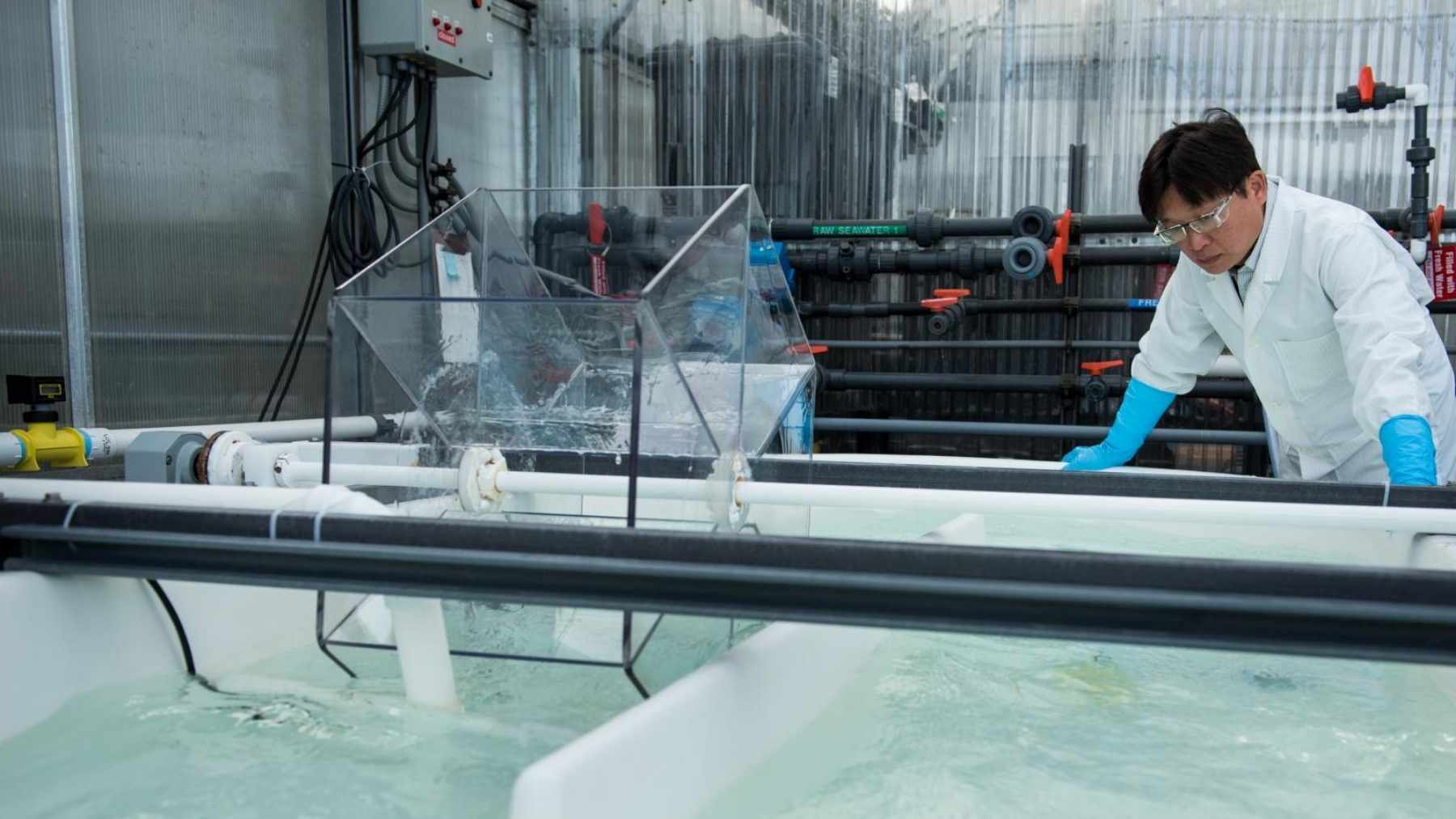
In June 2018, PNNL and LCW announced they had produced five grams of yellowcake from seawater. The lab’s description of the scale is worth repeating exactly: about two pounds of fiber, in a tank roughly the size of a large hot tub, fed with water pumped from Sequim Bay in Washington, for about a month at a time, three times over.
Five grams is what a nickel weighs. Gary Gill, the PNNL researcher who ran that work and whom the company now lists as a co-founder, said at the time that the result indicated the approach could eventually provide commercially attractive fuel from the oceans.
Eventually was doing a lot of work in that sentence, and Gill knew it. Put the 2018 yield and the 1.85 million pound target on the same footing and the gap is roughly 200 million times, with none of the steps in between demonstrated in public.
The American Nuclear Society, which covered the license on July 23, reported that SuperCritical has not announced a timeline to commercial deployment, a current production capacity, or how the fibers would be deployed at sea. It also flagged that the corporate relationship between LCW and SuperCritical, which says it was founded in 2024, has not been explained publicly. Wai is on the technical team and Gill is attached to the company. The paperwork between the two firms is not public.
The word “exclusive” went missing a day later
Here is a detail worth having straight. The release that went out July 14 said SuperCritical had secured an exclusive license and exclusive rights, and it carried a supportive quote from Ted Garrish, the Assistant Secretary of Nuclear Energy, who said seawater extraction had been demonstrated at lab scale and that DOE had invested in proving the process works.
An updated version filed the next day says the company secured a license, and that it was granted rights. The word exclusive is gone from both places, and so is the Garrish quote. Neither release explains the change.
Reuters, Mining.com and The Northern Miner all reported an exclusive license, working from the first version. The ANS write-up nine days later calls it a license. None of that means anything went wrong, and an exclusive field-of-use license is a normal thing for a lab to grant. It does mean the scope of what was signed is less pinned down than the coverage suggests.
Texas first, thirteen agencies, no final investment decision
The commercial plan, as the company laid it out to Reuters on July 15, is to deploy first in Texas and work through 13 regulatory agencies to get there, including the Texas Commission on Environmental Quality, the Texas Railroad Commission and the US Coast Guard.
SuperCritical has raised $4.5 million privately, says it wants to be trading on Nasdaq this year, and has not made a final investment decision on the plant. It says uranium could start flowing as soon as 2030 or 2031. CEO Alexander Canon Bryan told Reuters the long-term goal is to turn the US from a net importer of uranium and nuclear fuels into a net exporter.
That is a long way from where things stand. Reuters reports the US imports up to 75% of the enriched uranium its reactors run on, from a list that includes Russia, France and Germany. Russian material has been banned since August 2024 under the Prohibiting Russian Uranium Imports Act, and the waivers keeping some of it flowing expire January 1, 2028.
Domestic supply is climbing off a very low base. Uranium industry employment hit 711 full-time person-years in 2025, up 41% and the highest since 2014, and drilling was the busiest since 2013. All of that produced 1,388,000 pounds.
Nobody has published a cost that works
One number needs care before the comparison lands. Reuters is quoting 1.85 million pounds of uranium metal, while the EIA counts pounds of U3O8 concentrate, which is roughly 85% uranium by weight. Convert either one and the answer holds: the target is about half again as much uranium as every American mine produced in 2025.
It is also about 4% of what US reactor operators bought in 2024, which is the more useful way to read it. Meaningful domestic supply, not an independence button.
The economics are where seawater uranium has died every previous time, and the numbers are not close. The last major academic review of the field, published by Harry Lindner and Erich Schneider in Energy Economics in 2015, put production costs at $400 to $1,000 per kilogram of uranium. Spot at the time sat at or below $100 per kilogram.
Uranium has climbed a long way since. It has been trading around $86 a pound of U3O8 this week, which works out to roughly $224 per kilogram of contained uranium, and TradeTech’s long-term contract indicator reached $93 a pound at the end of March.
The cheapest end of that published range is still about double what the metal fetches, and the top end is more than four times it. Adsorbent capacity, how many cycles a fiber survives before it degrades, and how much uranium each cycle captures are the variables that decide whether the gap closes. SuperCritical has published none of them.
The Northern Miner, reporting the license, noted that skeptics think commercial seawater production could still be decades away, and that the low grade makes processing a serious problem. That has been the consensus for 40 years, and one press release does not move it.
The reactors are getting built. The fuel is the hold-up
The timing is not random. American developers have spent the past year proving the machines work, including three separate microreactors going critical in a single month this summer, and the bottleneck has moved upstream to fuel.
The entire supply of American-made advanced reactor fuel currently comes out of sixteen centrifuges in one hall in Piketon, Ohio, about 900 kilograms a year, against reactors that each need 15 to 20 tons for a first core. You can build all the reactors you like and still have nothing to load into them.
Seawater uranium would not fix the enrichment half of that. Anything SuperCritical pulls out of the water still has to be converted to gas, enriched and fabricated into fuel by the same short list of facilities. What it would change is where the raw metal starts out, and whether the US keeps buying it from Kazakhstan.
Which is a familiar shape. It is the same story as the helium-3 sitting in that Minnesota gas well: a remarkable measurement, an obvious strategic use, and an unproven path from one to the other.
The license is real and the chemistry is real. The 1.85 million pounds is a spreadsheet. Whether uranium can be pulled out of seawater got settled in a hot tub in Sequim eight years ago, and it is the only part of this that has been settled. The rest is whether it can be done for less than the price of buying it, at 200 million times the scale, in front of 13 Texas agencies, with money the company has not raised yet.
 @johndeptuch ROOKIE1 month ago