
Want to take a stealth bomber to your next trip to Tokyo? That will likely never happen, but Japan Airlines is backing something very, very close.
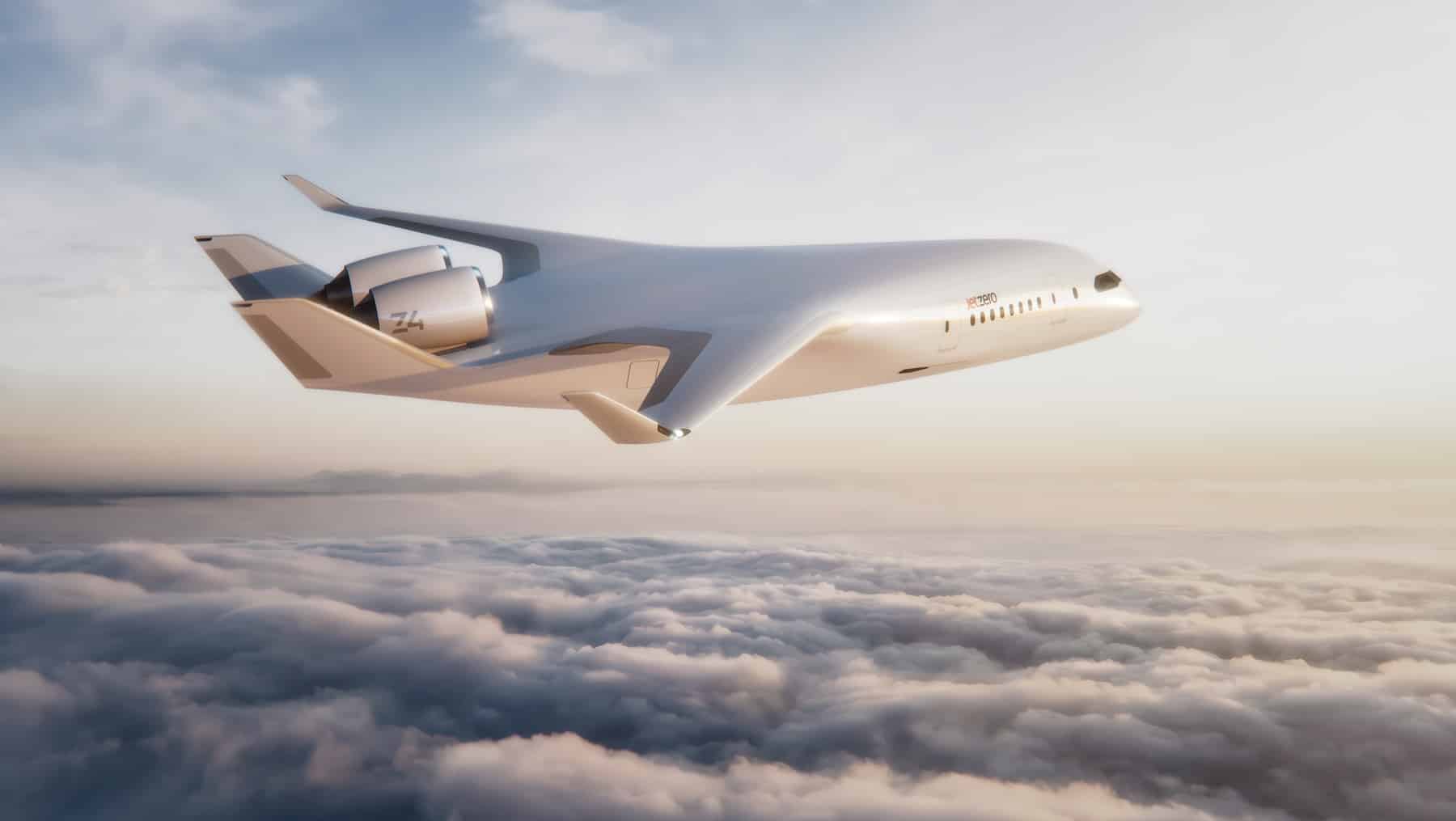
At the Farnborough Air Show on July 21, JAL announced its support for JetZero’s Z4 program, a manta-ray-shaped passenger jet with no tube fuselage at all. The goal isn’t to look completely badass, as you’d initially assume by looking at it. It’s about extreme fuel efficiency.
And the timing is not a coincidence. Airlines are getting absolutely hammered at the pump right now.
How the JetZero Z4 could change how we fly
The Z4 is designed to carry 250 passengers up to 5,000 nautical miles, roughly Tokyo to the northern US West Coast, while targeting a 30 to 50% fuel efficiency improvement over aircraft flying today.
It pulls that off with a blended wing body, or BWB, where the wings and fuselage merge into one continuous shape. Instead of a tube that just gets dragged along, the entire aircraft generates lift. Less drag, less thrust needed, less fuel burned.
JetZero is aiming at the “middle of the market” that Boeing’s 757 and 767 used to own, and nobody has properly replaced. The cabin is the fun part: wide and flat instead of a tube, which opens the door to seating layouts, galleys and lavatories that simply can’t exist on a conventional plane. The engines sit on top of the rear fuselage, so the airframe itself blocks a chunk of the noise from reaching the ground.
JAL and JetZero will now work together on flight operations, cabin layout, maintenance and ground handling, and JAL has joined JetZero’s airline advisory group alongside Gulf Air, per Aviation Week.
“Collaborating with JetZero on the Z4 aligns perfectly with our commitment to sustainable innovation,” said Takao Suzuki, Executive Officer for Corporate Strategy at Japan Airlines, tying the move to the carrier’s net-zero-by-2050 target.
One clarification, because this matters: JAL did not order anything. This is support, input and a seat at the design table, not a purchase.
Small detail: this plane has never flown
Before anyone books a window seat, let’s be clear about where this actually stands. The Z4 does not exist. Not as a prototype, not as a flying test article, nothing.
What exists is a full-scale demonstrator called Jet1, being assembled right now in a hangar in California’s Mojave Desert by Scaled Composites, the Northrop Grumman subsidiary, under a $235 million US Air Force contract. First flight is targeted for late 2027.
And that demonstrator isn’t a passenger plane either. Only the cockpit gets pressurized. The fuel tanks sit where the passengers would go. Its entire job is to prove the shape actually produces the lift and drag numbers the computers promise.
My favorite detail from the build: the wing is so wide that no existing curing oven can fit it, so they’re constructing a temporary oven around the wing itself. That’s the level of “nobody has done this before” we’re dealing with.
JetZero has also been flying a one-eighth scale version called Pathfinder out of Edwards Air Force Base since 2024 to validate the control laws. Engine choice for the actual production Z4 is still open, with a decision expected within a year, per Aviation Week. The demonstrator borrows Pratt & Whitney PW2000s, the same engines that pushed around Boeing 757s.
Why airlines are lining up for a plane that doesn’t exist
Because the fuel math right now is brutal.
Airlines will spend an extra $100 billion on jet fuel in 2026, IATA director general Willie Walsh warned at the industry’s annual meeting in Rio de Janeiro in June. Average jet fuel prices are running about 70% higher than last year after the Middle East conflict sent oil surging, pushing the global fuel bill from $252 billion to roughly $350 billion.
Industry profits are getting cut roughly in half, from $45 billion to $23 billion. And the damage is already showing up in earnings. Alaska Airlines posted a $1.3 billion fuel bill last quarter, up 85%, and lost nearly $500 million in the first half. United is trimming about 5% of planned flights.
Guess who ends up paying for that. US fares are already running about 27% higher after eight straight months of increases, per Forbes. A lot of American families were priced out of travel before this started.
So when a startup shows up promising to cut fuel burn per seat by up to half, airlines don’t laugh. They send engineers.
JetZero has passed $1 billion in total investment and commitments, with money from United Airlines Ventures, RTX Ventures, Northrop Grumman and Alaska. United has a conditional agreement covering up to 200 aircraft, contingent on that demonstrator actually flying in 2027. In June, JetZero broke ground on an eight-million-square-foot assembly plant in North Carolina.
The part where I stay skeptical
Aerospace analyst Richard Aboulafia of AeroDynamic Advisory has noted that JetZero has surprised a lot of people in the industry, while facing two enormous hurdles: proving the efficiency gains are real, then raising the money to actually certify and build the thing. Clean-sheet airliners routinely run late, and this one is a startup taking on Airbus and Boeing with a shape nobody has ever certified for passengers.
There’s also a competitor. San Diego’s Natilus is developing its own blended wing airliner, the Horizon, so “world’s first” is still a race, not a title.
Still, if the efficiency holds up, lower cost per seat is exactly the kind of thing that could eventually take some pressure off ticket prices. Emphasis on eventually. Even in the best case, you’re boarding one of these in the 2030s.
So we’ve got a manta-ray-shaped jet, a custom-built oven in the Mojave, a Japanese flag carrier at the design table, and a fuel crisis making all of it urgent. Would you fly in a plane with no windows down the sides and a cabin shaped like a stealth bomber, or does that sound like a middle seat with extra steps?