
Every solar farm you have driven past looks about the same from the road. Rows of dark panels tilted up at the sky, angled south, all of them waiting on noon.
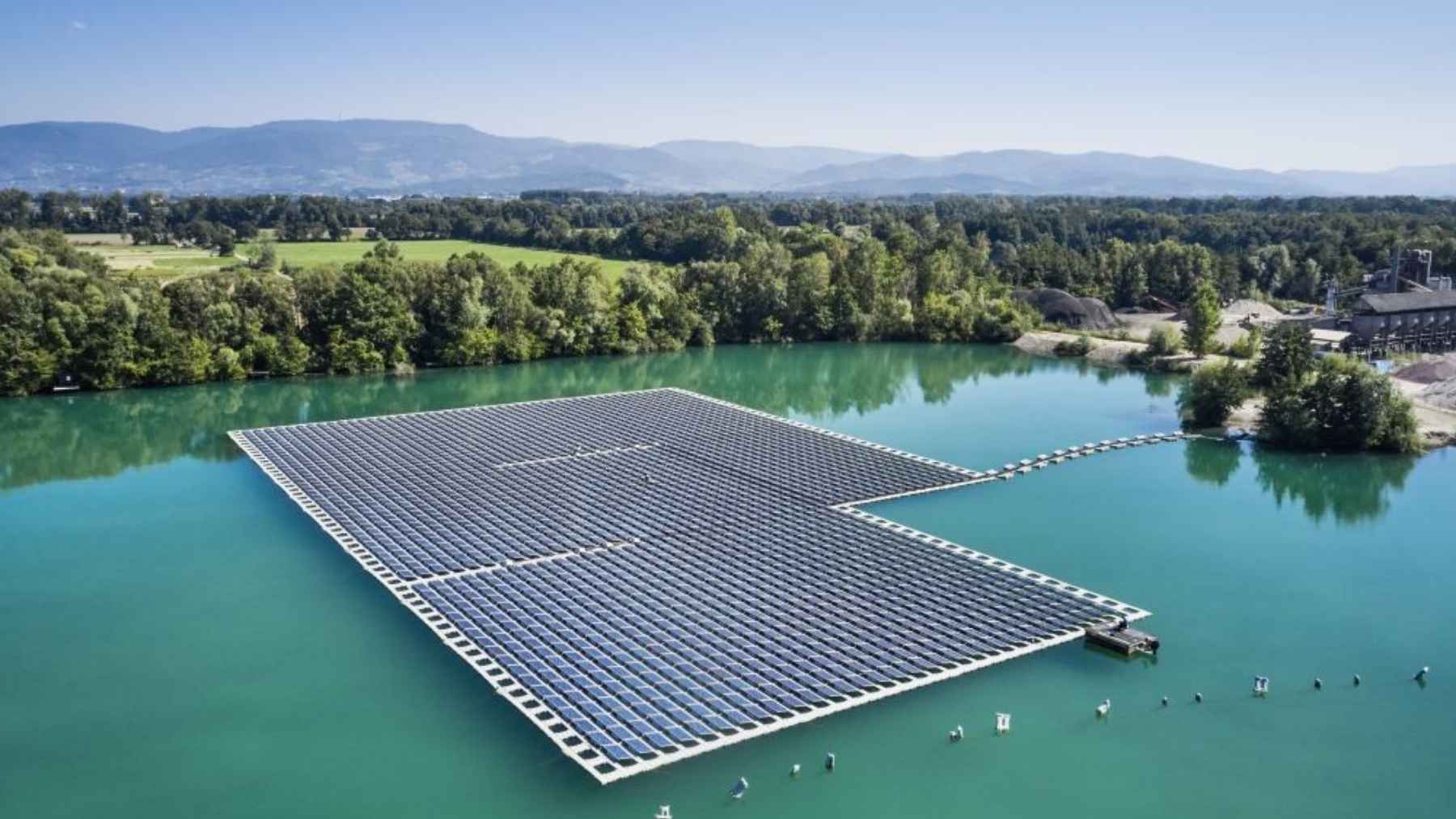
On a gravel lake southwest of Munich there are 2,600 panels standing dead upright instead. Edge-on to the sun, facing east and west in long rows, like somebody fenced the water in glass.
That is not a mounting shortcut or an unfinished job. It is the whole design, and the reason for it starts with a German law about how much of a lake you are allowed to keep in the shade.
The site is a working gravel pit at Gilching, in Bavaria’s Starnberg district. The builder is SINN Power, an engineering company based a few miles up the road in Gauting. The array went live on the grid on August 21 last year and had its ribbon cut on October 10, with Bavaria’s Minister-President Markus Söder taken out on a boat to look at it.
Rated capacity is 1.87 megawatts, good for roughly 2 gigawatt-hours a year. That is a small plant, and the claim being made is not about size. SINN Power calls it the world’s first vertical floating solar plant, and Germany’s Federal Ministry for Economic Affairs and Energy has used the same wording in its own energy transition newsletter. pv magazine, which has followed the project since it was announced in April 2024, hedged differently and called it the largest floating plant with vertically mounted panels.
The outfit running it sells crushed rock
The lake belongs to Kies- und Quetschwerk Jais, the gravel and crushing business that dug the hole the water sits in. Its managing director, Gottfried Jais, is a co-investor in the plant, and most of the electricity never leaves the property.
That matters more than it sounds. A gravel works runs crushers, conveyors and pumps, and it runs them in daylight, on weekdays, roughly March through December. Jais told pv magazine the arrangement “does not require any land and adapts perfectly to our production plant.”
So the customer is standing on the shore. No transmission fight, no land lease, no farmer to talk round. The company that owns the water owns the power station and burns most of what it makes.
A vertical panel on open water is a sail
The engineering problem here is a good one. Lay a panel flat on a float and the wind mostly slides over the top of it. Stand it up and you have built a sail on a lake, which is an efficient way to lose a solar farm in a spring storm.
SINN Power’s answer, patented as SKipp, was to stop resisting. Each float carries a keel-like structure hanging up to 5.2 feet (1.6 meters) below the surface, weighted with concrete at the bottom, and the modules are held upright against a cable system rather than a rigid steel frame.
When the wind loads up, the rows lean. pv magazine describes the mounting as built so the modules deflect under load through those cables, shedding wind resistance instead of absorbing it, while the submerged section holds the array steady as the lake level moves.
The rows also sit at least 13 feet (4 meters) apart in open water corridors. That gap does three jobs at once: it lets wind through, it stops one row shading the next, and it leaves the water underneath open to light and air. Austria took the opposite route with the same basic instinct, planting 800 vertical solar crosses on a glacier shaped so the wind scours snow away from them.
None of this arrived untested. SINN Power had been running a smaller vertical pilot at Baden-Baden for more than 18 months before Gilching went in the water.
German law lets you shade 15 percent of a lake and not an inch more
Since January 1, 2023, German water law has permitted floating solar only on artificial or heavily modified water bodies, and it caps any installation at 15 percent of the surface with a minimum 40-meter setback from the bank. The rule lives in section 36 of the Federal Water Resources Act and was written on ecological grounds.
For a flat array that ceiling is brutal arithmetic. Panels lying down cover exactly the area they occupy, so 15 percent of the lake is 15 percent of the possible plant, and that is the end of the conversation.
Stand them up and the shadow gets thin. Gilching covers 4.65 percent of the water. Even with a second phase already drawn up, another 1.7 megawatts, SINN Power says both stages together will stay under 10 percent.
There is a live legal question sitting underneath all of it. Lawyers at the German firm ARQIS have argued that for vertical systems the 15 percent should be measured against the water actually covered rather than the full project footprint, and noted that no German authority or court has ever defined what “cover” means in this context. The Bundesrat asked the federal government to revisit the rule in a resolution passed in September 2025. It has not been changed.
Noon has become the worst hour to sell electricity in Germany
The east-west trick is not only about squeezing past the water rule. It moves when the power arrives.
Panels aimed east and west make less at midday than a south-facing array and more in the morning and evening. In a country carrying roughly 117 gigawatts of solar, that is where the value went.
Germany logged 573 hours of negative day-ahead power prices in 2025, a record, according to Bundesnetzagentur figures, and they bunch up in sunny midday windows when everybody’s panels produce at the same moment. On May 1 this year the German day-ahead price hit the market floor of minus €499.99 per megawatt-hour.
Philipp Sinn, SINN Power’s founder and chief executive, introduced the plant at the opening as “a photovoltaic system that produces electricity when conventional power plants are standing still.” Turn that around and it says the same thing: it produces when everyone else’s solar has already flooded the market.
The federal economy ministry puts the commercially viable floating solar potential on Germany’s artificial lakes at 1.8 gigawatts with south-facing modules and 2.5 gigawatts with east-west ones. Same lakes, same 15 percent rule. Turning the panels sideways is worth about 700 megawatts on its own. Fraunhofer ISE and RWE count 6,043 artificial lakes of at least one hectare in Germany, and roughly 70 percent of them are gravel pits.
The performance numbers are the company’s, and they do not quite agree
SINN Power’s October announcement said the gravel works had cut its grid electricity purchases by close to 60 percent in early operation, with up to 70 percent expected once things settled down. The write-up the company published in November said grid draw fell 70 percent across the first three weeks, a stretch in which the plant made more than 100 megawatt-hours in autumn weather.
Both are self-consumption figures, and it is worth being precise about that. Neither is a panel efficiency number, neither has been independently audited, and the 70 percent describes how much less power the gravel works buys, not how well the panels convert sunlight.
The ecological claims are the company’s as well. SINN Power reports waterfowl nesting on the floats, fish gathering around the concrete ballast where algae form on it, and monitoring buoys showing water quality holding or improving. Independent work on this question does exist elsewhere: a Dutch quarry lake study counted fish and invertebrates under a flat array and found more life than the critics predicted. Nobody outside the company has published on this particular lake.
Nine months in, the delegations started showing up
The freshest thing about the plant is who has been standing on the bank looking at it.
During Intersolar Europe in Munich, June 23 to 25 this year, SINN Power skipped the usual booth routine and drove visitors 20 miles west to the water instead. The company says groups from India, Taiwan, China, Israel and Turkey came out to see it running.
That is the real test of a format record rather than a size record. A 1.87-megawatt plant does not move a national grid. A 1.87-megawatt plant that a Taiwanese delegation flies in to inspect might change what gets built on the next few thousand lakes.
American reservoirs are the version of this argument with the volume turned up. A federal NREL assessment published in February mapped floating solar potential on US federally regulated reservoirs large enough to power tens of millions of homes, on water that already has substations and transmission rights attached. The United States has no 15 percent coverage statute forcing anyone to stand panels on edge. Germany’s constraint is what produced the design.
The second Gilching phase is still in planning. The water rule is still on the books, still undefined for vertical hardware. SINN Power has meanwhile taken the same structural idea to sea, dropping a platform called SOcean into open water off Heraklion, Crete, on May 27 for a multi-month endurance run under a German federal research programme, carrying solar modules and wave energy hardware together.
Whether any of it scales depends on a sentence in German water law that nobody has yet defined. What is already settled is smaller and harder to argue with. The gravel company’s power bill went down, the lake is still a lake, and 2,600 panels have now stood through a Bavarian winter standing straight up.
 @tricia ROOKIE3 months ago