
Hydrogen-powered trains aren’t exactly a new idea. Germany has been running them since 2018, France has dipped a toe in, Japan ran a fare-paying test on the Tsurumi Line in 2022, and a hydrogen commuter train called Arrow started revenue service in Southern California last September. So when India announces its first hydrogen train has been cleared for commercial rollout, the headline isn’t really “another country joins the hydrogen rail club.” It’s the scale of the thing. According to Fuel Cells Works, India’s Railway Board has formally approved a 10-coach hydrogen fuel cell train-set for the Jind-Sonipat section in Haryana, on a platform that Railway Minister Ashwini Vaishnaw has been calling the longest and most powerful hydrogen train ever built on broad gauge.
The pilot route is short. The hardware is not. And the supporting infrastructure, including a 3,000 kg green hydrogen plant at Jind, is being built around it rather than borrowed from anyone else. That last part is the bit worth paying attention to.
What’s actually been built
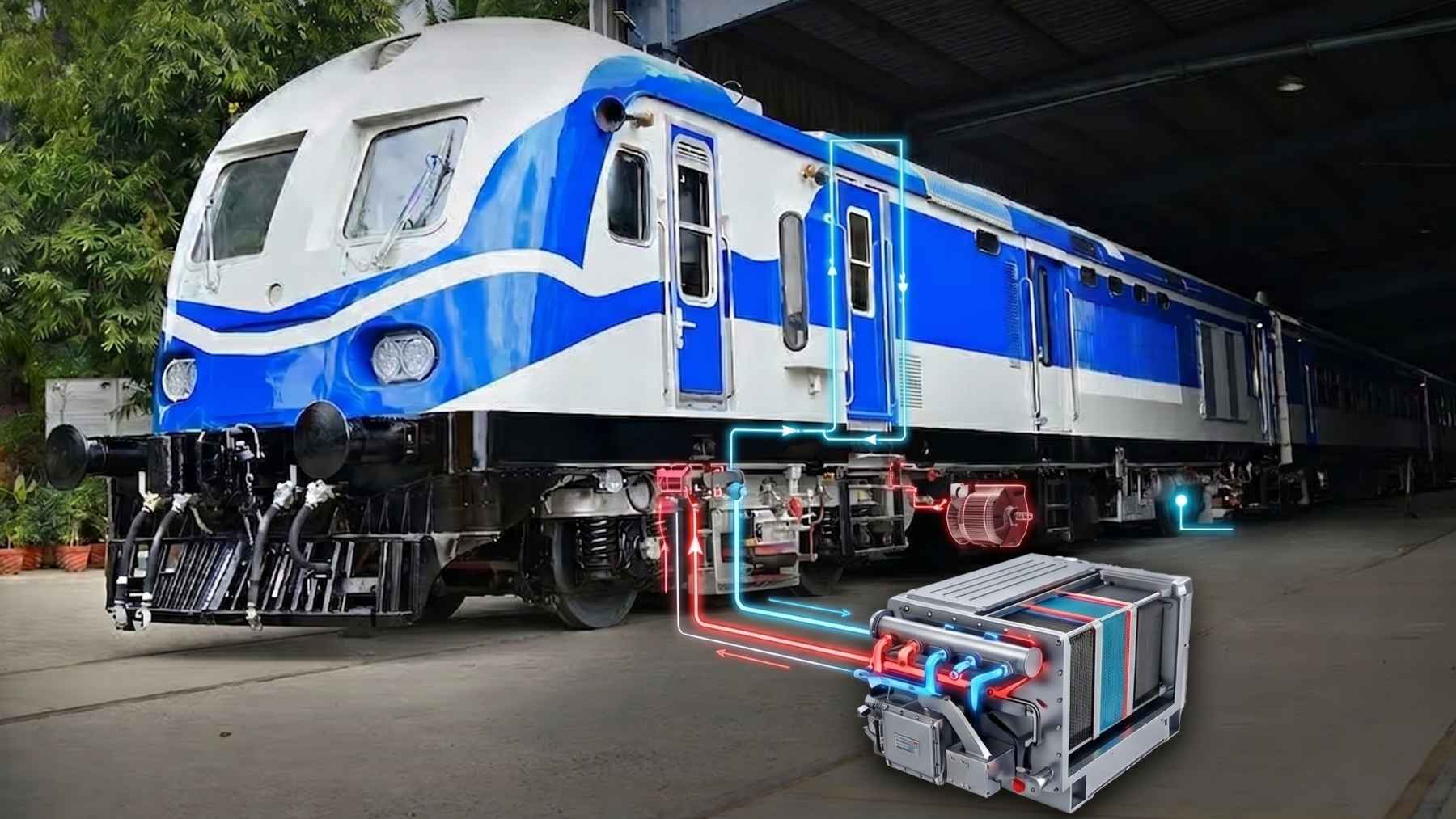
The train-set is 10 coaches long. Two of those are Driving Power Cars (DPCs) rated at 1,200 kW each, which combined push the total output to 2,400 kW. The other eight are passenger coaches. According to a May 22 circular from the Ministry of Railways, the trainset will operate at a maximum speed of 75 km/h on the Jind-Sonipat corridor — a deliberately conservative ceiling for a pilot service, well below the 140 km/h Germany’s Coradia iLint can hit on its regional lines, and a reminder that this is a non-electrified branch line, not an inter-city express.
The Research, Design & Standards Organisation (RDSO) completed an oscillation trial of the train-set back in March, running it for around 20 km at 70 km/h to validate behavior at speed. The new circular green-lights the move from trial to commissioning. The Petroleum and Explosives Safety Organization has also issued the licence required to store and dispense compressed hydrogen at the Jind site, with safety sensors — hydrogen leak detectors and flame detectors at the production, storage, and refuelling points — set to be inspected on a regular schedule.
For context, the Coradia iLint, the train that effectively kicked off the modern hydrogen rail era, uses two-car sets. India’s version is five times longer per train-set, which is why Vaishnaw has been calling it the world’s longest hydrogen train on broad gauge. The emissions story is the straightforward part: hydrogen fuel cell trains combine hydrogen with oxygen to generate electricity, and the only thing coming out the other end is water vapor. No carbon dioxide, no particulates, no diesel soot. Which matters more on a non-electrified branch line than it does on a metro corridor, because the alternative on those routes is almost always a diesel locomotive.
Why Jind to Sonipat
The route choice isn’t accidental. Jind and Sonipat are both in Haryana, and the section sits under Northern Railway. It’s short enough to be manageable for a pilot, long enough to stress-test the range, and the surrounding infrastructure is being built specifically to support it.
The hydrogen will come from a green hydrogen plant being built at Jind itself. The plant uses electrolysis — running electricity through water to split out hydrogen and oxygen — and has a storage capacity of 3,000 kg. It’s been wired up with a steady 11 kV supply for both train commissioning and daily operation, and is in its final commissioning stage.
That’s the “green” part of green hydrogen, assuming the electricity feeding the electrolyzer is itself renewable. If it’s pulled from a grid that’s mostly coal, the whole sustainability argument gets muddier. Indian Railways hasn’t publicly broken down the energy mix powering the Jind electrolyzer, which is a question that will become more relevant once the train is actually running.
The Haryana government has been monitoring progress closely. Haryana Chief Secretary Anurag Rastogi reviewed readiness back in January in a meeting with officials from Dakshin Haryana Bijli Vitran Nigam (DHBVN), and instructed them to set up periodic reviews of the power supply network and backup systems. Which tells you the state is treating the power side as a single point of failure, because it is.
The Atmanirbhar Bharat angle
This isn’t a project where Indian Railways bought a hydrogen train off a European supplier and stuck it on a domestic route. The whole development cycle, from initial design through prototype fabrication to the actual hydrogen traction technology, was done in India. The train-set was built at the Integral Coach Factory in Chennai, the specifications were framed by RDSO, and the operation and maintenance manuals — for the train and the hydrogen plant alike — are now approved by the same body.
The political framing is Atmanirbhar Bharat — Self-Reliant India — the government’s broader push for indigenous manufacturing across strategic sectors. Hydrogen traction is a useful flagship for that because the alternative would have been licensing the tech from Alstom, Siemens, or one of the Chinese state-owned manufacturers. India chose to do it in-house. Whether that decision pays off depends on whether the pilot actually works and whether the cost numbers eventually come together.
On that second point, officials have been careful. Vaishnaw told the Lok Sabha that since the train-set and its infrastructure have been developed on a pilot basis, comparing the cost of hydrogen-fuelled trains to existing traction systems “at this stage would not be fair.” That’s diplomatic phrasing for “it’s going to be expensive per kilometer right now and we’d rather not get into the math yet.”
How this fits the global hydrogen rail picture
Hydrogen rail has had a complicated run elsewhere. Germany’s Lower Saxony, which deployed 14 Coradia iLint units on the Elbe-Weser network, pulled most of those trains out of service in late 2024, and German regional operators have signaled future orders will lean battery-electric instead. France has been moving slower than initially planned. Japan’s FV-E991 hydrogen train began fare-paying tests on the Tsurumi Line back in 2022 but hasn’t scaled. China’s hydrogen passenger train, developed by CRRC, has been running test operations but hasn’t moved into volume production either.
The pattern across these markets is the same: hydrogen trains work as a technology, but the operating economics are tough against battery-electric alternatives on most routes — and the supplier base is wobbling. Cummins just sold its fuel cell business after $657 million in losses, including the unit that made the stacks for the Coradia iLint. India’s pilot is essentially the country saying it wants to figure all of that out for itself, on its own hardware, on a route where the alternative isn’t an electric train but a diesel one.
For Indian Railways, which is in the middle of a huge electrification push, hydrogen is more of a complementary tool than a replacement strategy. Non-electrified branch lines, hilly sections where overhead wires are awkward, and routes where ridership doesn’t justify the capital cost of full electrification — those are the use cases where hydrogen makes sense. The Jind-Sonipat pilot is the testbed for figuring out whether it can deliver on any of that, and there’s a broader plan behind it: Indian Railways has been moving toward a tender for a fleet of 35 hydrogen-fuelled trains, with a budget on the order of ₹2,800 crore.
What to watch from here
The first commercial run is the immediate thing. Beyond that, the numbers that actually matter are the ones Vaishnaw has so far declined to share: the cost per kilometer, the realistic range under loaded passenger conditions, the refuelling time, and the availability rate once the train is in regular service rather than commissioning. The 3,000 kg storage capacity at Jind is enough to keep one train fed with comfortable margin on a short corridor. Scaling that to a fleet of 35 would mean significantly more electrolyzer capacity and a steadier renewable power supply, neither of which is trivial. But that’s a problem for the next phase. This phase is about getting a 10-coach hydrogen train, built entirely in India, to complete a short run in Haryana without anything embarrassing happening. If it pulls that off, the conversation about the rest can actually start.
 @madhurkaicker ROOKIE5 months ago