
High-speed rail usually crosses a big river the obvious way, on a bridge. You see the piers, the deck, the trains rolling over the top. A bridge is cheaper and simpler than carving a hole under a riverbed, so that is almost always the pick.
The Yangtze made that a harder call. Near its mouth it is one of the busiest shipping waterways in China, and dropping bridge piers into that traffic was a fight the engineers decided to skip. They pointed a machine straight down instead, under the water, to grind a rail tunnel through the mud.
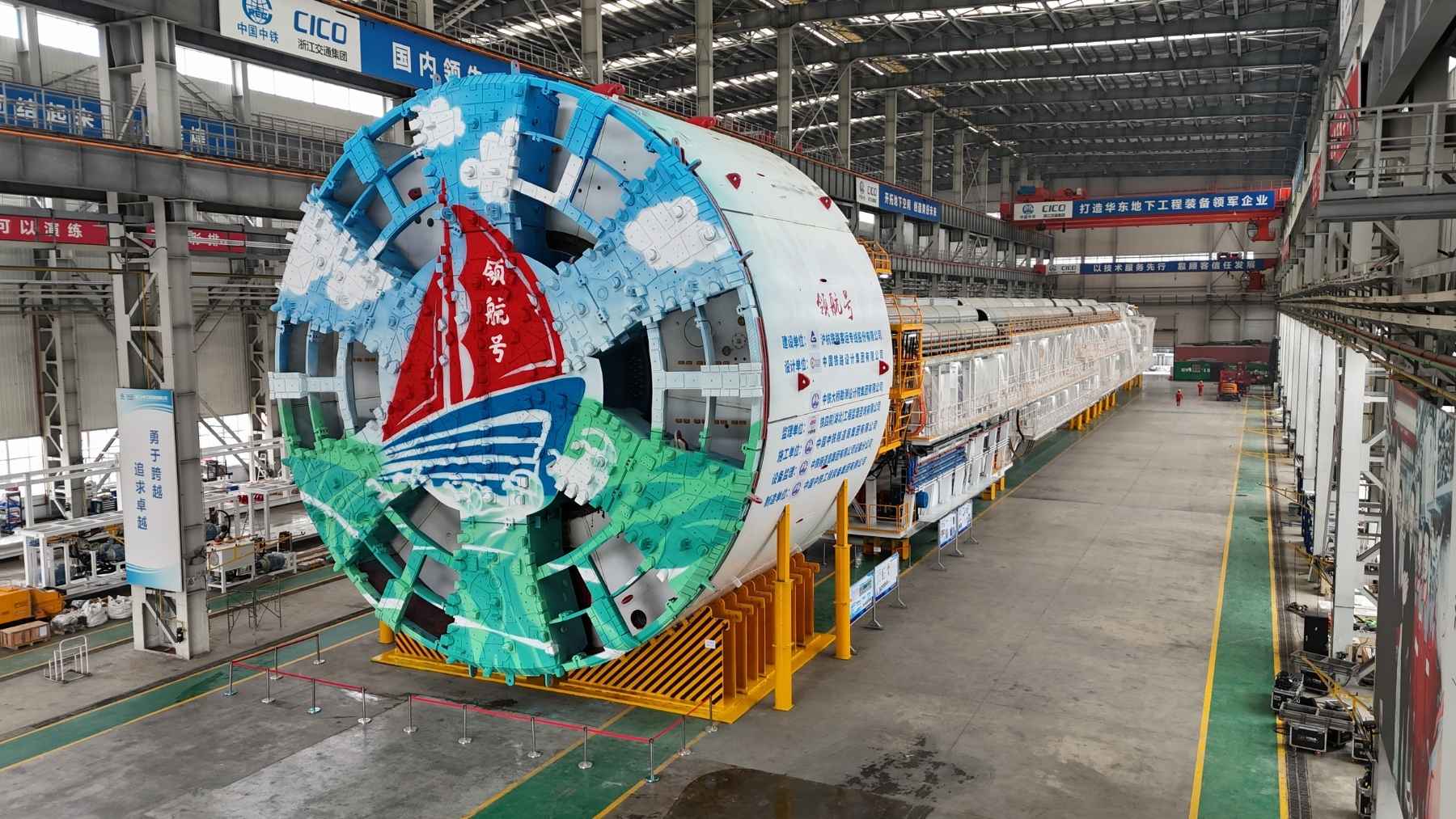
That machine is called Linghang, and China built it at home rather than buying one from abroad. On March 29, 2026, after 23 months underground, it finished the worst part of the job: an 11,182-meter run beneath the Yangtze in one continuous drive, no stops, surfacing on the far bank near Taicang in Jiangsu province. People’s Daily reported the breakthrough.
China built the machine instead of importing one
Linghang is, by the count of its builders, the world’s largest-diameter shield machine ever made for a high-speed rail tunnel. The qualifier matters, because bigger tunneling machines exist for highways and metros. For a line built to run trains at full speed, this is the widest cutterhead anyone has turned.
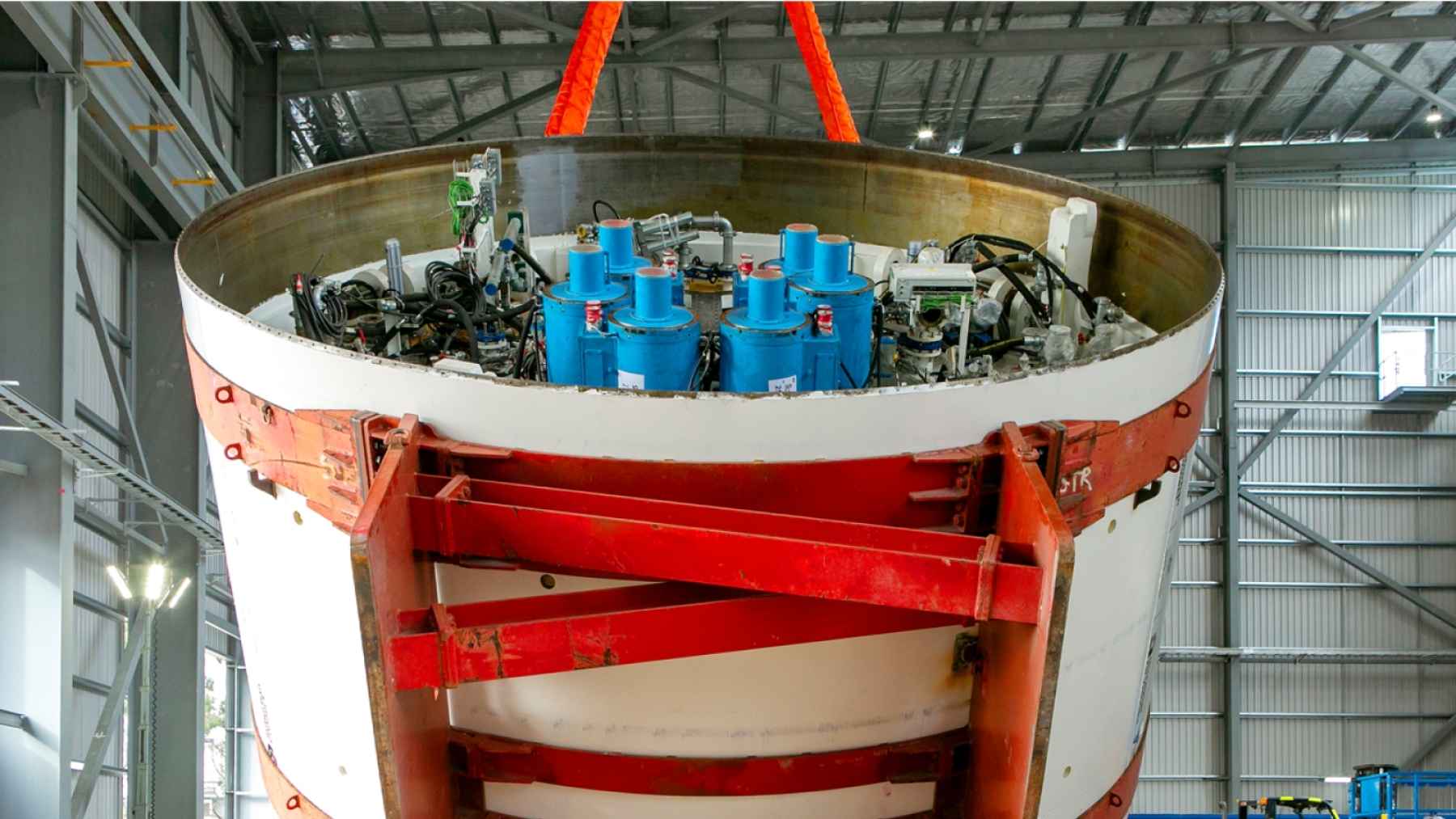
The specs are the kind you read twice. The cutting wheel is 15.4 meters across, about 50 feet, roughly the height of a five-story building. The machine and its trailing gantries stretch about 148 meters, close to 485 feet. It weighs somewhere around 4,000 metric tons.
It was built by China Railway Engineering Equipment Group, the Zhengzhou manufacturer that now ships this class of machine abroad. A decade ago China was still importing them. It rolled out its first home-grown 15-meter-class borer in 2017, breaking a long foreign monopoly, and this year sent a 15.7-meter machine to Australia, the biggest it has ever exported.
Eleven kilometers under the river, no stops
The bore itself is the headline. Linghang started digging on April 29, 2024, and ran for 23 straight months to reach the southern embankment of the Yangtze. The 11,182 meters it covered under the water came in a single uninterrupted drive.
According to Global Times, that makes it the first 15-meter-class machine anywhere to bore past 11,000 meters in one continuous run. Smaller machines have gone farther in a single drive. Nothing this wide had done it.
At its deepest the tunnel sits about 89 meters below the river, close to 292 feet, which the project team calls the deepest point ever dug under the Yangtze. Reaching Taicang does not retire the machine, though. It still has to nose its way into a maintenance station at Shaft No. 2 before the tunnel can be closed out.
The conditions down there were the real test. Engineers had to push across the river’s full width against extreme water pressure, through the loose, shifting geology of the Yangtze riverbed. That is exactly the kind of ground that can stop a machine cold if the pressure at the cutting face gets read wrong.
A bridge would have been easier
None of this is the cheap way to cross a river, and the people who built it know that. The tunnel exists because the surface was spoken for. The Yangtze near the estuary carries too many ships to thread a high-speed bridge through, so the trains go under.
The payoff is speed. The tunnel is designed for 350 km/h, roughly 217 mph, which means trains will not slow down to cross the river at all. Holding that speed underground is a precision problem. “At a speed of 350 km/h, the required precision is within the millimeter range,” Wang Yi, the project’s deputy equipment manager, told ThePaper.cn.
Other countries make the opposite call. Norway skips the giant machines and blasts its tunnels by hand, arguing it is cheaper through hard rock. New Jersey has a pair of German-built borers sitting in a trench across from Manhattan, shipped over in pieces. China built its own and pointed it under one of its busiest rivers.
The thing mostly drives itself
What separates Linghang from a plain steel drum is the software. It runs on a control system the project calls I-TBM, and for long stretches it bores without anyone at the face, guided remotely from the surface.
The setup leans on a full digital twin of the dig, a live software model that tracks pressure, advance rate and spoil removal and flags trouble before it turns into trouble. CGTN reported the machine also carries a high water-pressure sealing system to hold back the river at depth.
The project team says nine separate intelligent systems handle sensing, design, construction and management, which is how a machine this size bores with nobody standing inside it. That is the genuinely new part. The scale is impressive; the automation is the piece that was not possible a few years ago.
It isn’t the only record-setter down there
Linghang has company under the Yangtze. An even bigger machine, the Jianghai, is grinding out a six-lane road tunnel under the same river. A separate vertical shaft borer, CREC Qiming, was lowered in from Shaft No. 2 to sink the access shaft, one machine going sideways and one going down on the same project.
The full 14.25-kilometer tunnel is meant to be bored through by late 2026, according to China Daily. It is the eastern end of the Shanghai-Chongqing-Chengdu high-speed line, a backbone route in China’s “eight vertical and eight horizontal” rail grid, with a reported total investment near 500 billion yuan, about $72.8 billion, per Chinese state media.
There was plenty to avoid overhead, too. Chongming is treated as a world-class ecological island, and the route runs beneath a national fish-conservation zone, which is part of why the crossing goes deep and stays sealed instead of disturbing the surface.
For the people who will actually ride it, the tunnel does something specific. Chongming, the big island at the mouth of the river, has never had a high-speed connection. Once the line opens, state media says the trip from Chongming to Shanghai’s Baoshan station drops to about 17 minutes, with faster links on to Nanjing and Hefei behind it.
The point isn’t the size
Strip away the records and Linghang is really a story about who builds the machine. Norway blasts its tunnels by hand, New Jersey ships its borers over from Germany in pieces, and China is now turning out record-sized cutterheads in Zhengzhou and pointing them under its own rivers.
The 11,182 meters under the Yangtze is the proof it can do the whole thing without importing the hard part. The tunnel still has to be finished, and the trains still have to run. But the machine already did the part everyone said was the difficult one.