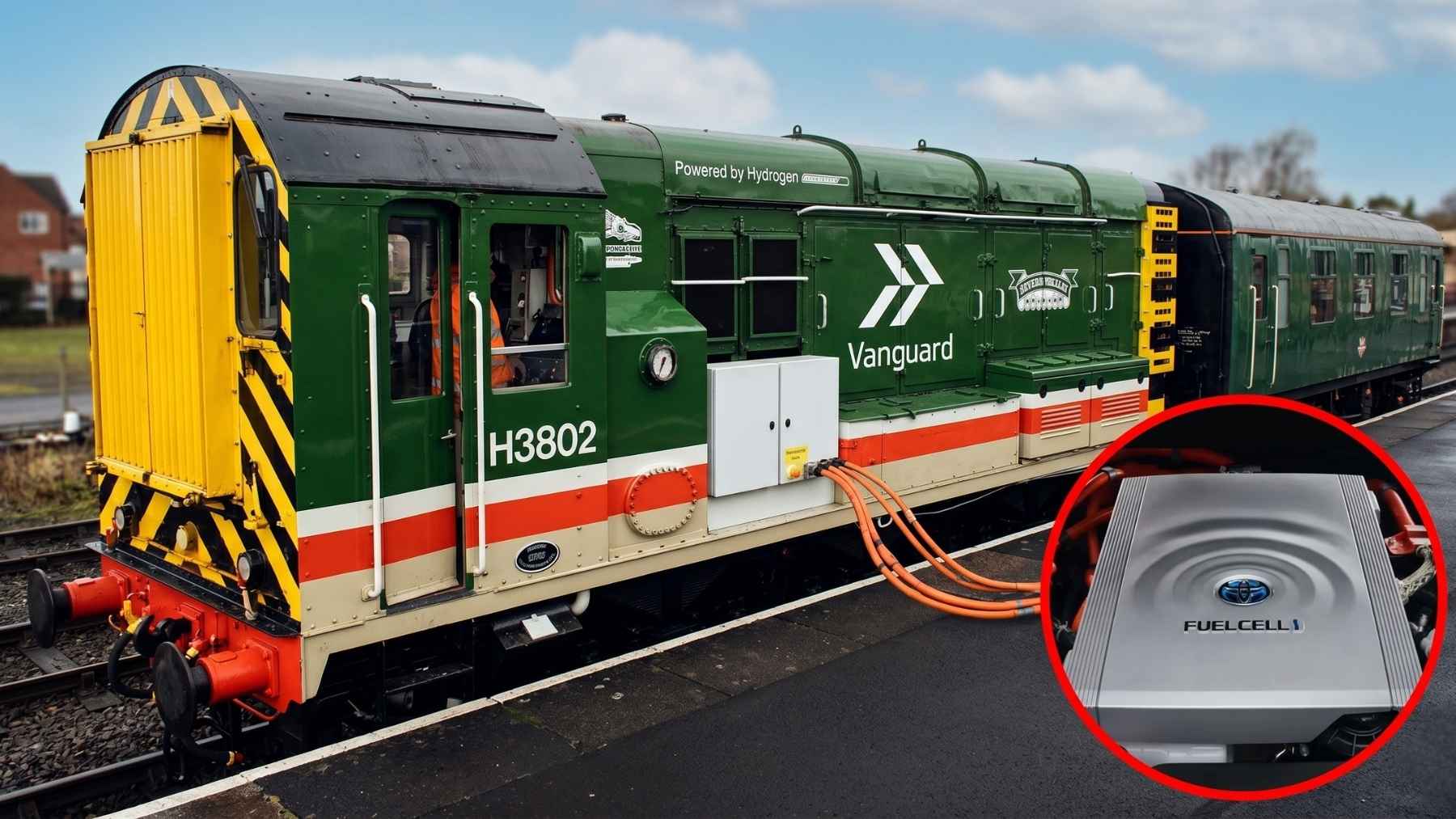

On February 26, 2026, at Kidderminster Town station in Worcestershire, the Severn Valley Railway and West Midlands engineering firm Vanguard Sustainable Transport Solutions rolled out a locomotive named HydroShunter. The body is a Class 08 diesel shunter built in Derby in 1959 and pulled from a scrap line. The drivetrain underneath has been replaced with a Toyota 80 kW hydrogen fuel cell, a 230 kWh battery, and the original electric traction motors. According to Railway Gazette, the package delivers up to 250 kW of tractive effort and around 20 hours of running time per duty cycle. The cab itself is mostly unchanged. SVR driver Bob Dunn told the BBC the difference is “a few extra lights and meters.”
This is genuine news, and it travels poorly to a US automotive audience for two reasons that are worth separating. The first is that the HydroShunter is not pulling passenger trains. Shunters are yard locomotives — they assemble carriages, move stock around depots, and operate at low speed under a single roof’s worth of refueling infrastructure. The trains carrying tourists across the 16-mile heritage line between Kidderminster and Bridgnorth are still steam and heritage diesel. The second is that the most mature main-line hydrogen passenger train in the world, Alstom’s Coradia iLint in Germany, has been mostly off the tracks since December 2024 for reasons that matter to anyone tracking when hydrogen vehicles will actually arrive in the US.
What the HydroShunter actually is
The Class 08 is a piece of British railway furniture. More than 1,000 of them were built between 1952 and 1962 to handle yard work across the nationalized rail network. Most have been retired. A handful, including the donor for the HydroShunter, ended their service lives on heritage railways being cannibalized for parts. Vanguard Sustainable Transport Solutions, which spun out of the University of Birmingham roughly six years ago, has been working on this conversion since at least 2021, when the original diesel engine was lifted out of the donor locomotive at the SVR’s Kidderminster depot.
The result is, in engineering terms, a battery-electric locomotive with a hydrogen fuel cell acting as a range extender. The 230 kWh battery is the working power source. The Toyota fuel cell charges it. The electric traction motors that were always inside a Class 08 — Class 08s have always been diesel-electric, with a diesel engine driving a generator that fed electric motors — do the actual work of moving wheels. This is the same architecture Toyota uses in the Mirai, the same architecture Hyundai uses in the NEXO, and broadly the same architecture every hydrogen passenger vehicle in production today uses.
Dr Alexander Burrows, chief executive of Vanguard, told industry press that the company has “already a lot of real interest from potential customers who want to benefit from zero emissions, reduced noise, and improved operating costs in a retrofit solution.” That customer base is the relevant detail. Vanguard is marketing the HydroShunter to rail freight yards, depots, industrial sites, and ports. Not to tourist railways. The Severn Valley Railway is the test bed. The market is closed-fleet operators who need to replace diesel shunters under their own roof.
Why shunting is a fair test of the technology
Yard work is not a softer test than passenger service. It is a different test, with characteristics that happen to suit hydrogen well. Shunters run for long hours, often around the clock. They start and stop constantly. They pull heavy loads at low speeds. They refuel at one location. And they almost never travel more than a few miles from their home depot. Any failure mode that depends on distributed refueling infrastructure — the single most common technical and commercial argument against hydrogen passenger cars in the United States — is mechanically irrelevant in this application.
That is why the case studies of hydrogen actually arriving in the US look the way they do. Plug Power has been deploying hydrogen fuel cells in warehouse forklifts at Walmart, Amazon, and Home Depot distribution centers for more than a decade. Hyundai’s XCIENT Fuel Cell Class 8 trucks are running drayage routes between the Port of Oakland and Tracy, California, on a fixed-route schedule. Foothill Transit and SunLine in Southern California are operating hydrogen transit buses with depot-based refueling. None of those deployments require a hydrogen pump to exist next to a gas station. They require one pump to exist at the depot.
The HydroShunter is the rail equivalent of that pattern. It is real, it works, and it solves a specific problem in a closed system. Gus Dunster, managing director of the Severn Valley Railway, said the goal is to see the locomotive “in regular use at the railway.” Vanguard says it is now actively marketing the powertrain to operators looking for retrofit solutions rather than entirely new rolling stock.
The Coradia iLint counterpoint Germany has been living through
The harder question is what hydrogen does outside the closed system. The cleanest current answer comes from Germany, where Alstom’s Coradia iLint became the world’s first commercial hydrogen-powered passenger train when 14 units began service in Lower Saxony in August 2022, followed by 27 units on the RMV Taunus network in Hesse from December 2022. Alstom subsequently logged more than 200,000 km of revenue passenger service across the fleet, and one Coradia iLint covered 1,175 km on a single tank in September 2022. As technology demonstrations go, those numbers were strong.
What happened next was not. In mid-December 2024, Alstom pulled most of its 41-unit Coradia iLint fleet out of revenue service for urgent rework. Trains.com, Railway Gazette, and H2 View have since reported the same three root causes: fuel cell degradation that ran ahead of the design service interval, hydrogen supply reliability problems with contracted supplier Linde, and software faults affecting the trains’ energy management. From January 2025 onward, Regionalverkehre Start Deutschland began running 16 leased Alstom-built diesel LINT41 multiple units in place of the iLint fleet on the RMV Taunus network. The lease was contracted through the end of 2025 with extension provisions.
The Lower Saxony fleet did not recover quickly either. By August 2025, H2 View reported that only 4 of the 14 Coradia iLint units in Lower Saxony were still in service. The state-owned operator EVB was running its diesel backup fleet to fill in. LNVG, the Lower Saxony transport authority that originally ordered the trains, has since canceled further hydrogen purchases and announced it will move new orders to battery-electric multiple units instead.
Ulrich Krebs, chairman of the RMV transport association board, was unusually direct in his public statement on the pullback. “It is all the more regrettable that Alstom has done a disservice to novel forms of traction with this series of failures over two years,” he said in late 2024. Alstom has said it is developing new fuel cell technology for the iLint fleet and expects to begin rolling those upgrades out from 2025 onward. As of mid-2026 the upgraded fleet has not returned to full service.
Two test environments, two different outcomes
It is tempting to read the British shunter and the German passenger fleet as the same story. They are not. Yard shunting and intercity passenger service stress a hydrogen drivetrain in different ways, and they expose different failure modes. The HydroShunter runs at low speed, refuels at a single point, and operates inside a workshop that owns it. The Coradia iLint operates at line speed across multiple stations, depends on contracted hydrogen supply across a region, and has to integrate with the same network signalling and timetable as every other train on the route. The first is closer to a forklift. The second is closer to a Greyhound bus.
The technology is the same in principle. The deployment risk is not. Fuel cell degradation that shaves a few months off projected service life is a maintenance headline in a shunter. It is a fleet pullback in a passenger network. Hydrogen supply that flickers from a single industrial gas supplier is a downtime annoyance in a yard. It is a route cancellation in revenue service.
What this means for the US driver
The most useful translation of the UK and German stories together, for a US driver, is the following. Hydrogen vehicles in the United States are not vaporware. They are running today, in numbers that grow each year, in exactly the deployment shapes that yard shunters and German Coradia iLints would predict.
Plug Power’s hydrogen forklifts cross the floors of Walmart, Amazon, and Home Depot distribution centers in the tens of thousands. Hyundai’s XCIENT Fuel Cell drayage trucks shuttle containers off the Port of Oakland with single-point refueling at a dedicated depot. SunLine Transit Agency in California’s Coachella Valley has been operating hydrogen buses since 2000 — the longest-running hydrogen transit fleet in North America. Coca-Cola’s fleet operators have ordered hydrogen Class 8 trucks. The use case is consistent. Closed fleet, central refueling, predictable route, professional maintenance.
What is not happening at any meaningful scale in the US is hydrogen passenger cars at the gas station. The Toyota Mirai’s California fueling network has shrunk, not grown, since 2023. Hyundai sells fewer NEXOs in the US than Tesla sells Cybertrucks in a slow week. The mismatch is not engineering. It is geometry. Distributed retail hydrogen requires a station every 50 miles or so. Distributed retail gasoline already exists. Until one of those equations changes, hydrogen passenger cars will not arrive on a US driveway in volume.
The HydroShunter does not change that. Neither did the Coradia iLint when it worked, and neither does its pullback now that it does not. What both stories make clear is that hydrogen is real where the fueling map is short. And it is fragile where the fueling map is long.
The honest closer
SVR driver Bob Dunn’s quote about the cab change — “a few extra lights and meters” — is the right frame for where heritage rail can credibly take this. A West Midlands engineering firm and a tourist railway have just demonstrated, in real working conditions, that a 67-year-old diesel shunter can be converted to hydrogen and pull a vintage observation saloon down a heritage line. The retrofit costs less than buying new rolling stock. The technology is the same fuel cell architecture that has been in the Toyota Mirai since 2014. Vanguard says operators are asking about it.
None of that resolves the harder question of whether hydrogen will play a meaningful role in passenger transport in the United States by 2030. The German experience suggests caution. The US closed-fleet deployments suggest patience. The Severn Valley Railway suggests that for the specific job hydrogen actually fits — heavy, slow, depot-based, predictable — the engineering is ready. That is not the headline most US clean-energy writers had in mind for hydrogen. It is, however, the headline the Class 08 in Kidderminster just earned.
 @jonkelly ROOKIE5 months ago