
If you are driving south through Switzerland this month, the Gotthard road tunnel is shut at night. Twelve nights of it, between August 10 and 27, from 11pm to 5am, Monday through Thursday only, so the weekend traffic still gets through. Crews are cutting relief joints into the slab that hangs above the lanes, because in 2023 a crack opened in that slab near the northern portal and pieces of concrete came down onto the road.
That is the tunnel Switzerland has been driving through since 1980. Sixteen point nine kilometers, about 10.5 miles, two lanes, one bore, traffic coming at you in the other direction the whole way.
A few hundred meters east of it, and four kilometers deep into the mountain, sits the machine that will eventually let the Swiss close that tunnel entirely and rebuild it. As of this spring she is exactly halfway. Her twin, coming the other way, spent almost a year not moving at all.
Alessandra hit tunnel meter 4,000 in April
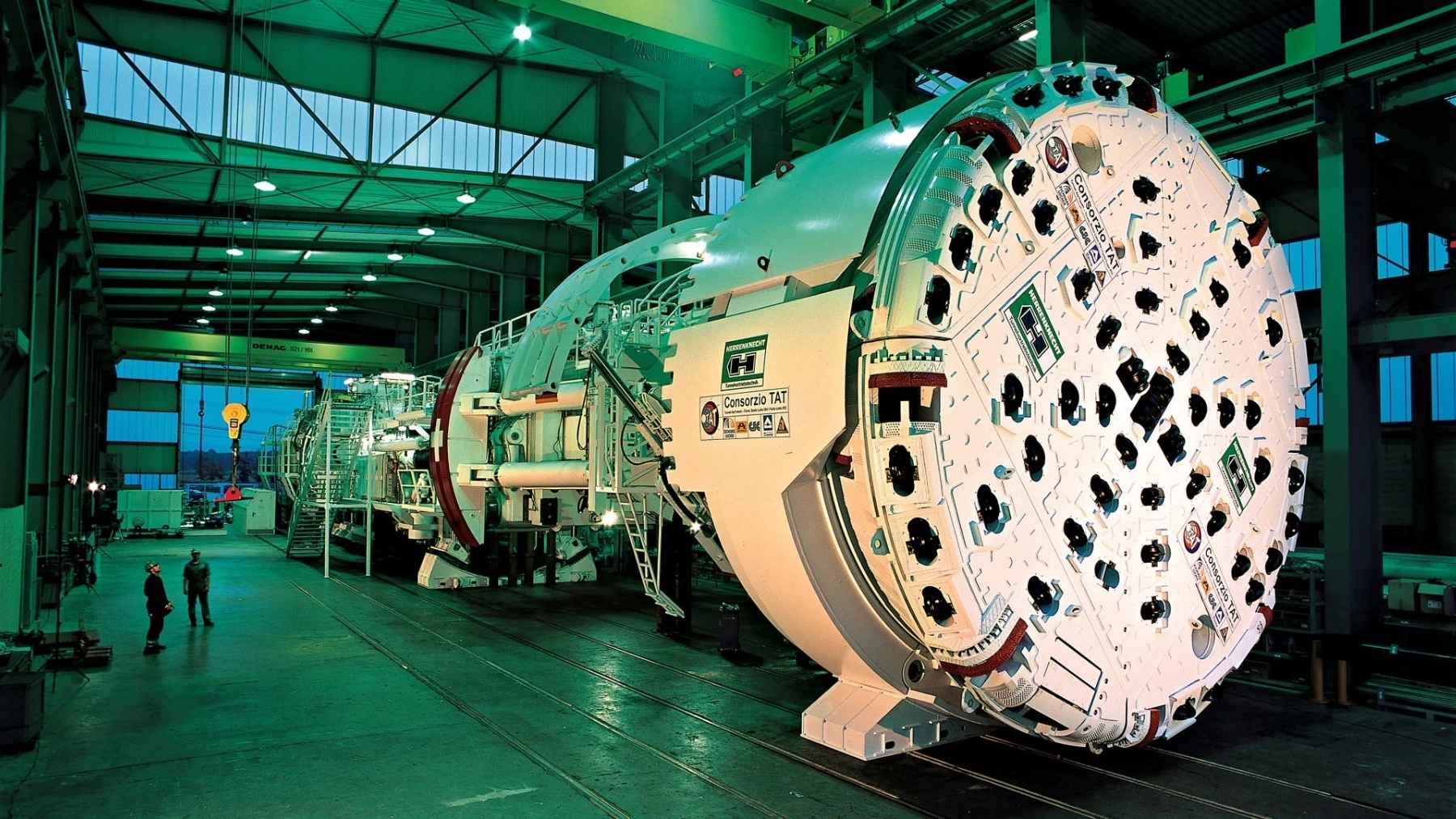
The machine is a Herrenknecht single shield hard rock borer, 12.225 meters across the cutterhead, roughly 40 feet, and about 100 meters long counting her trailing gear. Fifteen motors turn that head with a combined 5,250 kilowatts, a shade over 7,000 horsepower. Herrenknecht likes to describe that as around seven times what a current Formula 1 car makes, which is the manufacturer’s comparison rather than mine.
She is called Alessandra. She started digging on February 14, 2025, from the portal at Göschenen, working for the “secondo tubo” joint venture of Implenia and Frutiger on behalf of the Swiss Federal Roads Office.
On April 29 this year, after about 14 months underground, she reached tunnel meter 4,000. The Federal Roads Office put that at roughly half of the northern drive. The last slab of rock dropped away and, following mining tradition, the first person through the gap was a miner carrying a statue of Saint Barbara.
The rock she went through was not friendly. Herrenknecht’s own account describes stretches heavy in quartz and blocky granite, hard enough to chew through disc cutters fast enough that they needed replacing constantly.
Where the granite behaved, the crews moved. Chief executive Martin Herrenknecht called it “a remarkable achievement by the tunnelling crews” and put the peak rate at up to 32 meters in a day. That is 105 feet of finished Alpine tunnel between one shift change and the next.
The worst 320 meters were blasted out by hand before the machine ever arrived
Here is the part that gets skipped in most of the coverage. Alessandra did not cut through the fault zone. She drove into a hole that was already there.
The zone is called the Mesozoikum, it sits under the Andermatt end of the Urseren valley, and the Federal Roads Office puts it at around 320 meters of mostly loose rock. A 12-meter machine cannot cut loose rock. There is nothing solid for the shield to brace against, and the roof does not hold while the head is turning.
So the planners went at it backwards. In 2024 they drove a separate access tunnel sideways into the fault from an existing gallery, then excavated the whole 320 meters the old way, with drills and explosives, and held the ground up with steel arches, rock bolts and sprayed concrete. That work finished in September 2025, seven months before the machine got anywhere near it.
What happened on April 29 was a big expensive borer arriving at a room the miners had already built for her. Which is a strange thing to celebrate, until you consider the alternative. That is what the whole northern drive was engineered around: get the humans in front of the machine, with dynamite, before the machine can get itself into trouble.
The southern crews learned what happens when the sequencing does not work out.
Her twin sat under 2,000 cubic meters of collapsed rock for almost a year
Paulina is the same idea built slightly bigger. About 12.3 meters across, 116 meters long, 2,118 tonnes, sixteen motors putting out 5,600 kilowatts. She belongs to the Marti 2TG consortium, which is Marti Tunnel, Mancini & Marti and Ennio Ferrari Impresa Generale, and she was switched on at Airolo on the same February morning in 2025 as Alessandra.
She got 192 meters.
On June 23, 2025, the drive stopped. The ground above her, a section known locally as the Tremola geology, was heavily fractured with open voids running through it, and roughly 2,000 cubic meters of rock came down around the machine. The Federal Roads Office has since described it in exactly those terms.
At the time, the agency said the stop was a controlled precaution and the machine was neither damaged nor stuck. Swiss public broadcaster SRF later questioned that account after obtaining internal project minutes. The office rejected the criticism.
Getting her out took the same trick as the north, applied under pressure. Crews drove a 250-meter connecting gallery from the southern access tunnel, then blasted their way about 500 meters through the Tremola toward the stalled cutterhead, taking only the crown of the profile rather than the full bore.
Paulina restarted on May 18, 2026. From stop to restart is 329 days.
The agency’s own numbers on the damage: six to eight months of delay, and 15 to 20 million Swiss francs in extra direct costs. Both, it says, sit inside the reserve already built into the budget, and it is still holding the 2030 opening date.
To protect that date, the office has floated running three shifts a day seven days a week, pulling other work forward, or simply letting Alessandra dig further south than planned and meeting Paulina somewhere short of the middle.
Every ton of it comes back out, and most of it gets a second job
The second tube will generate around 7.4 million tonnes of broken Gotthard. None of it goes to a spoil heap.
About 500,000 tonnes had been crushed and graded into aggregate by May, feeding a concrete plant the crews built in a cavern inside the mountain, which then casts the lining segments that get bolted up behind the machine. The rock the tunnel produces becomes the tunnel.
The rest rides north. Roughly 3.5 million tonnes are earmarked for Lake Uri, at the southern tip of Lake Lucerne, where a century of channelising the river Reuss and dredging it for gravel wiped out the shallow water shelves in the delta. Those shelves, anything under about 10 meters deep where light still reaches the bottom, are where most of the lake’s biology actually lives.
Around a million tonnes had been delivered by May, on roughly seven trains a day. From the industrial port at Flüelen the rock goes onto barges that run out to pontoons every fifteen minutes carrying up to 450 tonnes a trip, then gets laid down on the lakebed.
It is the third time Switzerland has rebuilt that shoreline out of tunnel spoil. The first two rounds came from the Gotthard Base Tunnel and a bypass at Flüelen, between 2001 and 2008.
They are already pulling asbestos out of the tunnel next door
Running between the 1980 tube and the new one is the service and infrastructure gallery, built alongside the original and still fully operational. Since April 2026 crews have been stripping out its drainage channels, which contain asbestos, along the entire length of the tunnel. That job alone runs about three years.
It is being done now, years early, so that when the first tube finally closes in 2030 the refurbishment can move faster and more safely. Which tells you something about the timeline nobody puts on the graphics: the 2030 date is not when the Gotthard is finished, it is when the real work on the old tunnel starts.
The two machines are due to meet inside the mountain in 2027. Traffic goes into the new tube in 2030, the 1980 bore closes behind it for about three years of rebuilding, and from 2033 both are open.
Cross-Alpine tunnelling has a habit of stretching, as the crews on the Brenner Base Tunnel and the Lyon to Turin base tunnel have found. Machines also come in behind their advertised rate fairly often, as two borers under Vancouver managed recently.
And when all of that is done, in 2033, at a cost of 2.14 billion francs before tax, the Gotthard will move exactly as many cars per hour as it does today. Each tube gets one lane and a shoulder, and nothing else.
That was the deal Swiss voters approved in the 2016 referendum, 57 percent in favour, on the explicit condition that nobody use a second hole in the mountain to widen the road. Switzerland is spending two billion francs to buy itself a tunnel it can afford to close.