
Mitsubishi stopped building cars at Tonsley Park, on South Road in Adelaide, back in 2008. The buildings came down. Part of the site is now an electrical substation.
That substation was put there to feed tunnel boring machines. On July 1 the state and federal governments said the first of them, a 3,858-US-ton machine named Mary, had started digging under the same stretch of road the car plant used to face.
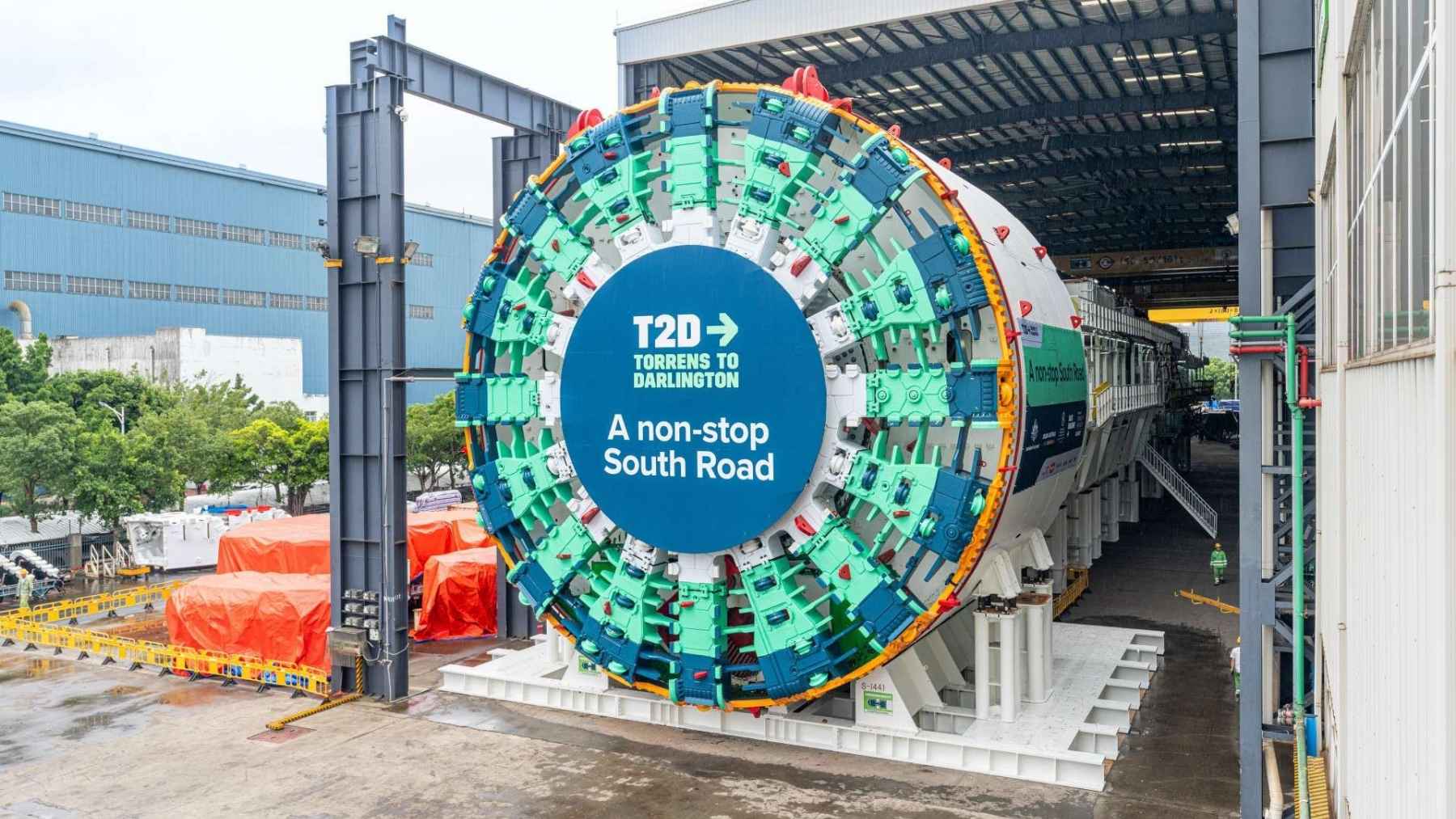
Mary is about 100 meters long, or 328 feet, and 15 meters across. Australia weighs her at 3,500 tonnes, which is where that 3,858 comes from. The state’s own attempts to convey that width run to the Thebarton Theatre, the goalposts at Adelaide Oval and the Bunnings at Edwardstown. For anyone outside South Australia: 49 feet, roughly a four-story building, spinning.
She is the first of five. Three of them dig the main tunnels. The other two turned up this month and are a different animal, which is a story further down.
The project she belongs to is the largest South Australia has ever attempted, and it is called River Torrens to Darlington, or T2D. It costs A$15.4 billion, around $10.7 billion in U.S. dollars, split evenly between the state and federal governments. It buys 6.5 miles of road.
The cutting wheel is the part that doesn’t fit on a road
Cutterheads this size do not arrive whole. Mary’s weighs more than 300 metric tons once it is bolted together, and it came off the ship at Port Adelaide in five pieces. The center section on its own ran about 175 metric tons and measured 9 meters, close to 30 feet, across.
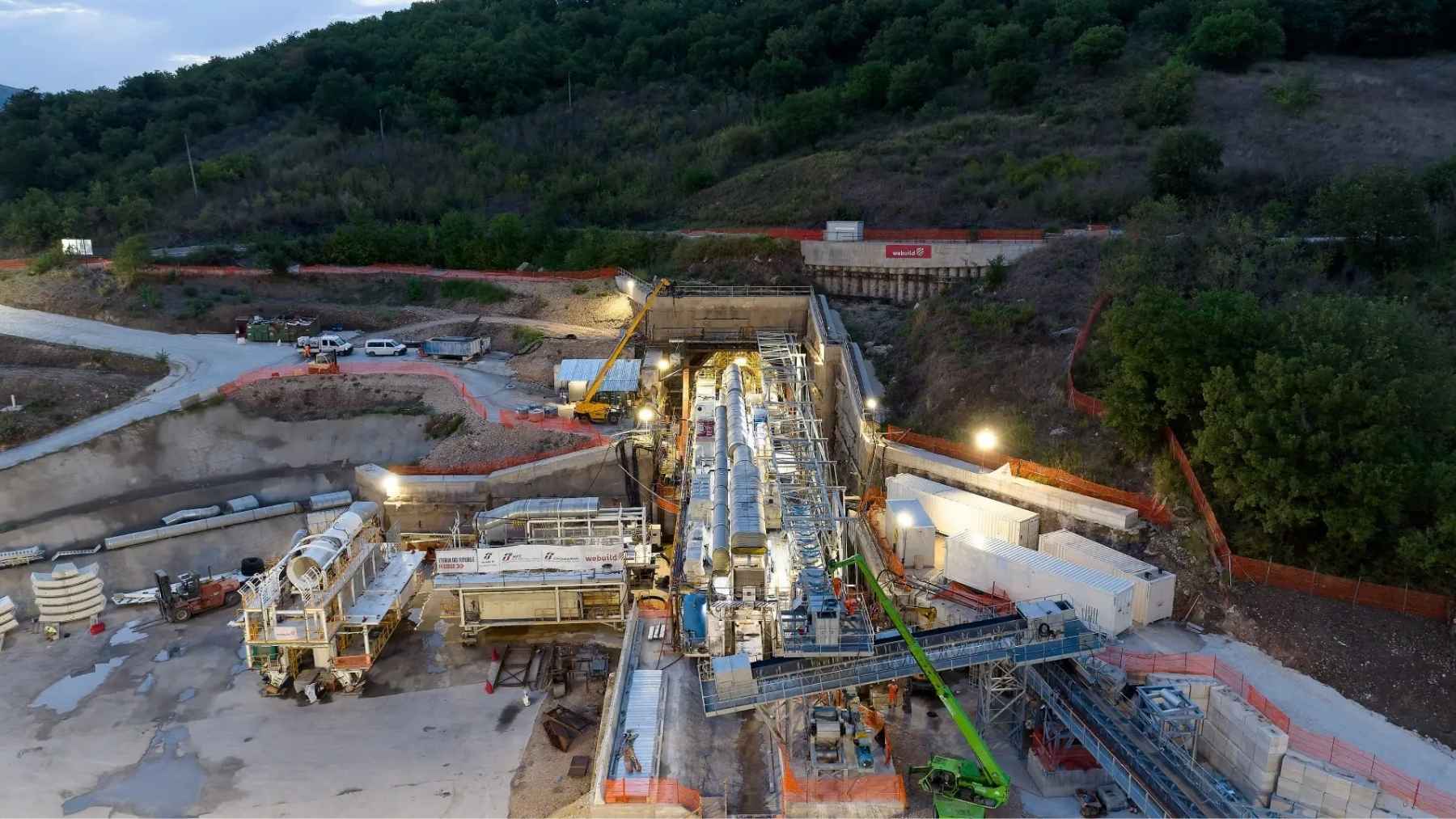
Those pieces crossed the city on a Saturday night in October 2025 under rolling road closures, headed for the project’s Southern Precinct at Clovelly Park. A 500-metric-ton gantry crane lowered them into the launch box one at a time. Assembly and commissioning ate the next eight months.
The launch box is a hole 120 meters long, 50 meters wide and 20 meters deep. Digging it removed more than 343,000 metric tons of material, and that was before Mary bored a single meter of tunnel.
Australia has not tried three of these on a road before
Mary is cutting north from Clovelly Park toward Glandore, carving one of the twin Southern Tunnels at 4.5 kilometers, about 2.8 miles. Catherine drops into the same box to grind the parallel tube beside her.
Catherine was blessed in that launch box on Saturday July 11, by Father Joseph Wales Raja George from St Bernadette’s church nearby, and is being readied to launch behind her sister.
Elizabeth, the third, launches from the Central North Precinct at Hilton and drives 2.2 kilometers north to Torrensville. Crews then turn her around and she digs the second Northern Tunnel back the way she came. She gets her own blessing first.
The state government’s claim is that this makes T2D the first road project in Australia to run three large-scale boring machines concurrently. Melbourne’s North East Link, the closest comparison, uses two. All three of Adelaide’s are meant to be turning by the end of the year.
Power turned out to be its own build. Two purpose-built substations feed the machines: Tonsley East for Mary and Catherine, and Richmond East, energized at the end of May, for Elizabeth. Each is rated at the equivalent of 5,000 homes and delivers a dedicated 22,000-volt supply.
SA Power Networks, which built both, says it normally builds one substation every three years. Neither gets torn down afterward. Once the tunnels open, the two switch over to running the ventilation, lighting and safety systems inside them.
The fourth and fifth machines are 4 meters across
Here is the part that changed this month. The first of two much smaller boring machines arrived in Adelaide, and the second is expected within weeks. Both cleared factory acceptance testing in China before shipping.
They stand 4.1 meters, roughly 13 feet, and they are essentially scaled-down copies of Mary. Their job is the connective tissue nobody photographs: a cross passage every 120 meters along the whole 10.5-kilometer alignment, linking the northbound tube to the southbound one.
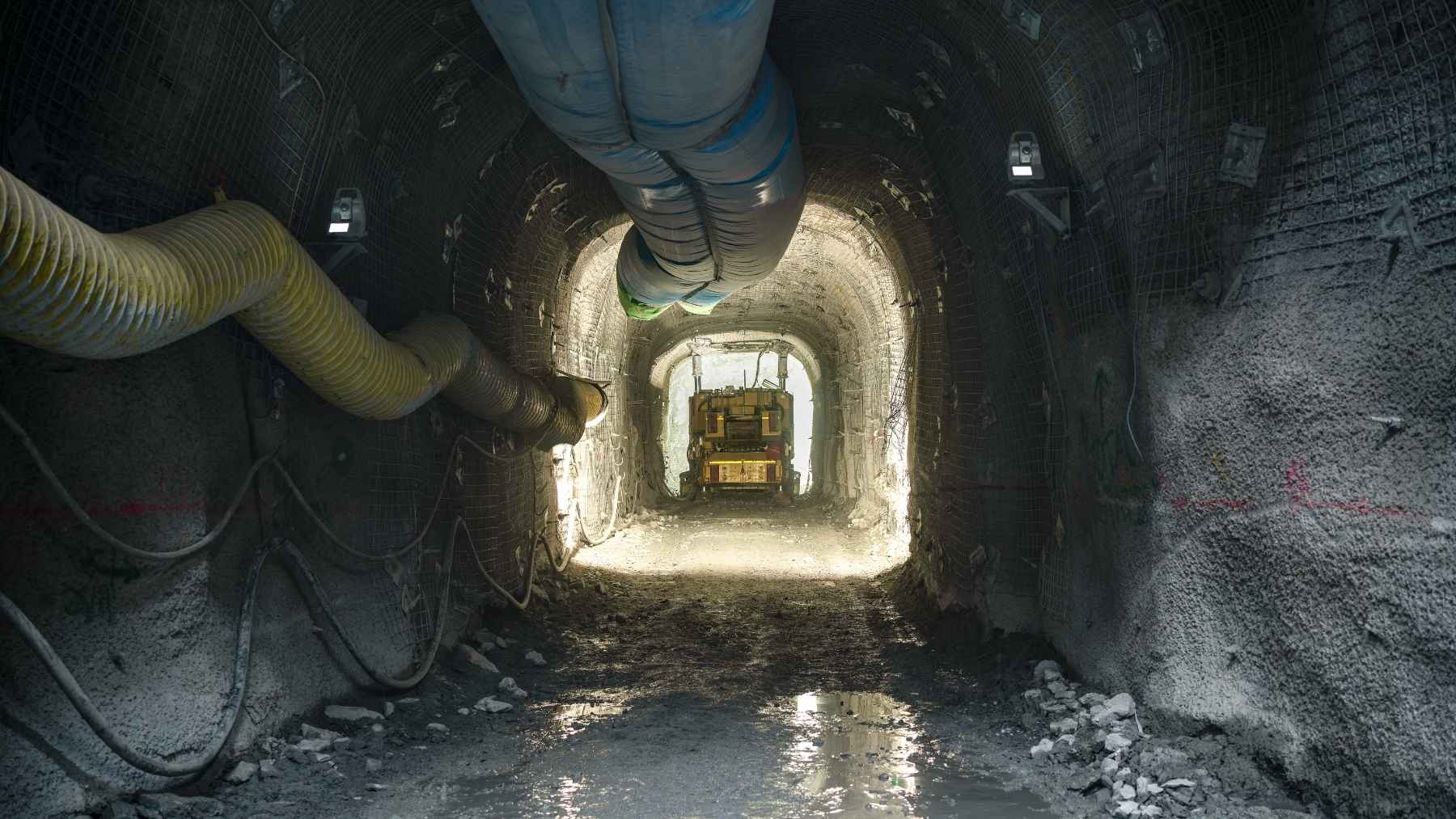
Those passages are not optional. They are the evacuation route if something goes wrong in a tunnel, and they carry maintenance access plus the electrical and signalling gear. Adelaide’s soft ground and clay are what make it practical to cut them with dedicated machines rather than by hand, according to the project.
It also hands the state a second Australian first. No tunnelling project in the country has previously run two machines built solely for cross passages, which takes the T2D fleet to five.
“Since we signed on the dotted line less than two years ago, we’ve seen these machines designed and manufactured,” Acting Premier Kyam Maher said, before adding that they then travelled halfway around the world, came off the port piece by piece, and are now tunnelling.
Mary covers 33 feet on a good day
Mary works 24 hours a day, seven days a week, with as many as 20 specialists inside her, and she advances 8 to 10 meters. Per day. Call it 26 to 33 feet.
The cycle does not vary. Teeth and discs on the cutterhead shave the face, conveyors drag the spoil out the back, and a segment erector sets 10 precast concrete pieces into a ring behind her. Hydraulic cylinders push off that fresh ring to shove the machine forward, and it starts again.
That pace is normal, not slow. It is also nowhere near the ceiling: a 2,000-ton borer in Dubai just posted 30 meters in a single day, which made news precisely because almost nothing else does it.
Each of those concrete segments weighs about 12 metric tons. The four tunnels need more than 55,000 of them, all cast in a 285-meter shed at Waterloo Corner, north of the city. By mid-May the shed had finished 1,000. Battery-electric multi-service vehicles run them down the tunnel to the machine.
The tunnels themselves sit 10 to 25 meters below the surface, so between 33 and 82 feet under the houses of Adelaide’s inner suburbs. Tunnelling across the whole project should take up to 24 months, and the finished build is expected to generate 7.5 million metric tons of spoil.
The names came out of a public vote
Boring machines get female names. The custom traces back to the 1500s, when miners and tunnellers prayed to St Barbara for protection underground, and nobody in the industry has seen a reason to drop it. Britain’s HS2 named a machine after the first woman to drive its trains, which is the same instinct.
South Australia asked the public and got more than 2,000 submissions. The winners were Mary Lee, Catherine Helen Spence and Elizabeth Webb Nicholls, three of the campaigners behind the Constitutional Amendment (Adult Suffrage) Act that the South Australian parliament passed on December 18, 1894.
Mary the machine was blessed and formally commissioned in late May by the Archbishop of Adelaide, Patrick O’Regan, about five weeks before she started digging.
The project’s press material calls that act the moment South Australia became the first place in the world where women could both vote and stand for election. South Australia’s own History Trust says that is not accurate. Colorado gave women the vote in 1893, and three women were elected to the Colorado General Assembly on November 6, 1894, six weeks before the Adelaide bill passed.
Spence still has a claim of her own. She ran for the Federal Convention in 1897 and became Australia’s first female political candidate.
Two Herrenknecht machines named Mary are digging right now
All three of Adelaide’s large machines came from Herrenknecht, the German manufacturer. So did the 1,200-ton borer that has been working north under the Potomac in Washington since this spring, and that machine is also named Mary, after Mary Edmonson, who tried to escape slavery on a schooner in 1848. Mayor Muriel Bowser blessed hers with a bottle of DC tap water.
The 2,000-ton machine digging Montreal’s metro extension is a Herrenknecht as well, stamped with serial number S1423.
Not everyone builds a tunnel this way. In Nashville, The Boring Company’s Prufrock machines tilt off a truck straight into the dirt, skip the launch pit and run with nobody underground at all.
Adelaide went the other direction: a 66-foot pit, a 500-ton crane, months of assembly and 20 people riding the machine. Sydney went further still and assembled a 4,350-ton Chinese-built borer inside a cavern dug under a suburban cricket ground.
Adelaide is the only mainland capital without a non-stop motorway
That line comes from the state’s Department for Infrastructure and Transport, and it is the reason any of this is happening. Every other mainland Australian capital has a metropolitan motorway a driver can cross without stopping.
T2D closes the final 10.5 kilometers of the North-South Corridor, which leaves 78 kilometers, or 48 miles, of traffic-light-free road between Gawler and Old Noarlunga. The government projects a nine-minute run from West Hindmarsh to Darlington and around 130,000 weekday trips pulled into the tunnels. Infrastructure Australia expects daily car trips across Adelaide to climb 26% by 2031.
“For decades, completing a non-stop South Road has been talked about,” Premier of South Australia Peter Malinauskas said in May, when the machines were named.
The digging itself is being done by the T2D Alliance, five firms working with the state: John Holland, Bouygues Construction, Arcadis Australia, Jacobs and Ventia. Anyone who wants to watch can now follow Mary’s approximate position, and the tunnel depth under their own street, on the project’s public TBM tracker.
Mary’s assignment is 4,500 meters. At 8 to 10 meters a day that works out to 450 to 560 days of digging, assuming nothing stops her, which is a large assumption. Florence, the borer on the Snowy 2.0 hydro scheme a few hundred miles east, hit waterlogged ground and sat effectively stuck for something like 19 months.
After the digging comes the fit-out, and the road opens in 2031. What a driver gets is 21 sets of traffic lights gone and up to 40 minutes back at peak hour, on a road that used to have a car factory on it.
 @kimbayly ROOKIE3 months ago