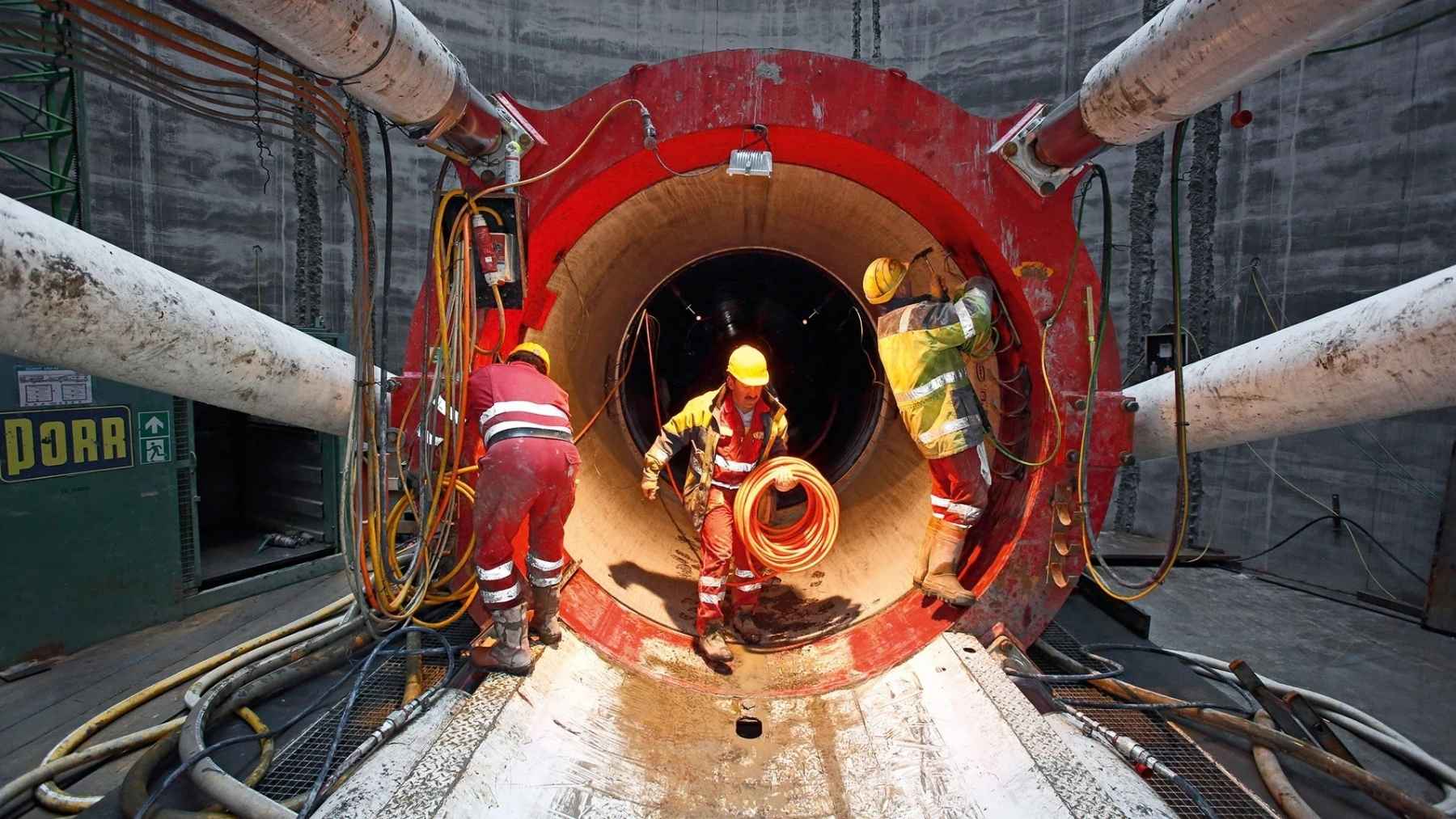

Every tunnel boring machine on Earth works on the same brutally simple idea. A wheel studded with steel discs spins against the rock face, crushes it into rubble, and conveyors haul the mess out the back. That is why the cutterhead on Mary, the German borer currently grinding under the Potomac, weighs 105 tons by itself.
Grinding rock is a fight the rock partly wins. Discs wear out. Crews stop and swap them. In genuinely nasty ground the cutter head gets destroyed, the machine has to be rescued, and sometimes nobody can reach it and it simply stays down there.
So a small group of engineers has spent years chasing the obvious workaround: don’t touch the rock.
That idea just had an excellent week. On July 7, Houston’s Quaise Energy announced the first close of a $134 million Series B, bringing its total to about $230 million, to keep melting its way into granite with a beam of millimeter waves. We’ve written about that machine and the 330-foot glass-lined hole it burned into Texas granite, and Quaise now says it is approaching a kilometer of depth at the same site. The investors include two of Japan’s largest energy companies. The plant the money funds is already under construction in Oregon.
Which makes this a strange week to bring up Petra. Because a San Francisco startup with a Tesla cofounder on staff pulled off contactless rock boring for real, in a Minnesota quarry, four and a half years ago. And it doesn’t exist anymore.
Swifty cooked the rock, then swept up the flakes
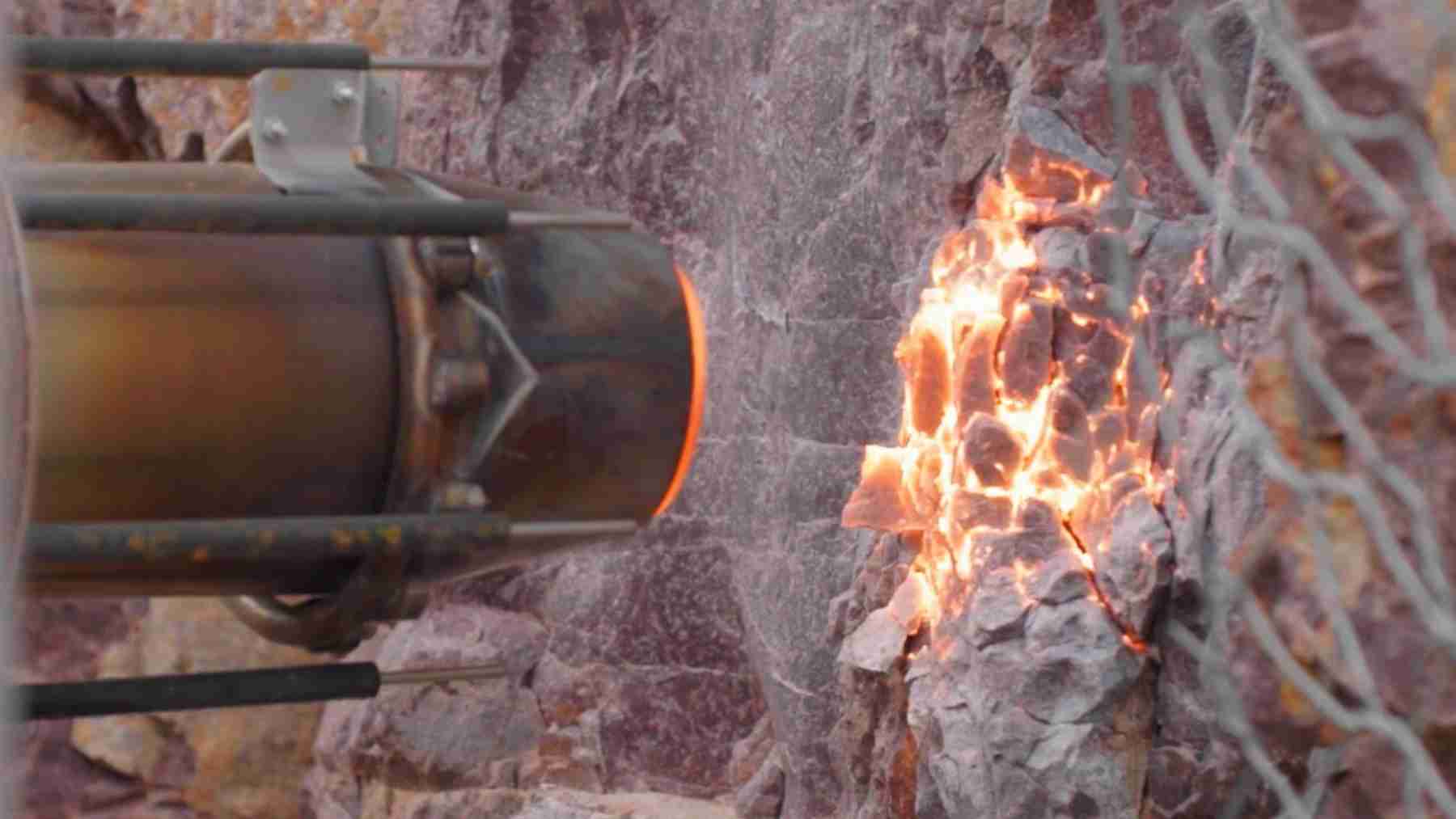
The robot was called Swifty, and the method is called thermal spallation drilling. You heat the surface of the rock so fast that the outer layer expands, cracks and pops off in flakes. The bit never makes contact. There is nothing to wear out.
Petra’s spallation head threw a jet of gas at the rock face at roughly 1,800 degrees Fahrenheit, hot enough that the surface glowed and charred before it started shedding. Then the debris got cleared out of the bore.
How, exactly, depends on which write-up you read. Some describe a vacuum pulling out the spoil, others a high-pressure flush. Petra never settled it, because as CTO Ian Wright and cofounders Kim Abrams and Shivani Torres told Forbes at the time, they weren’t sharing technical details, citing competitive concerns.
The physics wasn’t the invention. Thermal spallation has been kicked around by researchers for decades without ever getting properly commercialized. Petra’s claim was that it had finally built a machine around it that a utility contractor could actually use.
An inch a minute through rock that normally gets dynamited
In December 2021 Petra came out of stealth with a demonstration and a $30 million Series A led by DCVC, which brought total funding to $33 million. The company had started in 2018 under the name ArcByt. Abrams told Forbes she launched it with Torres that year in the wake of the fire that destroyed Paradise, California. Wright, one of Tesla’s five cofounders, was brought in later to fix a drilling approach that had begun with a plasma torch and wasn’t working.
The demo was a 24-inch bore driven 20 feet through Sioux quartzite in a quarry in southern Minnesota. Average advance: one inch per minute. Run the arithmetic and the whole 20 feet is about four hours of actual boring.
“We averaged an astounding one-inch-per-minute in a geology usually excavated by dynamite,” Wright said in the company’s announcement, which also billed Swifty as the first microtunneling robot able to reverse back out of its own hole. That sounds like a footnote. It isn’t. Backing out is how you rescue a machine instead of abandoning it.
Swifty was built for utility conduit, not subway tunnels. Bore diameters ran from 20 to 60 inches, and one machine covered the whole range, where conventional microtunneling rigs are built for a single size. The target customer was a utility trying to bury a power line through a mountain that eats drill bits.
Yes, Elon Musk was already running a tunneling company by then. Wright told Forbes the overlap was pure coincidence and that there was “no collusion there.”
Sioux quartzite is the reason crews reach for dynamite
Sioux quartzite is roughly 1.7 billion years old and about 95% quartz grains welded together with silica. It doesn’t break around the grains. It breaks through them.
Abrams described it in a CNBC interview as the hardest rock on earth, which is a sales line more than a geology one. The engineering number is better anyway. Phoenix Boring, the company that now owns most of the technology, puts Sioux quartzite at up to 44,000 PSI compressive strength.
For scale: the bedrock The Boring Company is currently chewing through under Nashville came back from coring at approximately 14,000 PSI, and strong rock was reported as part of why the company picked the city. Sioux quartzite is in a different weight class, and it is the reason crews normally reach for explosives instead of a cutter head.
Petra wound down in 2024, and an engineer bought the machines with his savings
Petra spent 2022 and 2023 doing what a hardware startup does. It bought a trenchless company called Zilper, folded the two founders into its leadership, and turned Swifty’s jet into one swappable module of a bigger multi-tool machine. That platform, Petra said, won the industry’s No-Dig award for new technology in 2023.
Then it stopped. If there was a farewell announcement, it did not travel the way the launch did.
The clearest account comes from the people who kept the hardware. “Despite the technical success, Petra wound down its operations in 2024,” Phoenix Boring writes on its own site. Roberto Zillante, the Zilper cofounder who had become Petra’s CTO, spent his personal savings buying the only two multi-platform machines in the United States back from his dying employer.
He then took them out and bored 500 feet of gas main for PG&E in California. Phoenix says that job is what convinced investors to back him, after which he acquired most of Petra’s remaining intellectual property and hard assets and started the company again under a new name.
PitchBook lists Phoenix Boring at nine employees, with backers including MaC Venture Capital, which also had money in Petra. A Form D notice picked up by filing trackers in March 2026 shows the company raising just over $5.2 million. Somebody, at least, still believes the jet works.
The biggest undergrounding job in America is being done with trenchers
Swifty’s real opponent was never the rock.
Petra existed because burying power lines through hard rock is ruinously expensive, and California keeps needing it. PG&E’s equipment started the 2018 Camp Fire, the same blaze that leveled Paradise. The utility pleaded guilty in 2020 to 84 counts of involuntary manslaughter and one count of unlawfully starting a fire, and undergrounding became its flagship promise.
That promise is being kept. In October 2025 PG&E announced it had energized 1,000 miles of underground powerline in high fire risk areas, with 1,600 miles expected by the end of this year. Cost per mile has fallen from $4 million at the start of the program to $3.1 million in 2025. Peter Kenny, the utility’s senior vice president of electric operations, noted that “skeptics said it couldn’t be done.”
Read the list of what drove those savings and there is no boring robot on it. PG&E credits local contractors, shallower and narrower trenches, reusing excavated soil, and equipment like chain trenchers, rock-wheel saws and slinger trucks. Machines that touch the rock, winning by digging a cheaper hole rather than a cleverer one.
That is probably what killed Petra, not the physics. A 24-inch tunnel four hours long is a beautiful proof. A thousand miles of cable is a procurement problem.
Non-contact drilling is having its moment anyway
None of which means the idea was wrong. It means Quaise and Petra were aiming at different things with the same instinct.
Quaise fires millimeter waves from a gyrotron, a fusion-research device, straight down, vaporizing rock on its way toward heat more than three miles beneath Oregon. Petra threw hot gas sideways to flake open a two-foot conduit for a cable. Same refusal to touch the rock. Completely different weapon, completely different customer.
The difference that matters is who is paying. Quaise sells electricity, and the buyers of electricity right now are data center operators with no patience and enormous budgets. Petra sold boring to regulated utilities that answer to a public utilities commission on cost per mile.
One of those markets funded a $134 million round this week. The other one hands you a $3.1 million per mile benchmark and asks you to beat it with a machine that advances an inch a minute.
Swifty was never the problem. If a jet of 1,800-degree gas can walk through 44,000 PSI quartzite, it can walk through the Sierra foothills. The question was always whether anyone would buy enough of them, and the answer, today, is a nine-person company in San Francisco with two secondhand machines and a Form D filing.