
Rolling steel drums of nuclear waste off the back of a ship is the kind of thing cartoon villains do. For four decades, it was also official European policy. Between 1950 and 1990, several European governments loaded more than 200,000 barrels of radioactive waste onto ships, sailed out over the Atlantic, and dropped them onto abyssal plains more than 13,000 feet down.
All of it was legal, logged, and declared to the International Atomic Energy Agency. Then the dumping stopped, the paperwork went into a filing cabinet, and for roughly 40 years almost nobody checked on the barrels.
That just changed, in the span of two French research cruises. In the summer of 2025, an autonomous robot called UlyX mapped 3,355 of the drums sitting on the seafloor. Then, between May 27 and June 28 of this year, the crewed submersible Nautile made 20 dives to the barrels themselves. The CNRS, France’s national research agency, published the results on July 2: several barrels are in an advanced state of deterioration, and some have leaked their contents onto the seabed.
This was all perfectly legal
The practice sounds insane today, but it ran on simple logic. The deep ocean was far away, enormous, and apparently empty, so that’s where the waste went.
According to declarations the dumping states filed with the IAEA, the drums hold low- and intermediate-level waste: process sludge, contaminated metal parts, ion exchange resins, even laboratory gear. Not spent fuel rods. The truly nasty stuff stayed on land.
The waste was mixed into bitumen or cement inside steel drums, and those drums handled the crushing pressure at 10,000 to 16,000 feet just fine. Containing radiation forever was never part of the spec. Patrick Chardon of the Clermont Auvergne Physics Laboratory, who co-leads the project, put it plainly before the first cruise: the barrels were “designed to withstand the pressure at depth, but not to truly contain the radioactivity.” The containers themselves were only ever expected to hold together for a couple of decades.
International agreements shut the practice down in the early 1990s, with a global ban on dumping radioactive waste at sea taking hold in 1993. And then came the strange part. Before these cruises, the last time anyone laid eyes on the site was the mid-1980s, when the French submersible Epaulard photographed exactly six barrels. Six, out of more than 200,000.
A robot found 3,355 barrels in 26 days
Nuclear Ocean Dump Site Survey Monitoring, or NODSSUM, is the project France assembled to fix that. The CNRS leads it, alongside Ifremer, the national ocean institute, the ASNR nuclear safety authority, and partner labs from Germany, Norway, Canada and Spain.
The first cruise left Brest in mid-June 2025 aboard the research vessel L’Atalante and spent 26 days working the dump zones, about 400 miles (650 kilometers) off the French coast in international waters.
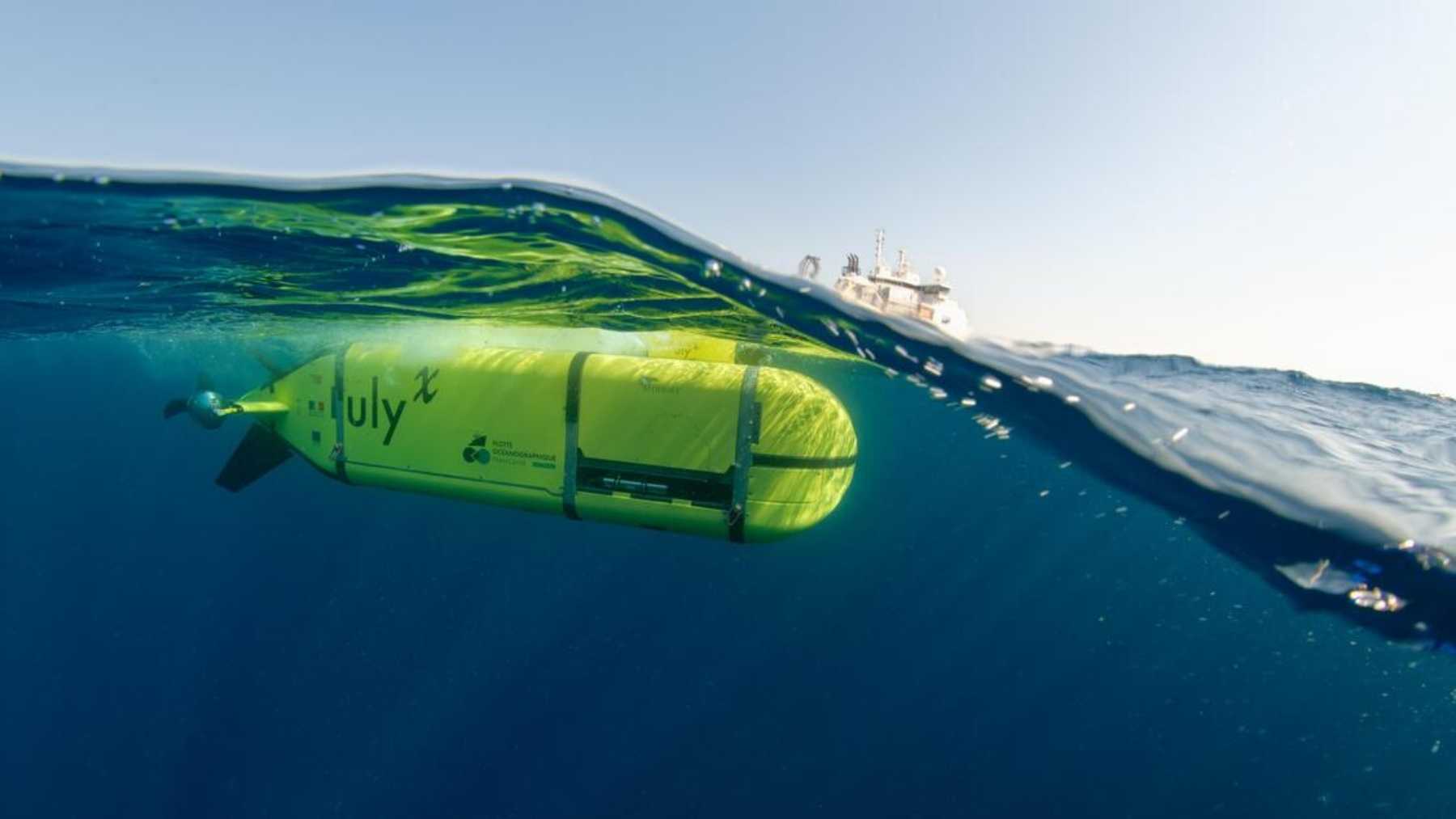
The star of that leg was UlyX, a 15-foot (4.5-meter) autonomous underwater vehicle making its first scientific dives ever. No tether, no pilot. The robot runs its own missions, and its onboard software can change course mid-dive based on what its sensors detect. It’s rated to nearly 20,000 feet (6,000 meters).
UlyX flew about 230 feet (70 meters) above the seafloor, sweeping high-resolution sonar across 63 square miles (163 square kilometers) of abyssal plain. That pass pinned down 3,355 individual barrels, per the CNRS’s Hubert Curien institute. The robot then dropped to 33 feet (10 meters) off the bottom to photograph dozens of drums one by one.
The haul from that single campaign: 5,000 liters of water samples, 345 sediment cores from the ocean floor, and 34 fish and crustaceans, mostly grenadiers and amphipods, caught in traps built by the Clermont physics lab. The first read was cautiously boring. Barrel condition varied widely, and there was no visible environmental contamination.
Machines that can work at these depths are multiplying fast. Japan is building a deep-sea drone to mine rare earths at the same 6,000-meter mark, and Saab’s Sabertooth already lives full-time on the seabed of a Norwegian oil field. UlyX just gave the category its strangest job yet: census-taker for a nuclear dump.
Then humans went down for a look
Sonar maps tell you where the barrels are. They can’t tell you whether a drum has split open. For that, the project sent people.
The second cruise ran May 27 to June 28, 2026, aboard the Pourquoi Pas?, with about 30 scientists on board and a very different machine hanging off the stern: the Nautile, France’s crewed deep-sea submersible.
The Nautile has been in service since 1984 and remains the only crewed European sub that can reach these depths. Three people, a pilot, a copilot and one scientist, squeeze into a titanium sphere seven feet (2.1 meters) across. Per Ifremer, the trip down alone takes about two and a half hours, and a full dive runs up to eight. Two manipulator arms handle the sampling, and the sub works in tandem with UlyX: the robot maps, and the humans dive to the interesting spots.
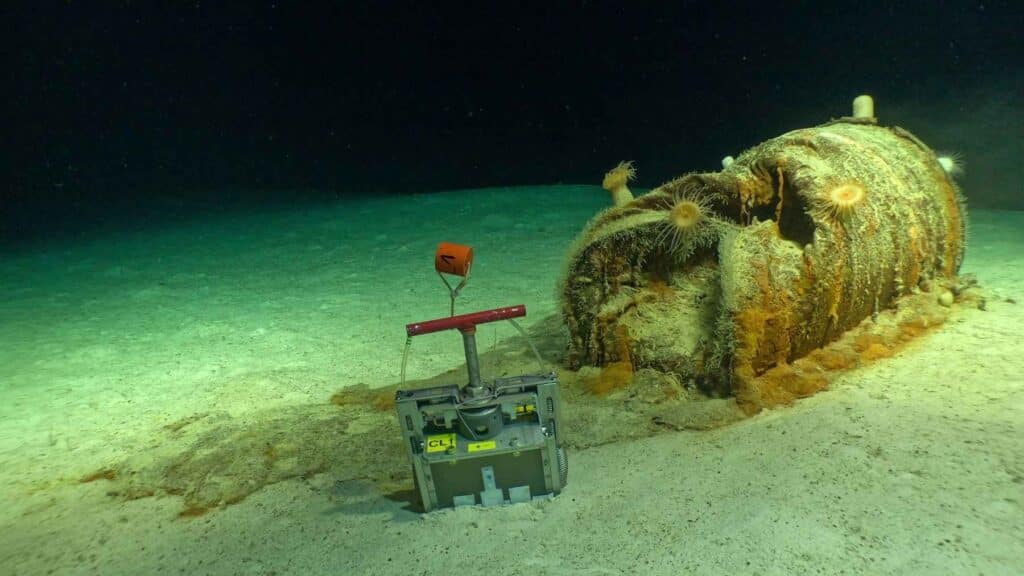
Over 20 dives to depths beyond 15,400 feet (4,700 meters), the crews got the first direct look at the drums since the Epaulard’s six-barrel photo album. Several were badly deteriorated. Some had leaked their contents onto the surrounding seabed. The different encapsulation materials, resin, bitumen and cement, sat exposed where the steel had failed.
The teams also found the barrels colonized. The CNRS reports they documented and mapped the biodiversity living on the drums, right beside them, and across the surrounding habitat. Deep-sea life, it turns out, will settle on a nuclear waste drum as readily as on a rock.
The radiation numbers cut both ways
Here’s the finding that will get quoted for years. On-site measurements confirmed radionuclides characteristic of this specific waste, at activity levels higher than the team expected for the area. The barrels are not inert. Something has been getting out.
And here’s the other half, from the same CNRS release: those levels remain low. Low enough that the samples can be handled without major radiation protection constraints. Higher than expected and still low are both true at once, which is exactly the kind of result that gets butchered in headlines.
Untangling what it means is the hard part. This stretch of ocean already carries a radiation fingerprint from 20th-century atmospheric weapons testing, from Chernobyl, and from decades of authorized discharges by coastal nuclear plants. Proving the extra activity came from the drums means matching the exact isotopic signature of the waste sealed inside them.
Time is quietly helping. According to Chardon, most of the waste dumped here will have lost essentially all of its radioactivity within 300 to 400 years, and only around 2 percent of it stays dangerous much longer than that.
The water, sediment and biological samples are now headed to labs across Europe, including Germany’s Thünen Institute, which is screening the fish for radioactive traces and PFAS while it’s at it. Hard numbers on which radionuclides, and in what amounts, are months away.
Nobody is hauling 200,000 barrels up from 15,000 feet. The project’s own position is that recovery would be logistically overwhelming, so the mission is to assess the drums where they sit, figure out which ones are failing, and stop managing a nuclear dump site off 40-year-old photos of six barrels.
Finland just spent two decades and roughly a billion euros building the opposite of this, a tomb 430 meters down in solid bedrock designed to need zero attention for 100,000 years. That’s what burying nuclear waste looks like when you plan it. The Atlantic’s abyssal plains are what it looks like when you don’t, and France finally sent something down to take attendance.