
Ammonia has spent the last few years being sold as the fuel that finally cleans up shipping. It is carbon-free when it burns, the world already makes it by the shipload for fertilizer, and the biggest marine engine builders on the planet have spent a decade teaching two-stroke engines to run on it.
Burning it is the hard part. Ammonia is toxic, it does not want to ignite, and when you force it to, the exhaust can carry nitrous oxide, a gas with roughly 273 times the hundred-year warming power of carbon dioxide.
A company in Brooklyn looked at all that work and took the exit ramp. Amogy does not burn ammonia at all. It splits the molecule back apart on board, pulls the hydrogen out, and feeds that hydrogen into a fuel cell.
It has now done this in a drone, a farm tractor, a Class 8 semi and a 67-year-old tugboat on the Hudson. And on June 8 it signed the supply agreement that turns the demo into a 40-megawatt power project in South Korea.
Burning ammonia is the expensive way to do it
The combustion route works. It is just fussy. Ammonia has a high auto-ignition temperature and a lazy flame, so the marine two-strokes now arriving at shipyards run on roughly 95% ammonia by energy, with about 5% pilot fuel, usually diesel or fuel oil, injected to light the charge.
That is a carbon-free engine that needs a squirt of diesel to get going. Then comes the aftertreatment: an SCR catalyst to knock down nitrogen oxides, plus careful combustion control to stop nitrous oxide from quietly eating the climate benefit you just paid for.
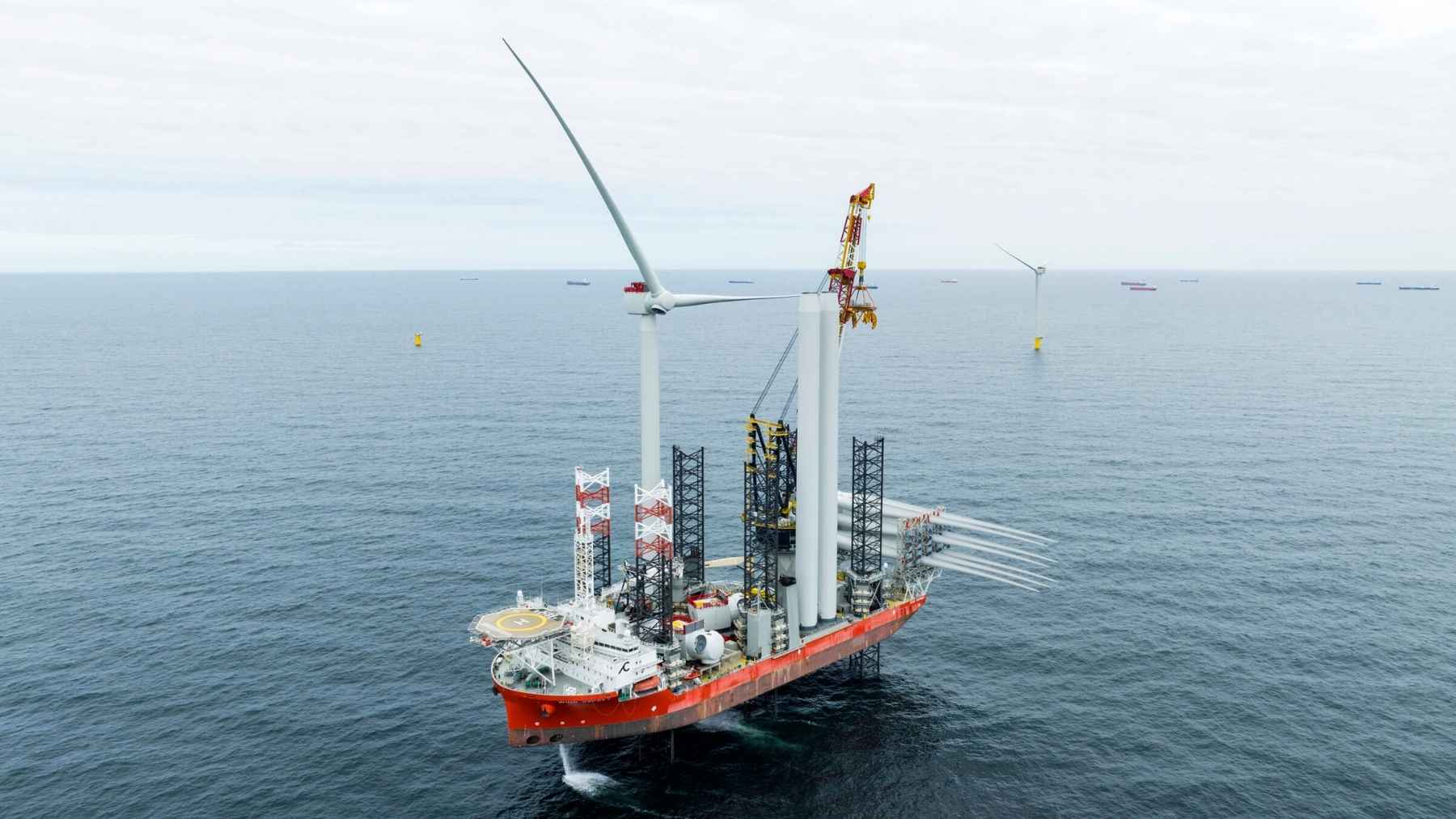
None of this is theoretical. WinGD delivered the first commercial two-stroke ammonia engine in 2025 and it went straight into a gas carrier under construction in South Korea, with roughly 30 more on the company’s order book. The engine is real, the ships are real, and the first cargo ships built to burn ammonia are scheduled to enter service this year. All of them light their ammonia with a pilot fuel, and meeting the strictest NOx limits means bolting a catalyst on behind it.
The cracker skips the flame entirely
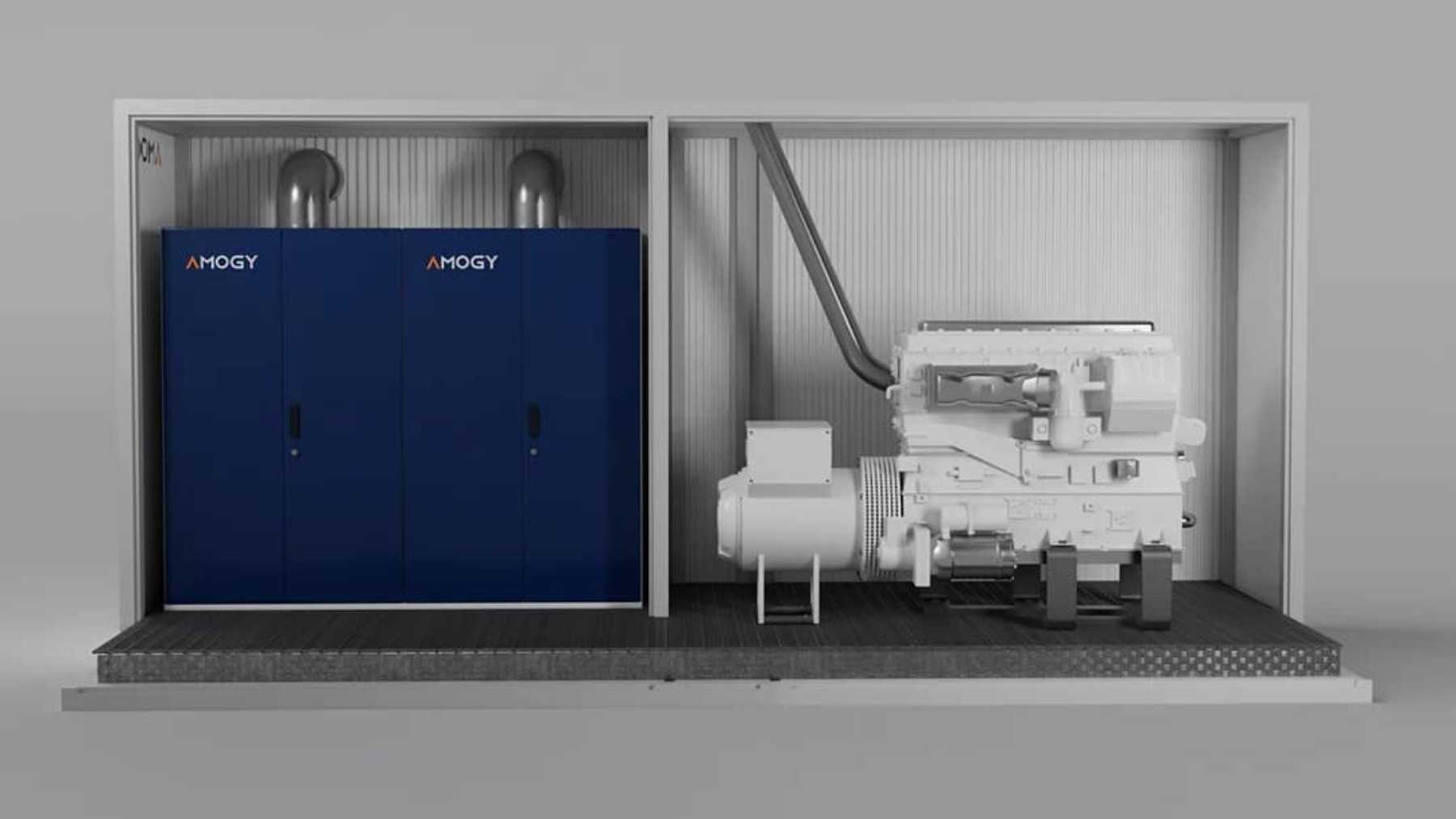
Amogy’s box does the chemistry instead of the fire. A catalytic reactor cracks liquid ammonia into hydrogen and nitrogen. An absorber scrubs out whatever ammonia survives the reactor. The hydrogen goes into a low-temperature fuel cell, which turns it into electricity and water, and electric motors do the rest.
The appeal is in the molecule. Ammonia is about 18% hydrogen by weight, it stays liquid under mild pressure at room temperature, and Amogy puts its energy density at roughly three times that of compressed hydrogen. You get the hydrogen fuel cell without the hydrogen tank.
Cracking ammonia is old industrial chemistry, normally done in enormous high-temperature reactors at fertilizer plants. The four MIT alumni who founded Amogy in 2020 rebuilt the catalyst to work at lower temperatures, which let the reactor shrink to something you can bolt to a deck. The company says its catalysts are up to 70% more efficient than commercially available alternatives, a figure that comes from Amogy rather than an independent lab.
Chief executive Seonghoon Woo told MIT News that nobody else has demonstrated ammonia powering machines “at the scale of ships and trucks.” The quieter half of the pitch is that with no combustion there is no pilot fuel, and no flame front to negotiate with a class society.
A tugboat from 1957 made the case
The boat is named the NH3 Kraken, which is a chemistry joke and a decent one. It was built in 1957, spent its later working life breaking ice, and was laid up at a shipyard in Kingston, New York, when Amogy bought it and gutted the diesel plant.
On September 23, 2024, the retrofitted tug sailed on a tributary of the Hudson River upstream of New York City, running on green ammonia and a megawatt-scale version of the cracker-and-fuel-cell system. The Maritime Executive reported that its 2,000-gallon tank is good for ten to twelve hours of operation.
Amogy calls the Kraken the world’s first carbon-free, ammonia-powered vessel, and the wording is doing real work. Ammonia-burning ships had already moved under their own power, including Fortescue’s converted offshore support vessel and an ammonia-fueled tug launched by NYK in Japan. What the Kraken did first was the cracking route: ammonia to hydrogen to fuel cell, no combustion anywhere in the chain.
It is not spotless either. The company acknowledged that the system still throws off trace amounts of nitrogen oxides, which it says it is working to eliminate. Trace, not zero.
The semi-truck is the part that should bother diesel
Before the boat there was a truck. In January 2023 Amogy showed a retrofitted 2018 Freightliner Cascadia, a Class 8 tractor, carrying a 300 kW ammonia-to-power system with 900 kWh of stored net electric energy. It ran for several hours on the campus of Stony Brook University.
The number that should get a fleet manager’s attention is not the power. It is the fill: eight minutes, according to Amogy. A battery-electric Class 8 cannot do that, and charge time is the single hardest thing about electrifying long-haul freight.
Then the reality check. That was a university campus, not Interstate 80. There is no ammonia fueling network for trucks, no production Class 8 running on the stuff, and no regulator anywhere has written the rules for pumping a toxic gas into a tractor at a truck stop. Amogy has since aimed its commercial effort at ships and stationary power, which is where the customers with permits live.
Korea is where the money actually shows up
In April 2025 Amogy signed on with GS Engineering & Construction, HD Hyundai Infracore and the city of Pohang to build a 1 MW ammonia-to-power pilot, with a plan to grow the site to 40 MW of commercial capacity around 2028 or 2029. The system pairs Amogy’s cracker with HD Hyundai Infracore’s HX22 hydrogen engine.
The hydrogen in Pohang goes into a piston engine, not a fuel cell. Amogy sells the cracker either way, which is the whole strategy. Whatever consumes the hydrogen downstream, somebody has to split the ammonia first.
Amogy and GS E&C turned that partnership into a joint venture called Amun Energy in April. On June 8 the two executed a supply agreement for the commercial 40 MW project, beginning with the 1 MW pilot and scaling to 40 MW of installed capacity by 2029. Woo called it “a clear commercial pathway for scaling ammonia-based distributed power generation in Korea.”
Samsung Heavy Industries, which agreed last November to contract-manufacture Amogy’s systems, builds the hardware. The company has raised more than $300 million from backers including Amazon’s Climate Pledge Fund, Aramco Ventures, SK Innovation and Mitsubishi Corporation.
Japan is the next stop, and the shape of the deals there says something. In March, Amogy signed with Hoku Infrastructure to look at ammonia-powered data centers. On June 16 it announced a partnership with the 130-year-old trading house KOWA to supply cracked hydrogen in Japan’s Chubu region.
That last one is not a power system. It is hydrogen logistics: ship the ammonia, crack it where the hydrogen is wanted, skip the cryogenic tanker entirely. Amogy’s own corporate boilerplate now describes it as an ammonia-to-hydrogen and ammonia-to-power company, in that order.
The cracker does not fix the ammonia itself
Every ammonia-as-fuel argument hits the same wall, and no catalyst climbs it. Most of the world’s ammonia is made from natural gas. A fuel cell that emits only water does nothing for the climate if the ammonia arrived from a steam methane reformer.
Green ammonia, made with renewable hydrogen, is the fix, and that supply chain is thin and expensive. India has been building one of the first at real scale, and the price it locked in was low enough to make news, which tells you exactly where the baseline sits. The same missing molecule is under every clean-fuel mandate being written right now.
Then there is ammonia itself. It is toxic at low concentrations, and a bunkering spill in a crowded port is a public health event rather than a fuel spill. That problem belongs to the harbormaster, not the catalyst.
The rules are stuck too. The International Maritime Organization’s environment committee met in October 2025 to adopt the Net-Zero Framework, the global fuel standard and carbon price meant to make clean marine fuels worth buying, and voted 57 to 49 to adjourn the session for a year. It reconvenes this October. Until something like it passes, ammonia costs more than fuel oil and nobody is obliged to care.
Meanwhile the industry keeps arguing about how to consume the molecule. A gas turbine cleared to run on pure hydrogen at sea collected its marine type approval in Athens last month. The engine builders keep refining pilot injection. Amogy is quietly selling the step that comes before all of them.
The Kraken did its job the moment it moved. Everything after that is procurement, and procurement is where clean-fuel startups usually go to die.
Pohang is the test. Forty megawatts is a real industrial power block, built by Samsung Heavy Industries, running on ammonia somebody still has to make cleanly, in a country that passed a Distributed Energy Act specifically to make projects like it possible. Woo says dozens more are in the works.
Exactly one of them has a signed supply agreement and a delivery date.