
Every argument about green hydrogen turns into an argument about the power bill. Electricity is the biggest cost in splitting water, so the industry spends its life hunting cheap solar, cheap wind and cheap grid connections. Almost nobody goes after the machine doing the splitting.
An Australian company has spent five years doing exactly that. Last month, somebody finally signed for one.
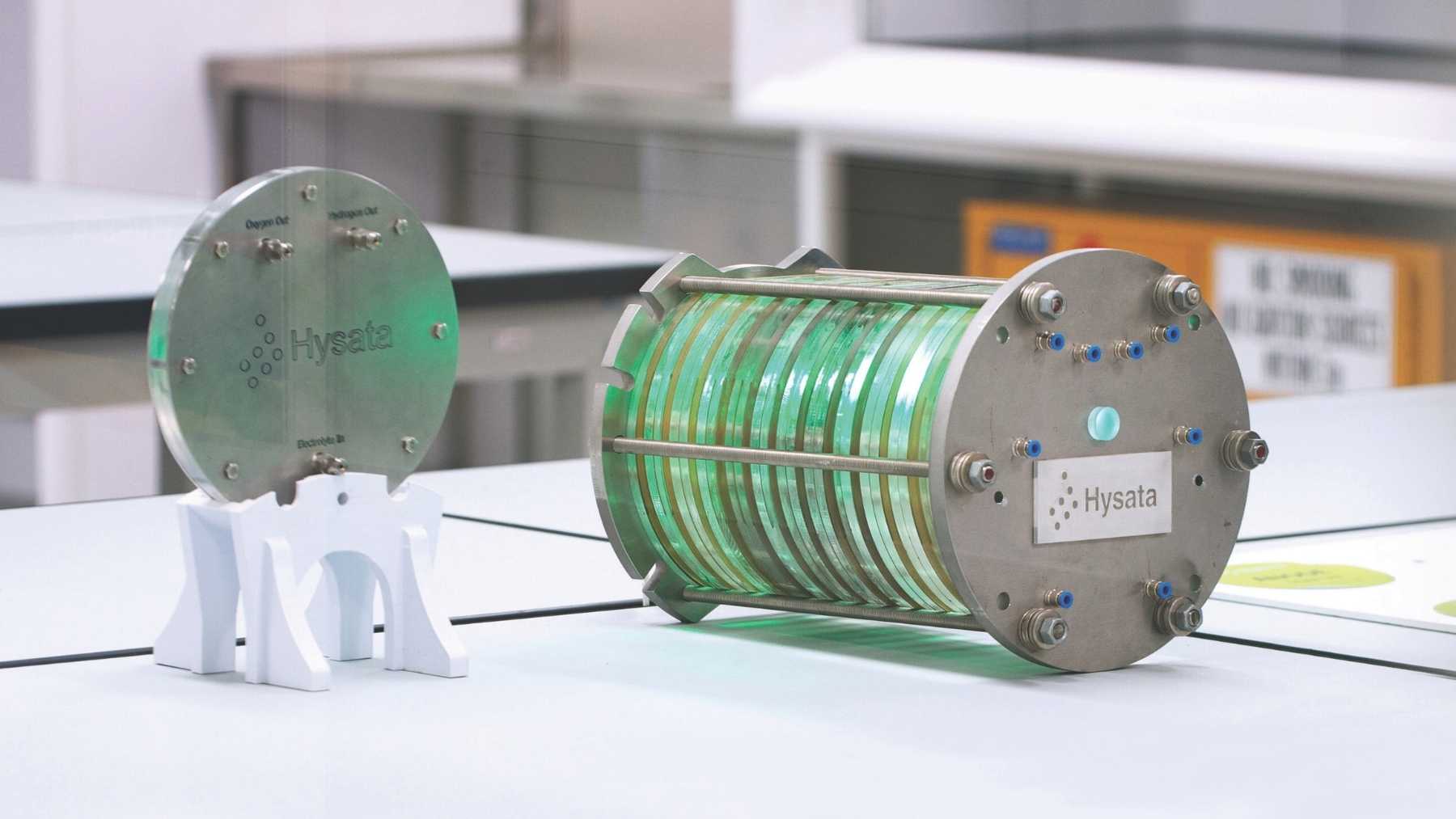
Hysata, based in Port Kembla on the New South Wales coast, builds an alkaline electrolyzer that feeds water to the cell by capillary action, the way a paper towel pulls a spill up off the counter. The Australian Renewable Energy Agency, which funds the pilot, says the design lifts system efficiency from 75 percent, where commercial electrolyzers sit today, to 95 percent.
On June 15 the company announced its first binding megawatt-scale order, from a customer it will only describe as a global heavy-industry leader, for delivery in the first half of 2027.
It’s a real milestone. It’s also a much smaller machine than the efficiency headline implies, and the gap between those two facts is the actual story.
Bubbles are why an electrolyzer runs hot
A standard alkaline electrolyzer dunks two electrodes in liquid electrolyte and pushes current through. Hydrogen forms on one side, oxygen on the other, and both come off as bubbles that cling to the electrodes on the way out.
Those bubbles are the problem. They blanket the surface where the reaction is supposed to happen, and they add electrical resistance. Resistance turns electricity into heat instead of hydrogen. Then you spend more energy hauling that heat back out with a cooling system.
Hysata’s cell never lets the electrodes touch bulk liquid at all. The electrolyte, potassium hydroxide, sits in a reservoir at the bottom and climbs a porous separator wedged between the two electrodes, pulled upward by capillary action alone. The separator is a polymer foam; the company has described it as looking like a kitchen sponge under a microscope.
Water reaches the electrodes through the sponge. The gases come off into dry chambers on the far side, with nothing to bubble into. Less resistance, less heat.
Hysata told the trade publication Hydrogen Insight in 2023 that the cell throws off roughly ten times less heat than a typical alkaline or PEM stack, which is the reason it can strip out most of the cooling hardware. A machine that barely warms up doesn’t need much of a chiller.
98 percent and 95 percent are not the same number
This is where the story usually gets mangled, including by people who should know better.
The peer-reviewed figure is 98 percent, and it belongs to a single cell in a laboratory. In March 2022, a University of Wollongong team published the capillary-fed design in Nature Communications. Running at half an amp per square centimeter and 85 degrees Celsius, the cell needed 1.51 volts. That works out to 98 percent cell energy efficiency on a higher-heating-value basis, and 40.4 kilowatt-hours of electricity per kilogram of hydrogen. Commercial cells in the same comparison needed about 1.77 volts and 47.5 kWh/kg.
The paper’s corresponding author, Gerhard Swiegers, is now Hysata’s chief technology officer.
The 95 percent figure is a different animal. It describes the entire system, stack plus balance of plant, and it comes to 41.5 kWh/kg. ARENA repeats it throughout its project documents, sourced from Hysata.
Hysata’s own site says its 95 percent system efficiency “has been recognised via publication” in Nature Communications. The paper it points to measured a cell, four years ago, at lab scale. The system number is the company’s.
To the journal’s credit, Nature Communications did publish an author correction to that 2022 paper in 2024, fixing a calculation error in one of its cost references. The efficiency measurements were left alone.
The pilot is 200 kilowatts, not 200 megawatts
ARENA’s project page puts the capillary-fed demonstration at 200 kilowatts. That is a research machine, and it should be read as one.
For scale: Orica’s Hunter Valley Hydrogen Hub, which reached a final investment decision this year with ARENA money behind it, will install a 50-megawatt electrolyzer at Kooragang Island. That’s 250 times bigger than the Hysata pilot.
The bigger Hysata machine is a separate project. In 2023 the company won a A$20.9 million ARENA grant toward a A$47.5 million effort to build a 5 MW commercial-scale electrolyzer and field-trial it for six months.
The 200 kW pilot itself runs under HyGATE, the German-Australian hydrogen incubator. Hysata works there with three Fraunhofer institutes, Forschungszentrum Jülich and three German industrial suppliers. The project started in June 2023.
Its most recent progress report, filed in January 2026 and covering the back half of 2025, spends most of its pages on intellectual-property agreements for shipping samples between partners, on customs and biosecurity paperwork, and on the discovery that several equipment suppliers had never sent a system that large to Australia before.
None of that makes a press release. All of it decides whether the machine shows up.
Queensland pulled the plug, and Hysata had a plan B
The 5 MW demonstrator was supposed to run next to Stanwell Corporation’s power station in Rockhampton, Queensland. Stanwell had committed A$3 million and the site under a memorandum of understanding.
In February 2025, the Queensland state government announced it would halt all investment in hydrogen. In March 2025, Stanwell confirmed the demonstration site would not proceed.
You won’t find that in the marketing. You will find it, stated flatly, in Hysata’s own February 2026 lessons-learnt report to ARENA, which adds that the company had been courting backup partners in parallel and was able to move the demonstration elsewhere and adjust its scope without much disruption.
The rest of that report is about when to lock in material choices and who owns a decision when procurement and quality disagree. Deeply unglamorous. Also the difference between a company that ships hardware and a company that doesn’t.
A 9.4-gigawatt pipeline that became one megawatt-scale order
This is the part the announcements skip.
When Hysata opened the Port Kembla factory in August 2023, it described a 9.4-gigawatt pipeline of signed conditional orders and letters of intent. It planned a 100 MW-per-year production line. It expected commercial-scale units delivered in 2025 and gigawatt-scale capacity by 2026.
It is now July 2026. The first binding order is megawatt-scale, singular, and arrives in the first half of 2027.
Conditional orders and letters of intent are not orders. That distinction is precisely why the June announcement matters, and why Hysata leaned so hard on the word binding.
Chief executive Paul Barrett has been unusually blunt about the boom that produced all those letters. “It’s probably fair to say the green hydrogen industry has had a dot-com moment,” he told Australian Associated Press this month, pointing to a stretch of cheap capital and announcements made with no offtake attached to them.
The numbers agree with him. A Nature Energy study tracked 190 green hydrogen projects and found that of the 4.3 gigawatts of capacity the industry announced for 2023, 0.3 GW got built on schedule.
Efficiency only pays if the machine lasts
The physics is the strong part here, and the physics is not the risk.
A kilogram of hydrogen holds 39.4 kilowatt-hours of energy. That is a hard floor. Barrett’s whole pitch rests on how far above it you have to operate: “Electricity is the largest cost component in green hydrogen production,” he said in the June announcement. Shaving 11 kWh off every kilogram, forever, is a bigger lever than almost anything else a plant operator can pull.
What nobody outside the manufacturers can verify yet is durability. On June 23, BloombergNEF reported that Chinese electrolyzers have caught up with Western equipment on efficiency while costs fall on both sides, and cast doubt on whether electrolyzers as a class are meeting the lifetimes the industry advertises. A cell that starts at 95 percent and degrades faster than a cheap one at 75 percent is not a bargain.
There is more than one way to attack the cost of hydrogen, and Hysata has picked the hardest. Electric Hydrogen trucked a complete 100-megawatt hydrogen plant into West Texas on skids and says the approach cuts total installed cost by up to 60 percent, going after construction rather than physics. Fraunhofer ISE wired concentrator solar cells straight into an electrolyzer and hit 31.3 percent solar-to-hydrogen outdoors. Others have given up on manufacturing the molecule at all and are pumping hydrogen out of Kansas bedrock.
Hysata bet the company on the cell.
The next real test isn’t an announcement. It’s the 5 MW demonstrator, at whichever site replaced Rockhampton, running for six months while somebody who doesn’t work at Hysata reads the meter. Then a megawatt-scale unit inside a working industrial plant in 2027, at load, in weather, for years.
If the sponge holds up, the machine has earned the noise around it. If it doesn’t, Hysata will have spent five years and a US$111 million Series B proving something in a laboratory that a factory floor never confirmed. The customer who signed last month is simply the first one willing to pay to find out.