
America’s nuclear revival usually gets described as a paperwork problem. Permits, licenses, hearings, the decade of legal wrangling before anyone pours concrete. Fix the regulator, the argument goes, and the reactors follow.
On June 23 the Department of Energy conditionally committed up to $17.5 billion in loans, and the money is not aimed at lawyers. It is aimed at parts. The financing, offered through the department’s Office of Energy Dominance Financing, is meant to buy the long-lead equipment for as many as 10 Westinghouse AP1000 reactors, in up to five projects of two reactors each, with the goal of having them under construction by 2030.
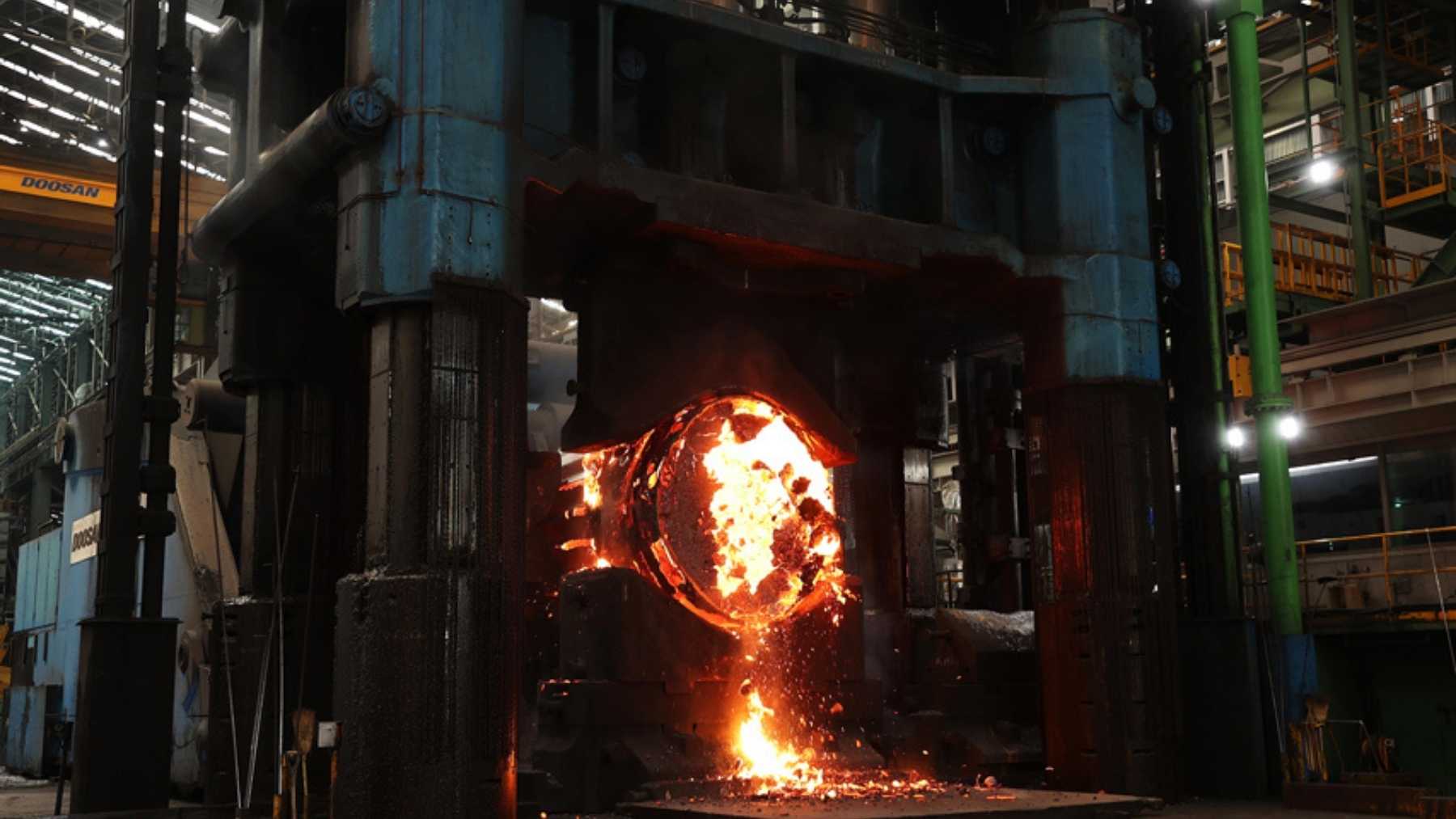
Long-lead equipment means the reactor pressure vessel, the thick steel can that holds the fuel, the coolant and the reaction for the life of the plant. And the machine that can forge one of those in a single seamless piece is not in America. It is a 17,000-ton press on a factory floor in Changwon, South Korea, owned by Doosan Enerbility, and it has already forged the vessels for the last four American AP1000s.
The press is the gate, and the numbers are unforgiving
Reactor vendors would rather the biggest forgings arrive as one piece. Weld several forged rings together instead and you create seams that have to be inspected for the whole life of the plant. The World Nuclear Association’s position is that the fewer welds you need, the better.
Doing it in one piece takes a specific machine. For very large Generation III+ reactors, the Association puts the requirement at a forging press of roughly 14,000 to 15,000 metric tons, fed with hot steel ingots of 500 to 600 metric tons. Westinghouse has said the minimum for making the largest AP1000 components is a 15,000-tonne press taking 350-tonne ingots.
Those presses are not sitting around idle, either. One big press turns out about four pressure vessels a year, fitted in around whatever else it is making, which is why utilities book forging slots long before a project has a construction contract.
The list of countries running very heavy nuclear forging capacity today is short: Japan, China, South Korea, France and Russia. Doosan is South Korea’s entry. Its Changwon plant runs a 13,000-ton press and the 17,000-ton one, which handles ingots up to 540 metric tons and is the largest single figure in the Association’s global table. Doosan describes it as the world’s biggest four-pillar forging press, standing about 95 feet tall and 30 feet wide.
America had the presses in the 1970s and never upgraded them
The United States used to do this work. In the 1970s, US Steel and Bethlehem Steel each ran an 8,000-tonne press and could handle 300-tonne ingots, which suited the reactors being built at the time.
Then the orders dried up and nobody scaled the equipment. The Association’s assessment of the present situation is one sentence long: nothing in North America currently approaches these enterprises. The company that built most American reactor pressure vessels in the 1970s and 1980s is now owned by ArcelorMittal, a steelmaker headquartered in Luxembourg.
The gap is not really about press tonnage. Allegheny Technologies has a 15,000-tonne press in the US, which clears the force Westinghouse specifies. It can only take a 175-tonne ingot. Lehigh Heavy Forge tops out at 270 tonnes, North American Forgemasters at 170.
So the squeeze exists and the steel does not. The Association is specific about why: US forging capacity was never integrated with the steel mills and melt shops that would have to supply the hot metal as 600-tonne ingots. BWXT is the only remaining American manufacturer of nuclear reactor pressure vessels, and its largest commercial nuclear plant in North America sits across the border in Cambridge, Ontario.
Doosan already forged America’s last four AP1000 vessels
This is not Doosan’s first American reactor, which is a large part of why it keeps getting the next one. The company won contracts from Westinghouse and Shaw to supply the reactor pressure vessels and steam generators for four AP1000 units in the United States: the two now running at Vogtle in Georgia, and the two at V.C. Summer in South Carolina that were abandoned mid-build in 2017.
That second pair is not scrap. The Summer units are being revived by Brookfield and Santee Cooper, with most of the original hardware still on site. Korean-forged steel that has sat in a South Carolina warehouse since 2017 is about to go into an operating American reactor.
Doosan also supplied vessels and steam generators for two of the four AP1000s built in China, subcontracting some forgings to China First Heavy Industries. By mid-2017 it had delivered 32 reactor pressure vessels of various designs and 108 steam generators. It built the heavy reactor components and turbines for the four APR-1400 reactors at Barakah in the UAE, under a $3.9 billion contract signed in 2010.
The Texas deal that put steel behind the announcements
The company that turned this into a signature is Fermi America, co-founded by former Energy Secretary Rick Perry. Last October, days before President Trump flew to Seoul, Fermi signed an agreement with Doosan to begin forging production of its long-lead nuclear equipment, meaning the reactor pressure vessels and the steam generators, as World Nuclear News reported. It signed a front-end engineering design contract with Hyundai Engineering & Construction the same day.
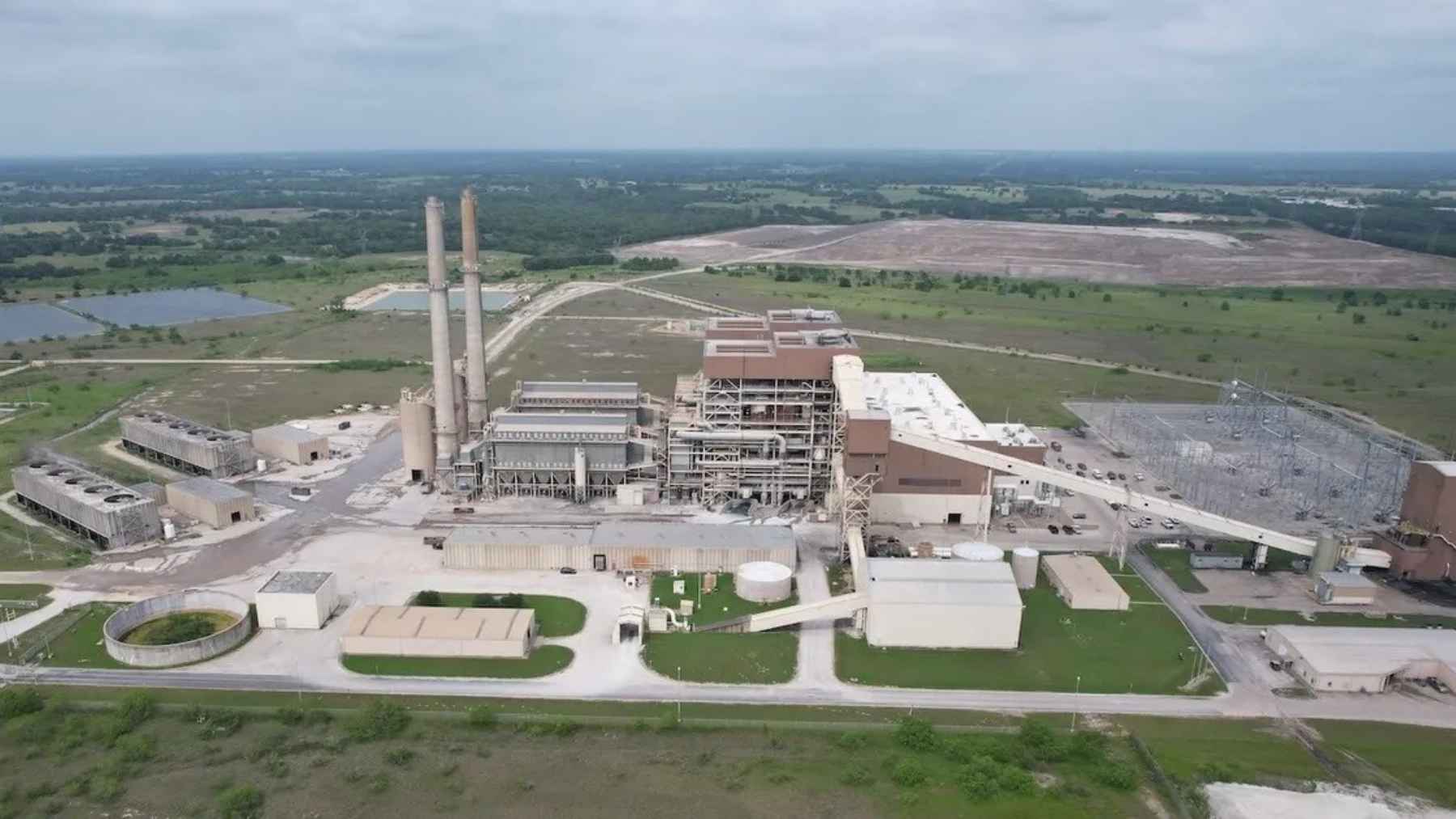
The reactors go at Project Matador, a private power campus in the Texas Panhandle next door to Pantex, where the country assembles and disassembles its nuclear weapons. Four AP1000s, about 4.4 gigawatts, feeding data centers behind the meter.
Fermi is further along on paper than anyone else and further from a shovel than the press releases suggest. It filed its combined operating license application in June 2025 and the Nuclear Regulatory Commission accepted it that September, which Fermi says makes it the first such application taken up for review in 15 years. The NRC’s own docket page notes that Fermi has filed two of the application’s three parts, and that the agency will run its full acceptance review and set a schedule once the third one arrives.
Nuclear construction at the site is targeted for 2027. Fermi replaced its chief executive in April. Toby Neugebauer, who signed the Doosan deal as co-founder and CEO, left the job and kept his board seat.
The loans do not buy a reactor, and nobody pretends otherwise
The $17.5 billion does not pay for a reactor. Westinghouse, jointly owned by Brookfield and Cameco, would use the loans to buy components. The commitment is conditional, and DOE has said it expects to name the utilities receiving the money later this year.
Edwin Lyman, director of nuclear power safety at the Union of Concerned Scientists, told Utility Dive the package is “a drop in the bucket compared to the likely total project cost”, which he estimated could approach $200 billion for ten reactors. His sharper point was that none of the five potential projects is backed by an actual construction contract yet.
What the money does buy is a place in the forging queue. At roughly four vessels per press per year, that queue is the scarce commodity, and it forms in front of presses that already exist.
Rolls-Royce went to Changwon too
In late May, Rolls-Royce SMR named the suppliers for the pre-production work on its 470-megawatt small reactor, the one headed for Wylfa in Wales and Temelín in the Czech Republic. It picked Doosan and the Czech firm Škoda JS to handle the reactor pressure vessel body and other core nuclear island parts.
Ruth Todd, the company’s operations and supply chain director, called them “some of the most important long-lead items in nuclear plant construction” in the announcement from Rolls-Royce SMR, and said the dual-supply approach was there to protect delivery. Neither supplier is British, which caused a certain amount of noise in Westminster.
The pattern repeats wherever the parts are heavy. Hungary’s 330-ton vessels are being forged in Russia. Poland’s three American reactors depend on the same short list of foreign forges, and the 14,000-ton press at Muroran in Japan has quietly supplied much of the world’s nuclear steel for decades.
A press takes longer to build than a loan takes to approve
Britain is trying to fix its end of this. Sheffield Forgemasters, owned by the Ministry of Defence, is putting up a new forge building on Brightside Lane for a 13,000-tonne press built by Mitsubishi Nagasaki Machinery, part of a £1.3 billion recapitalisation aimed mainly at the AUKUS submarine program. Installation is scheduled to begin in July 2027 and take about a year.
Even when it runs, 13,000 tonnes sits under the 15,000-tonne bar Westinghouse set for the biggest AP1000 forgings. That is the timescale everyone building reactors is actually working against. A loan can be approved in an afternoon and a license application filed in a morning. A press, its melt shop and the crews who know how to run it take the better part of a decade.
America designed the AP1000 and is about to order more of them than anybody. The vessels for the first ten will be squeezed into shape roughly 6,600 miles from the sites they are going into, by a machine nobody in the United States chose to build.