
Every nuclear plant on the grid can stop its own chain reaction in seconds. The control rods drop, the fission stops, the reactor is off. It works. It worked at Fukushima Daiichi, where the three reactors that were running scrammed automatically the moment the earthquake hit in March 2011.
All three melted down anyway. Stopping the fission does not stop the fuel from making heat, and when the tsunami took out the cooling, the decay heat did the rest.
That is the bargain you sign with a self-sustaining chain reaction. Every fission throws off enough neutrons to cause the next one, so the reaction pays for itself, and operating a plant means holding it back rather than feeding it.
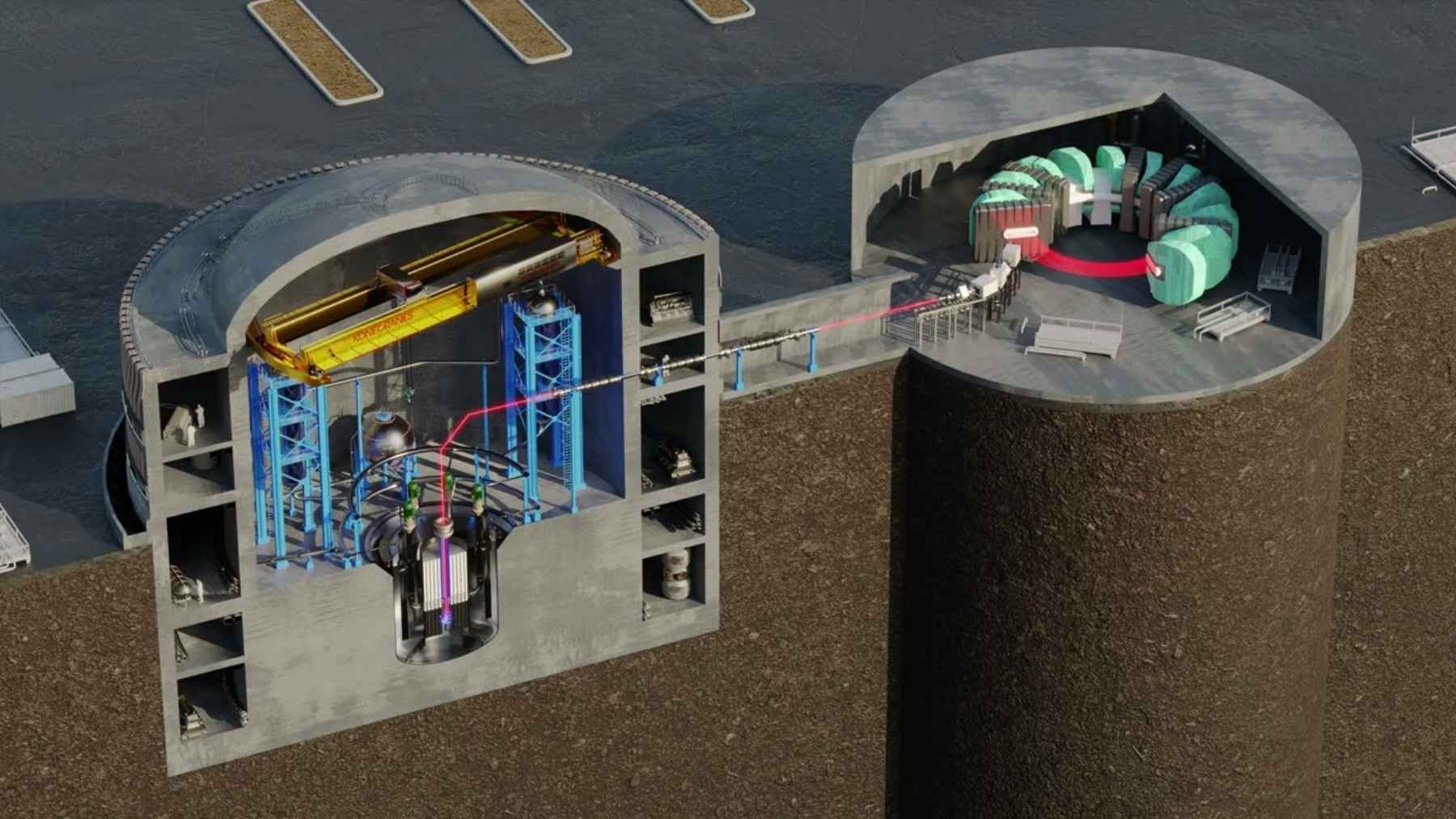
A Geneva company called Transmutex is designing a reactor that never gets to self-sustaining in the first place. Its core is built a few percent short of the neutrons it would need, and the shortfall arrives from a particle accelerator firing protons into a metal target inside the reactor. Stop the beam and there is no chain reaction left to stop.
The same machine is meant to run on the material every other reactor leaves behind. On June 4, Transmutex joined the Canadian Nuclear Isotope Council, and the announcement named both machines it is trying to build: HI-BEAM, an accelerator for medical isotopes, and START, short for Subcritical Transmuting Accelerated Regenerative Technology, the reactor designed to burn spent fuel.
Neither one exists. What Transmutex has is a set of physics experiments from the 1990s, simulation software, work on individual components, and a design. Germany’s nuclear waste regulator has been blunt about what that adds up to, and we will get there.
The reaction stops when you switch off the accelerator
Transmutex was founded in Geneva in 2019 by CERN scientists Federico Carminati and Jean-Pierre Revol, together with the entrepreneur Franklin Servan-Schreiber, who is now its chief executive. The idea is about 25 years older than the company. Carlo Rubbia, who shared the 1984 Nobel Prize in Physics and later ran CERN, spent the mid-1990s arguing that a particle accelerator could drive a reactor, and called the result an Energy Amplifier.
The mechanism is spallation. Fire a high-energy proton into a heavy metal like lead and it knocks neutrons loose. Feed those neutrons into a fuel assembly that is subcritical by design, and fission continues for exactly as long as the protons keep arriving. Transmutex chief financial officer Jean-Christophe de Mestral told Chemistry World in 2024 that the core runs about 3 percent short on neutrons.
Transmutex says the reaction dies less than two milliseconds after the beam does. The core sits in liquid lead, which is what carries the heat away afterward, because subcritical or not, the fuel still needs cooling once it stops splitting. Subcriticality takes the runaway scenario off the table. It leaves the decay heat exactly where it was.
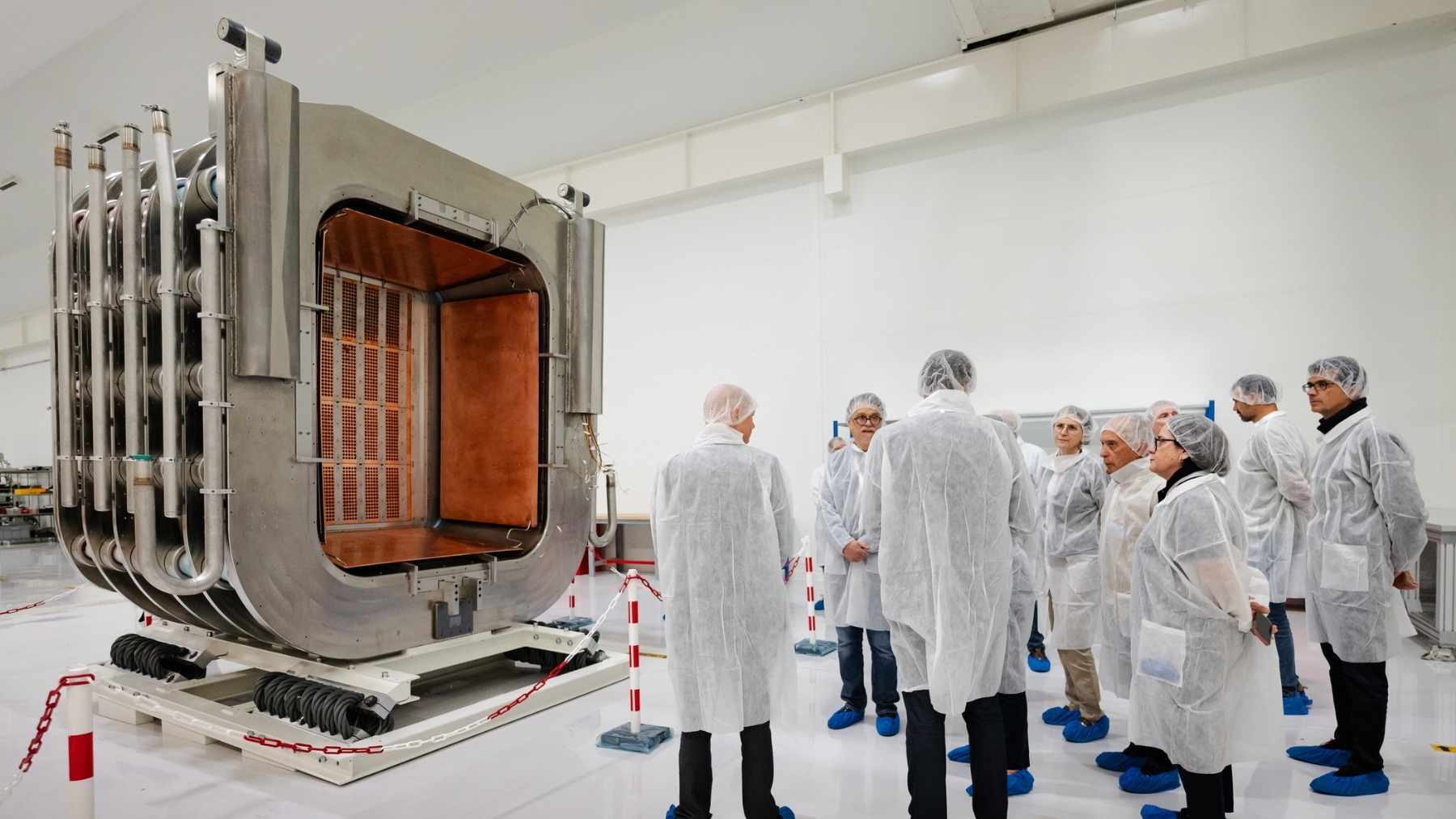
The accelerator is the part that does not exist. Transmutex chose a cyclotron over a linear accelerator, citing energy efficiency and a compact footprint, and says the design is modeled on the machine already running at Switzerland’s Paul Scherrer Institute. PSI’s HIPA ring cyclotron is the most powerful proton cyclotron in the world: 590 MeV, up to 2.4 milliamps, 1.4 megawatts of beam.
Transmutex’s FAQ says PSI’s power is now close to what START needs. A survey of new cyclotron projects presented at the 2025 International Conference on Cyclotrons and their Applications lists START’s driver at 4 megawatts, nearly three times the world record. Somebody still has to build that cyclotron.
Thorium will not burn on its own, and that is why they want it
Thorium-232 is fertile, not fissile. Left alone it sits there. Hit it with a neutron and it becomes thorium-233, which decays into protactinium-233 and then, about 27 days later, into uranium-233, which does fission. Because the fuel starts from thorium rather than uranium-238, it does not breed its way toward plutonium, americium and curium along the way.
It is the same fertile-not-fissile catch Copenhagen Atomics works around in Denmark, whose shipping-container thorium reactor needs a fissile kickstarter before the thorium does anything at all. Transmutex hands that job to the accelerator, and loads spent fuel from conventional reactors into the core alongside the thorium.
Spent fuel stays dangerous for hundreds of thousands of years because of two things, and neither is the uranium. Transuranics form when uranium captures a neutron instead of splitting. Long-lived fission fragments come out of the splitting itself. Transmutex’s FAQ puts the lifetime of both at more than 300,000 years, and says its reactor breaks them down until 20 percent of the original mass is left, as short and medium-lived waste.
Watch the units on that. The 20 percent is mass, and when Germany’s federal innovation agency ran the same technology through a study, the number that came out was a 90 percent cut in waste volume. The company’s public figures for how long the residue stays hazardous do not agree either. At One Ventures, which invested in Transmutex, has put it at 300 years. Servan-Schreiber told SWI swissinfo it was under 500. The German study said under 1,000.
Britain is chasing one thin slice of the same problem. Researchers there pull carbon-14 out of irradiated reactor graphite, seal it inside synthetic diamond, and collect the decay as a trickle of current. It works, and it handles one isotope. Transmutex is going after the actinides.
Germany paid for the study, then its own waste regulator tore into it
In February 2025, SPRIND, Germany’s federal agency for disruptive innovation, published an implementation study it had commissioned from Transmutex, the Technical University of Munich and TÜV Nord. The scenario put a transmutation plant at one of the decommissioned German nuclear sites already storing spent fuel, so nothing would need trucking across the country.
The claims were large. As Clean Energy Wire reported, the study argued that the hazard period could drop from around a million years to under 1,000, that waste volumes could fall 90 percent, that a system could be running by 2035 if the law changed soon, and that clearing one reference plant’s waste would take about 50 years.
Germany’s Federal Office for the Safety of Nuclear Waste Management, BASE, put out a statement of its own. The plant needs three things, it said: a particle accelerator, a nuclear recycling plant and a new generation of reactor. None of the three exists. The technology, in the office’s words, sits “at the level of paper or, at most, laboratory studies.” A deep repository would still be needed.
Transmutex agrees with that last part. Its own FAQ says a deep geological repository remains necessary, and that transmutation only shortens how long the waste has to be isolated. The argument is about how much shorter, and how soon.
On March 11 of this year, the International Nuclear Risk Assessment Group re-ran the scenarios and published a working paper. SPRIND had described one site, INRAG concluded, not a country. Clearing Germany’s full high-level inventory this way would take a fleet of irradiation facilities and a fuel-cycle industry that “might last for centuries.”
Transmutex does not dispute that the hardware is unbuilt. Its case is that every piece has been demonstrated somewhere already: an energy gain factor of 30 in CERN’s FEAT experiment in 1995, transmutation of technetium-99 and iodine-129 in TARC in 1997, a megawatt-class liquid-metal spallation target that ran four months at PSI, electrorefining of two tonnes of spent fuel at Argonne. What is left, the FAQ says, is an engineering effort rather than fundamental science.
Washington has bought a piece of that argument. In January 2025 the Department of Energy’s ARPA-E named Transmutex one of 11 projects in its NEWTON program, with more than $4.2 million to build an ion source reliable enough to keep a beam like this running. The work is being done with Los Alamos National Laboratory.
Belgium is already building the machine Switzerland is simulating
None of this is hypothetical in Mol, Belgium. At the SCK CEN research center, the MYRRHA project is putting up an accelerator-driven subcritical reactor for real: a lead-bismuth cooled fast core fed by a proton linac running at 600 MeV and up to 4 milliamps. Belgium approved 558 million euros for the first phase in 2018.
It is going up in stages, and the first of them, MINERVA, is only the opening 100 MeV of the linac. The reactor itself is a 2030s proposition. That is the timescale for this class of machine when a government has already written the check.
SCK CEN made the opposite hardware call, too. It chose a linac because a linac can be built with fewer interruptions in the proton flow than a cyclotron, and a subcritical reactor hates beam trips, since every one is a thermal shock to the core. Transmutex went with a cyclotron for efficiency and footprint. Belgium is the one pouring concrete.
America’s new reactors are chasing something else entirely. The first molten-salt reactor cleared for construction in the United States, going up in Tennessee, is there to sell electricity to Google. Most of that race is about the price of a megawatt-hour, not the size of the waste pile.
Switzerland will not let them build it at home
Switzerland voted in 2017 to stop building nuclear plants, and the revised law also banned the reprocessing of spent fuel indefinitely. A START plant needs both. Transmutex is headquartered in Geneva.
The politics have moved on the first one. On June 18, after the Council of States, the Swiss National Council approved the government’s counterproposal to the “Stop the Blackout” initiative, which would lift the construction ban. The Greens say they will force a referendum, so voters get the last word. That vote is about building power plants. Reprocessing is a separate prohibition.
So Transmutex sells the design and lets somebody else own the plant. Its FAQ says customers keep control of implementation and pick their own operators, a different business from the build-own-operate model most nuclear startups are pitching. The company told NZZ in 2024 that it was aiming for a US Nuclear Regulatory Commission license by 2035.
Which is why an isotope council matters more than it looks. The near-term product is HI-BEAM, an accelerator platform built to make alpha-emitting medical isotopes at industrial scale, actinium-225, radium-223 and lead-212 among them, at a moment when targeted alpha cancer therapies are nearing approval and the supply of isotopes to feed them is thin. Canada’s accelerator science and radiopharmaceutical infrastructure, Servan-Schreiber said, make it “a natural home for this kind of capability.”
Isotopes have buyers now. A reactor that eats plutonium has one kind of buyer, a government, and only once that government decides it wants one. Selling the first while the second waits tells you where Transmutex actually is.
The physics was checked at CERN and PSI between 1995 and 2006, and nothing since has cast doubt on it. What is still missing is a 4-megawatt cyclotron, a reprocessing plant, a reactor, a license and a customer. Transmutex calls that an engineering problem. BASE calls it paper. Both are describing the same list, and the fight is over how many decades it takes to work through it.
 mikeconley ENTHUSIAST3 months ago