
You have probably seen a drone-in-a-box by now, even if nobody told you that was the name for it. It is the weatherproof cabinet bolted to a warehouse roof or a substation fence, the one that pops open on a schedule, lets a quadcopter out, catches it on the way home and charges it until the next run. Every product in that category works for the same quiet reason: the box does not move.
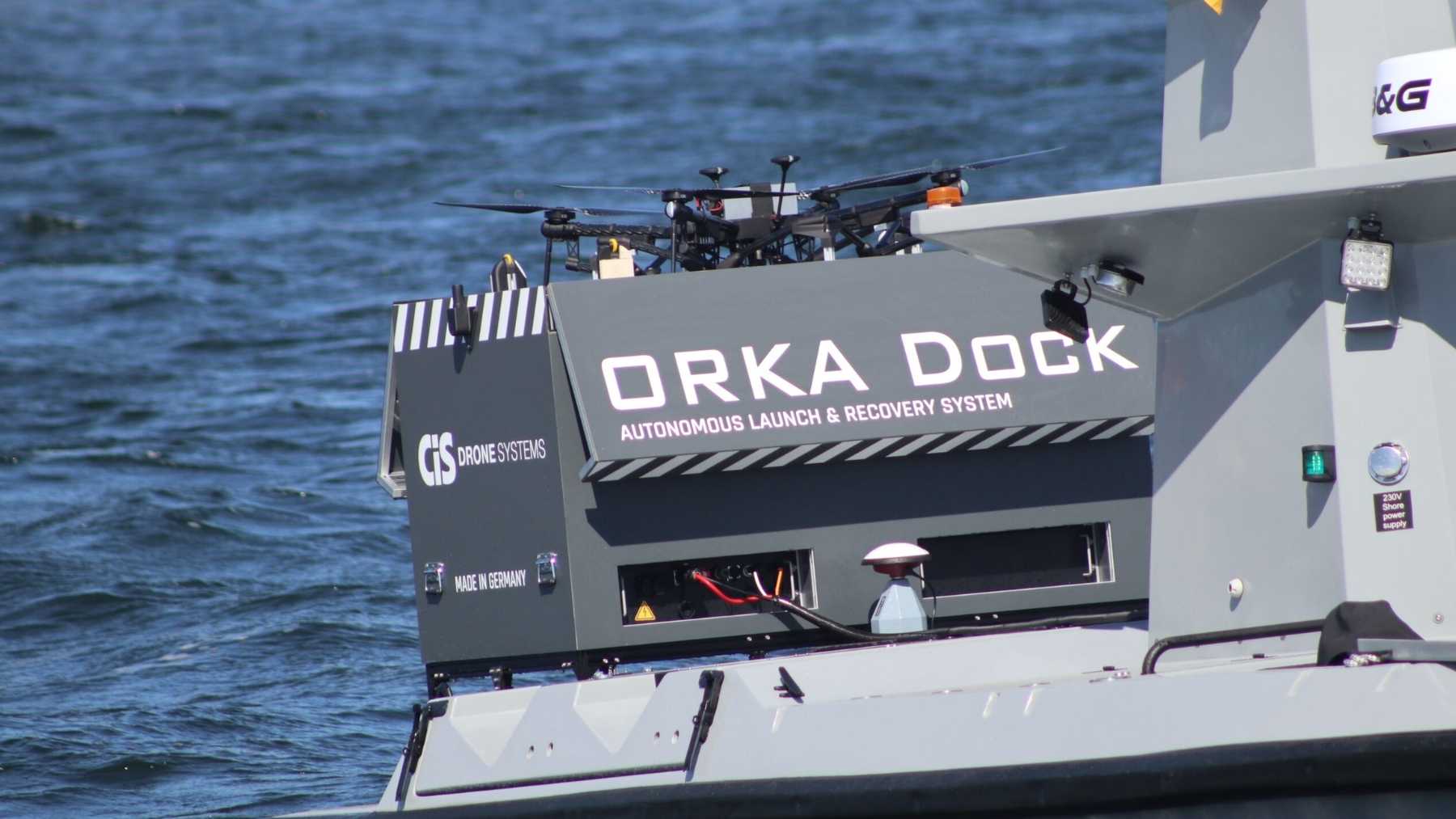
A German firm called CiS is now selling one that does. The ORKA Dock is a sealed hangar built to sit on the back deck of a boat with nobody aboard, open in under 30 seconds, put a drone in the air, and then recover that same drone onto a deck that is pitching in a swell and still making 15 knots (about 17 mph). No operator, no joystick, no hand on anything.
CiS put it on public display at the Combined Naval Event in Farnborough on May 19, and it did not show up as a slide. According to the company’s announcement, the dock had already been running daily for two weeks off a crewless boat in the Baltic, in an exercise where six European defense ministries were setting the problems.
Two months on, the more telling number is coming out of the factory. CiS builds around 100 ORKA aircraft a year at a site on the edge of Rostock with 30 people in it, and founder Tom Kaufmann told regional daily Nordkurier that the inquiries arriving from across Europe are running ahead of what that shop can produce.
The flying was never the hard part
Landing a multirotor on a boat is a different problem from landing one on the ground, and it is worth being precise about why. The deck is moving forward. It is also rising, dropping and rolling on a cycle the aircraft cannot see coming. And the touchdown has to happen inside a box barely wider than the drone itself.
CiS solves that with two pieces of its own kit. Recovery guidance comes from what the company calls its Precision Landing System, and the deck is found using BEACON, a patented deck-recognition technology that identifies the landing platform and compensates for the vessel’s motion instead of aiming at a fixed GPS point.
There is also one small sensor doing very unglamorous work. The ORKA carries a LiDAR altimeter with 20 meters of range and 5-millimeter accuracy, filed on the spec sheet under the heading “Safe Touchdown.” Five millimeters is about the thickness of three stacked pennies, which is roughly the tolerance you want when the thing you are landing on keeps dropping away underneath you.
Kaufmann’s framing of the result was blunt. Doing this from a moving uncrewed vessel in a live exercise with no operator intervention, he said, “is something that has never been done before,” and CiS believes it to be a world first.
That last part is the company’s own claim rather than an independent finding, and it reads better narrowly. What CiS is claiming is a mechanical first: a hangar that opens, launches and recovers on a deck that is moving forward and pitching at the same time. Coordinating aerial and surface drones together is not new. Running the entire cycle inside a box on a boat that never slows down is the specific thing being claimed.
They ran it against a live power cable between Germany and Denmark
The exercise matters more than the trade show, so it is worth knowing what it actually was. SeaSEC stands for Seabed Security Experimentation Centre, and it is not a vendor demo day. It is run by the Northern Naval Capability Cooperation, an alliance of the defense ministries of Germany, the Netherlands, Denmark, Finland, Norway and Sweden.
The 2026 edition, branded Data2Sea, ran from April 13 to 24 in the Mecklenburg Bight and out of the naval base at Rostock, in cooperation with the German Navy and hosted by the Rostock Institute for Ocean Technologies. Industry teams play blue. The participating navies play red.
Three scenarios covered cable protection, platform protection and harbour security, and the cable one was not a mock-up. Organizers wrote a real high-voltage power cable running between Germany and Denmark into the exercise, so detection and threat assessment had to work against live infrastructure in genuine Baltic conditions.
CiS says it took part in three separate consortia there, alongside HENSOLDT, Rheinmetall and Systematic. The company also says its MissionControl software fed the drone’s picture into Bundeswehr situational-awareness systems as well as those of its three industry partners, with an operator able to task the aircraft from a laptop while the full common picture stayed on screen.
The boat underneath it is doing a lot of the work
The host platform was a FLANQ Q-RECON 24, and its numbers explain why this pairing exists at all. FLANQ, a German maritime defense outfit with offices in Rostock and Halstenbek, lists the boat at 24 feet (7.3 meters), offered in monohull or twin-hull form.
Per FLANQ’s published specification, it does up to 56 mph (90 km/h), carries up to 4,400 pounds (2,000 kg) of payload and has a range of up to 3,000 nautical miles. The open back deck is built for launching and recovering aircraft, and there is an optional moonpool in the hull for putting sensors under the water.
Put the two together and the endurance arithmetic changes shape. Seventy-five minutes of flight is not very long. But the boat can stay out for thousands of miles and the dock recharges the aircraft between sorties, so coverage stops being a function of one battery and becomes a function of how long the hull can loiter.
That is carrier logic, scaled down. Launch, work, recover, recharge, launch again, with no flight deck crew because there is no crew at all. CiS has not published the dock’s dimensions or weight, so exactly how much deck it eats is still an open question.
FLANQ has had a busy summer either way. On July 14 the company announced that it and Lübeck’s GABLER had completed the surface half of sea acceptance testing on a very different machine: a drone boat designed to be fired out of a submarine’s 21-inch torpedo tube.
German dock, American radios
CiS describes the ORKA Dock as designed and built in Germany using sovereign components, and in the current European procurement climate that phrase is doing real work. Supply chain independence has become a stated policy goal across NATO members, and a German-built dock that turns any suitable hull into a persistent sensor is close to what Berlin has said it wants to buy from European industry.
The label applies to the dock, though, not to everything that flies out of it. CiS lists the ORKA’s communications options on its own product page as Silvus, DTC, Doodle Labs, Herelink and fiber, which puts American and British radios inside a German aircraft. The company is upfront about it, saying it deliberately uses established manufacturers from Europe, the United States and Germany.
The rest of the airframe is unremarkable in the way good military hardware usually is. Maximum takeoff weight is about 26 pounds (12 kg), it stays stable in winds up to 31 mph (14 m/s), tops out at 62 mph (100 km/h) and is rated IP55 for dust and water between -15 and 45 degrees Celsius.
The interesting entries sit further down the sheet. Dual RTK satellite antennas let it work out its own heading without a compass, inertial navigation keeps it flying if GPS drops out, and the listed interfaces include MESE, the Bundeswehr’s own situational-awareness system. A 394-foot (120-meter) fiber tether can also keep it airborne indefinitely.
The order book is beating the factory
Which brings it back to Bentwisch, the town on Rostock’s city limit where the ORKA is actually assembled. CiS was founded in 1990 as a software and network-information company. Kaufmann, now 25, took it over in 2022 with his brother Matthias and pointed the whole business at drones.
Current output is roughly 100 aircraft a year from a workforce of 30. Kaufmann told Nordkurier that the inquiries coming in from across Europe span military and civilian users, emergency services among them, and that the plan is to expand capacity as the dock moves into series production.
He also drew a line worth recording, telling the paper that CiS does not arm its drones. The ORKA’s stated job is covert reconnaissance, including work for the Bundeswehr, and it is built to watch rather than to hit anything.
Whether a 30-person shop can scale into that demand is the real question, and it is not a small one. Going from a hundred hand-built aircraft to a line that also turns out docks is a different business entirely, and the wider market is not standing still: Australia has ordered 40 crewless patrol boats in one go, and Lockheed Martin is pitching an underwater drone that clamps onto a friendly warship’s hull and hitches a ride.
What is missing from the public record is specific. No named buyers for the dock. No published weight or footprint. No evidence yet that the Precision Landing System behaves the same on a slow, heavy commercial deck as it does on a fast tactical boat designed around it.
What is on the record is two weeks of daily flying in an exercise written by six defense ministries, with a live power cable in the water, in which a box on a moving crewless boat opened, launched an aircraft, caught it again and repeated the whole thing the next morning. NATO has been pushing uncrewed hulls into the Baltic since it launched Baltic Sentry in January 2025 to watch the cables down there. This is what the top of one of those hulls is starting to look like.
 @wandajean ROOKIE2 months ago