
Almost every reactor you have ever seen a photograph of was built to make electricity. Steam hits a turbine, the turbine spins a generator, and those enormous cooling towers exist to throw away whatever heat is left over at the end of the chain.
A French startup called Jimmy has been building one since 2020 that skips the entire back half of that sentence. No turbine. No generator. No grid connection. The machine sells heat, and nothing but heat, to the factory standing next to it.
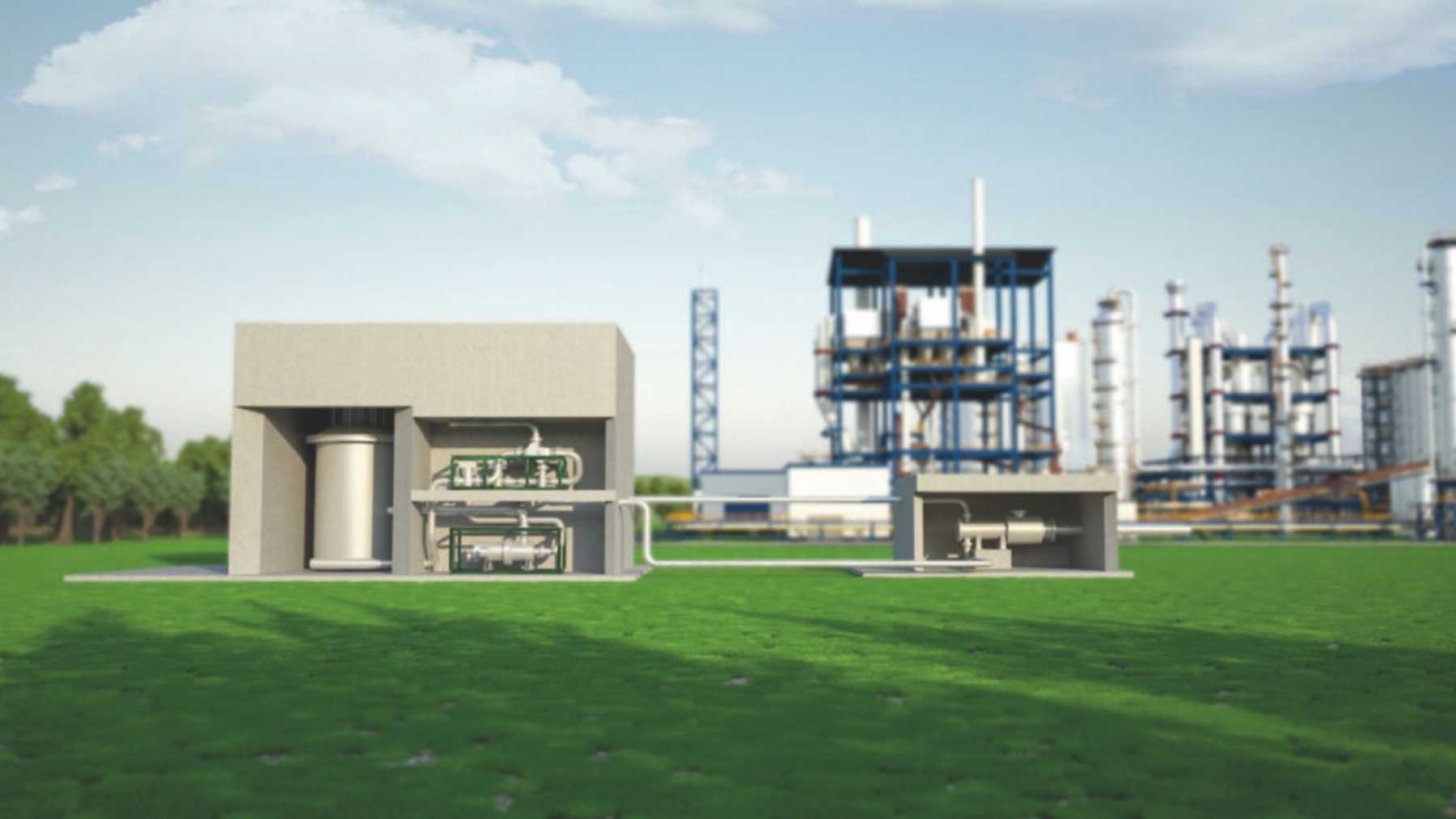
The factory is a sugar and ethanol plant at Bazancourt, near Reims, east of Paris. The reactor is a box roughly 40 meters on a side, about 131 feet, with pressurized helium running through a core that sits at 750 degrees Celsius, or 1,382 Fahrenheit.
On July 23, France’s nuclear safety authority logged an update to the construction license for that machine. There was no press release about it. The company’s own newsroom has not posted anything since June. The update showed up in a regulator’s table, and it says the reactor has been redesigned.
There is no turbine anywhere in this thing
Jimmy’s published specification describes a high-temperature reactor cooled by helium and moderated by graphite. The primary circuit pulls heat out of the core using pressurized helium. That is where a normal plant would start converting heat into motion.
Instead, the helium hands off to a secondary loop running carbon dioxide, which reaches up to 450 degrees Celsius (842 F). A cold loop comes in from the factory, gets heated by the CO2, and goes back out. Heat delivered to the industrial process tops out at 500 degrees Celsius (932 F).
The temperature is the whole argument. Jimmy points out that its core runs at 750 degrees while a water-cooled reactor runs closer to 300 (572 F), and process heat is the market nobody has been able to serve with nuclear at that grade. Sugar refining, distilling and drying all want steam, not electrons.
Fuel is TRISO, uranium kernels wrapped in carbon and silicon carbide layers, which the company says hold in 99.9 percent of fission products even in an accident. The graphite doubles as a passive heat sink if the reactor shuts down. Both claims are standard for the reactor family and both are still being examined by the regulator, which matters more than the brochure.
If the no-turbine part sounds familiar, it should. A Finnish outfit is chasing the same trick at the opposite end of the thermometer with a reactor that heats city pipes and never spins anything either. Jimmy is that idea aimed at a factory instead of a neighborhood, at process temperatures instead of hot water.
France’s regulator got a new set of drawings on July 23
The paper trail here is unusually easy to follow, because the Autorité de sûreté nucléaire et de radioprotection publishes exactly where every French small reactor project sits. Jimmy filed its construction authorization request on May 4, 2024, for a reactor meant to supply heat to Cristal Union’s site at Bazancourt.
The ministry came back with a request for more information on February 13, 2025. Jimmy’s answers landed on July 23, 2026, bundled with what the regulator describes as “changes to the reactor design” plus the responses that still applied after those changes. A technical examination of the updated file was ordered the next day.
Seventeen months between the questions and the answers is not a scandal, but it is a schedule. The company had told French trade press it would respond by March 2026, so this is already a few months past that mark, and the file has now been open for more than two years.
Jimmy’s second license, for a TRISO fuel assembly workshop at Le Creusot called Marie Curie, was filed on March 27, 2024. That one is listed as suspended, waiting on additional information. So the reactor and the plant meant to feed it are both sitting in the same queue.
Nobody has signed anything for the sugar mill
This is the part most coverage gets loose about. The license names Cristal Union’s Bazancourt site because that is where the machine would go. It does not mean the sugar cooperative has bought a reactor.
Cristal Union confirmed back in 2024 that Jimmy’s generator was the subject of a feasibility study and that no agreement had been signed, and it has never taken a biomass boiler off the table. Its own decarbonization materials describe a mix, with biomass boilers and biogas units already running across its sites.
The site itself is worth understanding, because it explains the pitch. Bazancourt is a sugar factory and a distillery, part of a cooperative that reported €1.8 billion in revenue and 2,300 employees as of 2024, and it ranks among the 50 largest industrial carbon emitters in France. Jimmy claims a generator there would avoid up to 100,000 metric tons of CO2 equivalent per year against natural gas, roughly 110,000 US tons.
Which is the number that decides this, one way or another. A boiler is a boiler, and the plant will keep burning gas until something cheaper and cleaner shows up with a license attached.
The fuel starts in New Mexico
Jimmy raised €80 million ($93 million) in March, half of it public money through the France 2030 program and half private, led by Crédit Mutuel Impact with ADEME Investissement and existing backers including Otium Capital. Nuclear Engineering International reported the money goes toward finishing the detailed design, hiring around 50 people, and getting the regulator’s approval.
Co-founder and CEO Antoine Guyot told Bloomberg the goal was to “complete the detailed design with suppliers” and clear safety approval for the first unit. The same reporting puts a 60 MWt unit at €100 to €200 million, two and a half years to build, with construction of the first one targeted for 2029.
Urenco signed a contract to supply the enriched uranium, starting with LEU+ enriched up to 10 percent and moving to high-assay low-enriched uranium once that exists in quantity. NEI reported the TRISO fuel itself would initially come out of Urenco’s plant in New Mexico, which is a strange loop: American enrichment, French reactor, French sugar. Graphite comes from Toyo Tanso under a 2024 supply deal, and Onet Technologies has the contract for the reactor vessel.
There is one open contradiction worth flagging. Jimmy’s own page says the generator is refueled every five years across a 20 to 30 year life, while NEI describes a 20-year design life with only one or two refueling operations total. Both cannot be right, and the design has changed since. Anyone quoting a refueling interval today is quoting a moving target.
If TRISO sounds like a European curiosity, it is anything but. The US has its own fuel plant turning uranium into particles the size of poppy seeds, and the graphite side of this technology is its own industrial problem.
America ran two helium reactors and turned one into a gas plant
Before anyone treats this as exotic French engineering, the United States got there first and then walked away. Peach Bottom Unit 1 in Pennsylvania was a high-temperature gas-cooled reactor that ran from June 1967 until its final shutdown on October 31, 1974.
Fort St. Vrain in Colorado was the bigger swing, helium-cooled and graphite-moderated, rated at 842 MWth and 330 MWe. It managed a lifetime capacity factor under 15 percent, got shut down for good in 1989 after control rod drive and steam generator problems, and the site burns natural gas today.
The American attempt at industrial heat this time around is enormous by comparison. Dow and X-energy want four Xe-100 reactors at Seadrift, Texas, on a 4,700-acre chemical site, for power and steam. The NRC finished its environmental assessment in May with a finding of no significant impact, and Dow said it did not expect a final investment decision before 2028.
That is the difference in a sentence. The American version is four reactors on 19 square kilometers of petrochemical plant. The French version is one box on a pad you could walk across in 40 paces, next to a place that makes table sugar. Westinghouse is working a third way with a truck-portable microreactor that also uses TRISO and also refuses to look like a power station.
None of the three has poured concrete on a commercial unit. Jimmy was talking about installing its first generator in 2026 when it filed the original license, and 2026 is nearly over. What changed on July 23 was paperwork, not steel, and the regulator now has the redesigned version of a machine that has to be cheaper than a gas burner or none of the rest of it counts.