
Back in June, the most famous drone boat in America was basically a lifeguard. When an Army Apache went down in the water off Oman, a 24-foot Corsair with nobody aboard found both pilots, got them on board and ran them out to a spot where a helicopter could hoist them up. We covered that rescue when it happened, and so did pretty much everyone else.
So it’s a little jarring that the same kind of boat made its next big headline by blowing something up.
On Sunday, July 12, three Corsairs drove into Bandar Abbas Naval Base, a major Iranian base right on the Strait of Hormuz. None of them came back out. U.S. Central Command said they’d hit a submarine and a maintenance facility for ships, and in a post on X the next day, it described the strike as “marking the first time American forces have employed sea drones in combat operations.”
They weren’t working alone, either. CENTCOM’s release from that Sunday lists dozens of targets hit across Iran by fighter jets, warships and one-way attack drones in the air, all aimed at Iran’s ability to keep going after ships in the strait. Only the sea drones were new.
If you haven’t run into the term, a one-way attack drone is exactly what it sounds like. It carries explosives to its target and doesn’t make the trip home, so a one-way drone boat is basically a self-driving torpedo that rides on top of the water instead of under it.
So what does the video show?
Not a whole lot. You can watch it on CENTCOM’s X account in less time than it takes to read this paragraph. According to USNI News, the 25-second clip shows the boats easing up to a pier while nobody seems to put up a fight. A camera on one of them picks up what looks like a Ghadir-class midget sub hanging from a big yellow gantry, completely out of the water. Then the picture jumps to a wider view, and you see the blast.
If you’ve ever watched a marina haul a boat out with a travel lift, with the hull hanging in a pair of slings, that gantry’s the same idea, just a lot bigger. Which makes that sub arguably the easiest submarine on Earth to hit. It wasn’t going anywhere.
The clip stops before you get to see any damage, and as far as I can tell, CENTCOM still hasn’t said how badly the sub or the maintenance facility got hurt. It also hasn’t said how much explosive each boat carried.
Five days later, a different American drone boat blew a hole in the retired assault ship Peleliu off Hawaii, but that was a sinking exercise against a ship the Navy was getting rid of anyway.
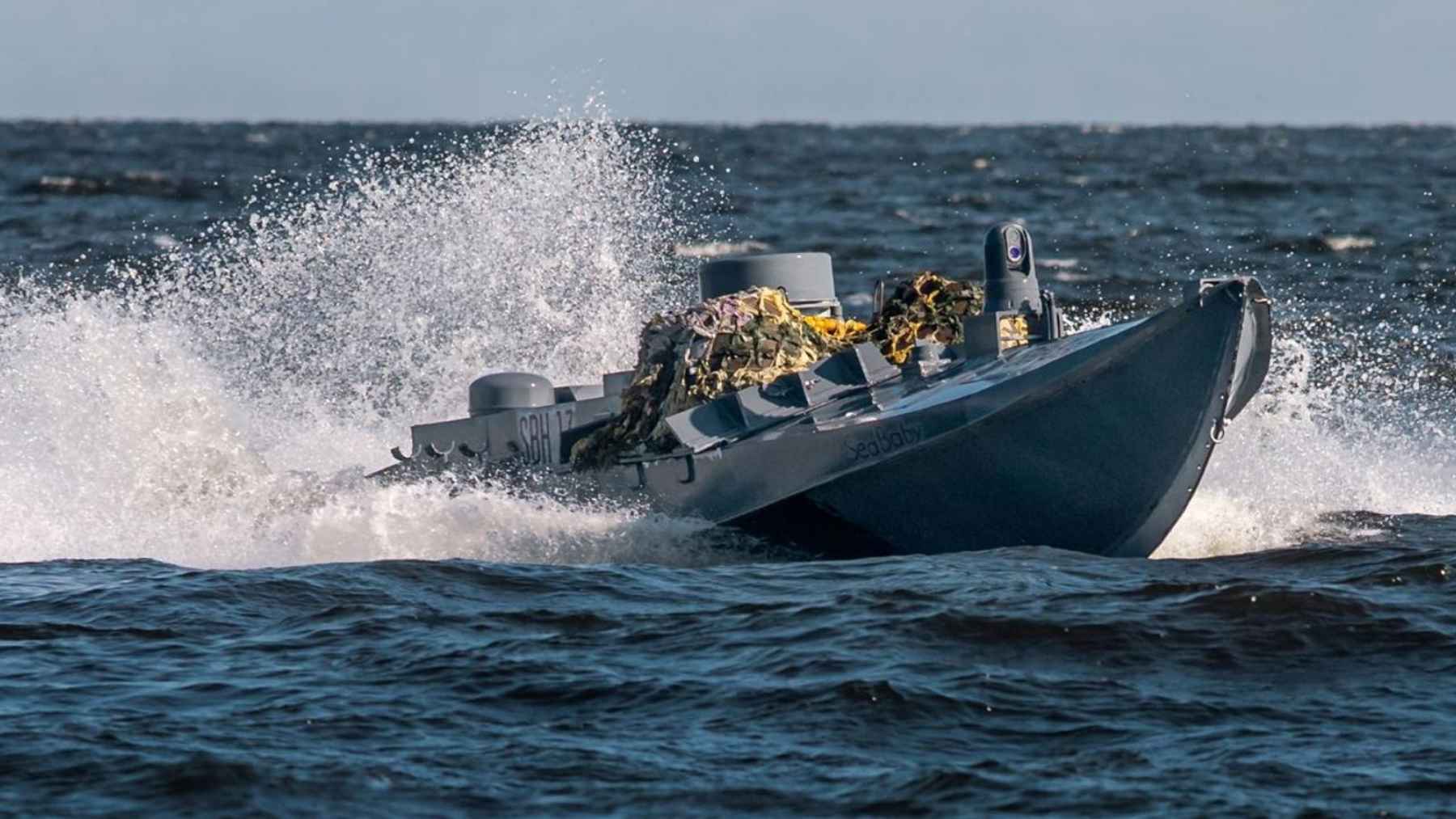
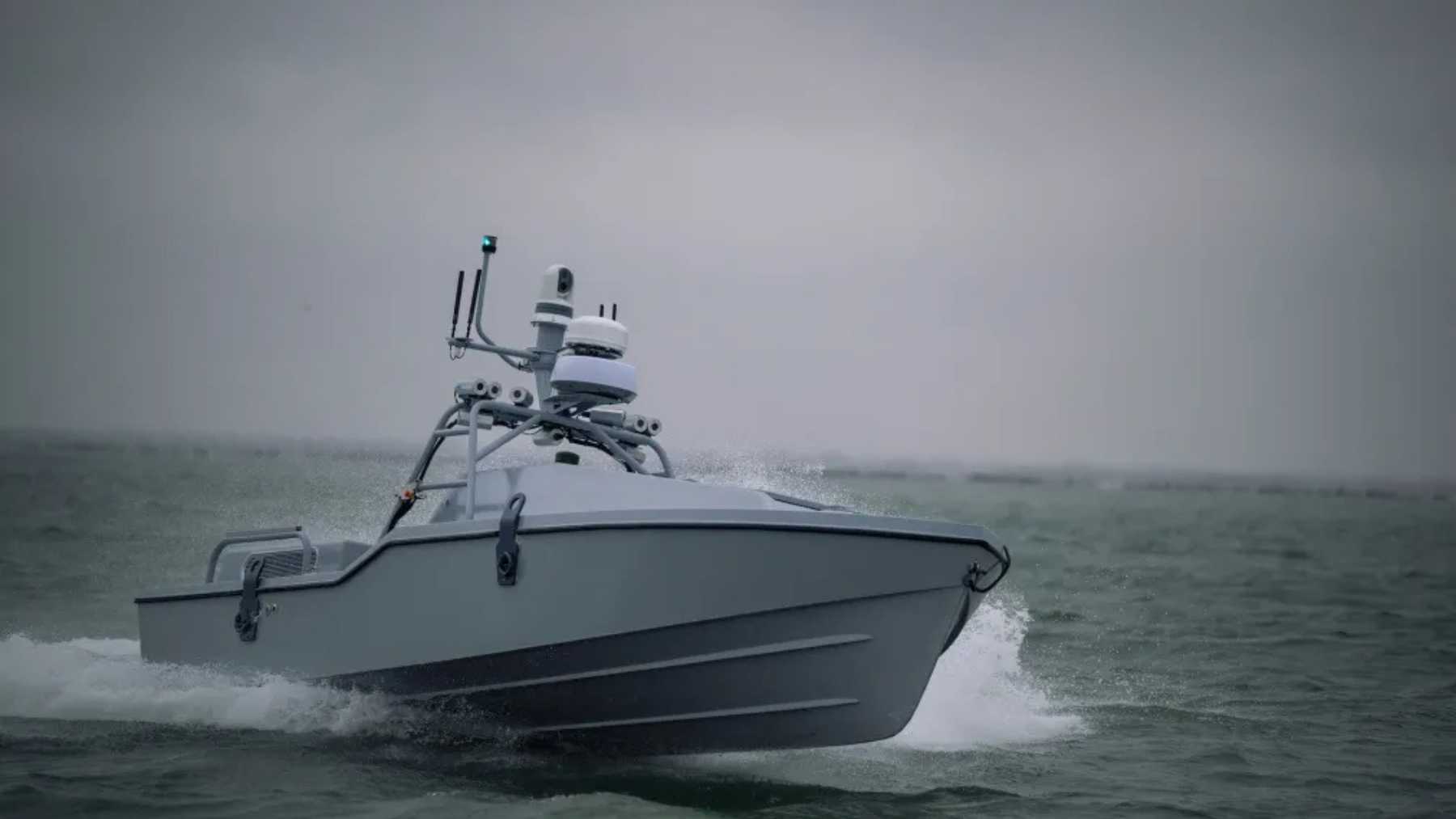
The Corsair is a 24-foot diesel boat with nobody on it
That’s roughly the length of a big pontoon boat, the kind you’d rent for a Saturday on the lake. Saronic, the Austin, Texas, company that builds it, rates the Corsair for more than 35 knots, which works out to a bit over 40 mph. It’s got an inboard diesel, and it’ll haul up to 1,000 pounds. Saronic also said on X after the strike that CENTCOM had used military versions of the boat.
Figures: Saronic, U.S. Central Command, Proceedings.
So how does a lifeguard end up as a weapon?
It was never only a lifeguard. Saronic has pitched the Corsair for everything from keeping an eye on the water to kinetic strikes, which is defense-speak for blowing things up. Eric Wertheim, who writes the Combat Fleets column for Proceedings, the U.S. Naval Institute’s magazine, says photos of the boat point to a stabilized thermal camera, a navigation radar and a satellite link that lets a person stay in the loop. Basically, someone miles away can steer it, or just watch while the boat’s own software does the driving. CENTCOM hasn’t said which way the boats ran on July 12.
Wertheim also notes in the October issue that the Corsair looks a lot like Ukraine’s Magura V7, which happens to be the same length. Ukraine’s drone boats have spent years going after Russia’s Black Sea Fleet, and they keep getting bolder, like the one that drove under an 899-foot tanker off Yalta to put its charge at the stern.
What Wertheim couldn’t find is almost as interesting. He says hardly anything’s come out about the Corsair’s beam, its draft or its engine, and I couldn’t turn up a weight for it anywhere, either. That’s a slightly odd gap for a boat the Navy’s been buying since last December, when Navy Secretary John Phelan announced a $392 million deal to put it into production. The announcement left out how many boats that buys, so I can’t work out what one costs.
So who sent them in?
You’d probably assume it was Task Force 59, the Navy’s drone unit in Bahrain. It started fielding Corsairs in the region in March, and it’s the outfit that ran the June rescue.
Apparently not. A Pentagon official, speaking to USNI News the day after the strike, said it was a CENTCOM operation, and that the Navy didn’t oversee it.
On August 13, CENTCOM dropped a hint about who did run it. In a release about a new drone task force, it credited Task Force Scorpion Strike with sending drone boats against Iranian ports in July. The release doesn’t mention Bandar Abbas by name. Still, it’s the only drone boat strike CENTCOM has gone public with, as far as I can find.
Scorpion Strike went up last December, set up by Special Operations Command Central, the headquarters that runs special operations across the region. It’s built around cheap drones designed for one-way trips, and CENTCOM says that same month it became the first unit to launch an attack drone off one of the Navy’s warships. Frankly, that’s a pretty logical home for a boat that’s built to blow itself up.
CENTCOM wants more of these
CENTCOM said in July that the strikes cut into Iran’s ability to keep attacking commercial ships. The strait’s still a rough place to be a tanker, though. The International Maritime Organization counted nine ships hit in or near the strait between October 1 and October 6, most of them crude tankers, USNI News reported on October 9. Both the U.S. and Iran have been striking ships as the fighting goes on.
CENTCOM isn’t stopping at one squadron, either. In that same August 13 release, it announced Task Force Falcon Strike, a new multinational unit that’ll run one-way attack drones in the air, on the water and under it, with a staff from Special Operations Command Central and whichever regional partners accept CENTCOM’s invitation to join.