
When a government agency goes shopping for an underwater robot, it usually comes home with something enormous. A crane to get the thing in the water. Operator consoles. Two shipping containers of support gear, and a ship big enough to carry all of it plus the people who run it.
France’s national chart-making service did precisely that in April. It took delivery at Brest of a Kongsberg Discovery Hugin Superior rated to 6,000 meters, named it Narval, and put the bill at around €15 million, or roughly $17.5 million.
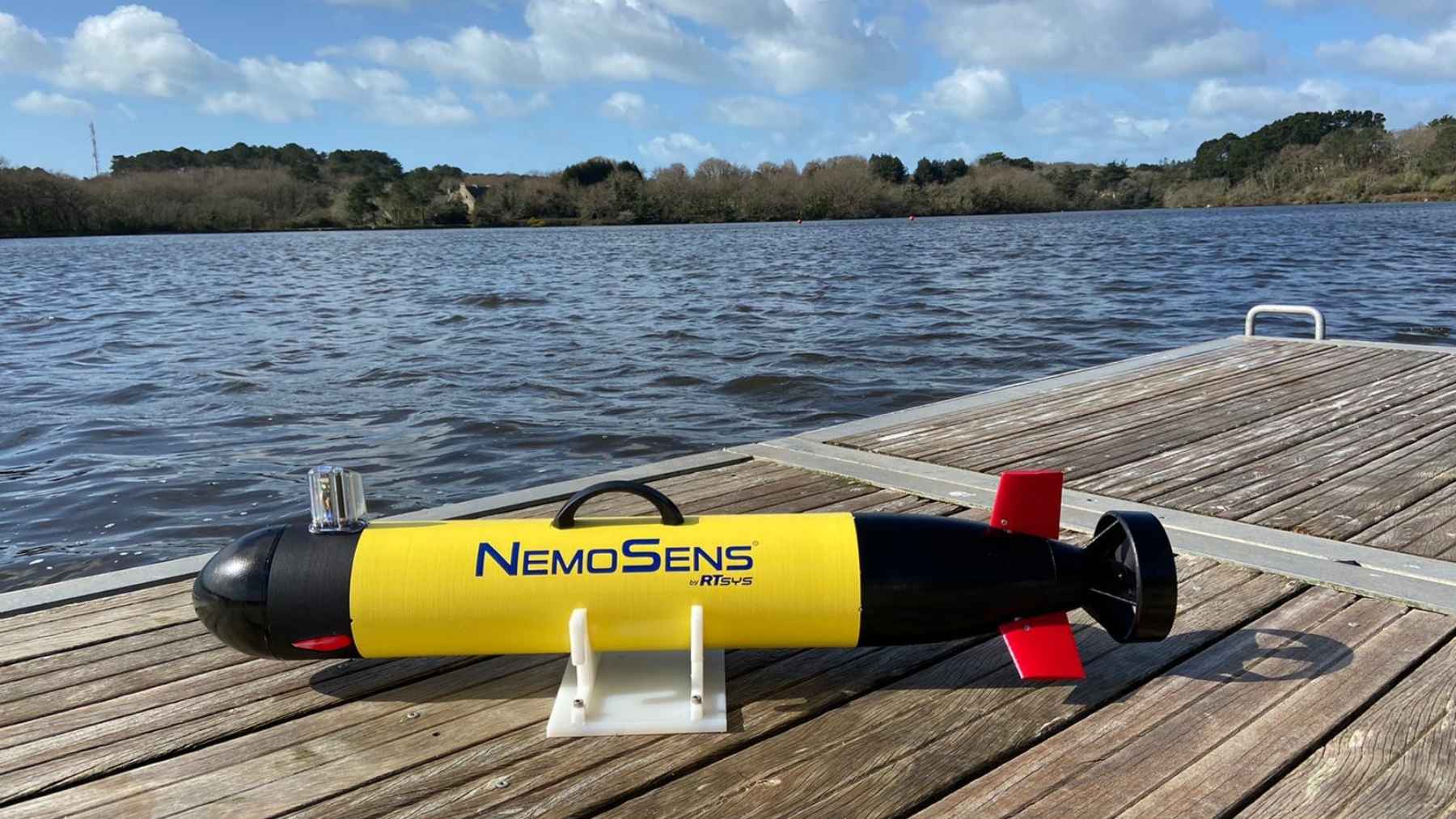
Then there is the other machine on the same shopping list. At the end of December, after a seven-month competitive tender, the French Hydrographic and Oceanographic Service (Shom) ordered a micro-AUV from Brittany manufacturer RTsys. It is a tube a bit over three feet long and just under five inches thick, and it weighs less than 22 pounds, which is less than a large bag of dog food.
It is the first micro-drone Shom has ever bought. It is meant to spend its working life on the continental shelf, in water where Narval would be wasted, doing a job that until now needed a boat with people on it.
France already bought the expensive robot, and it cost about €15 million
Shom announced Narval on April 20. It is the agency’s first autonomous underwater vehicle of any size, and it is a serious machine: high-resolution imaging and bathymetry, sediment characterization and water-column geochemistry, all available in a single dive.
It does not travel light. Shom’s own account of the delivery lists a launch and recovery system, operator consoles, a battery manager, post-processing software and two deck containers holding the operating stations. The reason that list exists is so the package can deploy from ships the agency already has, including the hydrographic vessel Beautemps-Beaupré.
That is the normal arrangement for deep-ocean work, and below a certain depth there is no way around it. At 6,000 meters, about 19,685 feet or 3.7 miles down, you need pressure housings, serious energy and a ship that can put the vehicle over the side and get it back.
None of which helps you at 100 feet, three miles off a beach. Which is exactly where the cables, the wrecks, the wind farm foundations and the century-old ordnance actually are.
The small one is three feet long and one person puts it in the water
RTsys lists the NemoSens at 960 mm long and 124 mm in diameter, which is 37.8 inches by 4.9 inches, at under 10 kilos (22 pounds) in air. French trade outlet Mer et Marine reported slightly smaller numbers for the unit Shom is getting: 89 centimeters, 12 centimeters across, 9 kilos. The vehicle is modular, so both can be right depending on what is bolted into it.
The maker rates it to 300 meters (984 feet), gives it a speed range of 2 to 8 knots, and claims more than eight hours of endurance at 4 knots. Shom does not plan to use all of that depth. Its stated mission is the continental shelf down to 200 meters, or 656 feet.
Payload margin is 2 kilos, about 4.4 pounds. That is what a micro-AUV really is: a battery, a thruster, a navigation stack, and a small hole where you put the useful part.
For Shom, the useful part is a single-frequency side-scan sonar and a magnetometer. The sonar draws the picture of the bottom. The magnetometer flags what is buried underneath it, which in European coastal water usually means steel: cables, pipelines, wrecks and the unexploded leftovers of two wars.
The drone runs an open Linux architecture, carries GPS and an inertial navigation system, and puts a strobe up its mast so somebody can find it at the surface. One person launches and recovers it from a small boat. That last detail is the entire economic argument.
Seven of them can work the same patch and talk to each other
The RTsys briefsheet puts the ceiling at seven NemoSens units operating together in swarm mode, coordinating acoustically underwater. Shom ordered exactly one, so that is a capability of the platform rather than a description of French plans.
It still matters for the arithmetic. Survey work is a coverage problem: how many miles of line you can run per day, at a given resolution, over a given box of seabed. A ship covers a lot of ground and costs a fortune per day. A single micro-AUV covers very little and costs almost nothing per day.
Several cheap ones running at once is the version where the small machine stops being a novelty. It is the same logic behind the 132-pound American survey drone that went into the North Sea instead of a crewed vessel, and behind the Belgian drone boat that hauls three underwater robots out to the search box and drops them in.
Shallow water is also where the security problem lives. The US Navy has been running an Iver3 along the Baltic seabed where cables keep getting cut, on a machine rated to roughly the same depth as this one. You cannot tell whether somebody has disturbed your seabed unless you know what it looked like last month.
Shom said the first half of the year, and it has not said the drone landed
The January announcement gave a delivery window of the first half of 2026 and said the system would be fully operational by the end of the year. That window shut on June 30.
As of late August, Shom’s news page carries no announcement of the NemoSens arriving, and neither the agency nor RTsys has published a handover. That does not mean it has not happened. Agencies hold ceremonies for €15 million deep-water robots and quietly sign for 22-pound ones, and nobody is obliged to issue a release every time a box turns up in Brest.
The rest of the fleet plan is on the record. Marlin, an Exail DriX H-8 surface drone ordered in December 2024, was received in September 2025. Two Alseamar gliders have been delivered. The larger DriX H-9 ordered alongside the NemoSens is not due until the first quarter of 2027.
Which leaves the micro-AUV in an odd spot. It is the cheapest item on the list, ordered in the same breath as the most expensive one, and the only one whose status nobody has confirmed either way.
The company building it has had a year
RTsys builds in Brittany, at Caudan and Lanester. On January 1 the parent group, until then called SeaVorian, renamed itself RTsys Group, moved its Lorient teams into a new site it says triples production capacity, and folded in marine electromagnetics specialist Mappem Geophysics, acquired in September 2025.
In August the company, the Republic of Singapore Navy and Singapore’s Defence Science and Technology Agency announced that RTsys COMET-MCM vehicles are now operationally deployed hunting mines in the Singapore Strait. That is a bigger AUV than the NemoSens, built at Lanester, and roughly 150,000 ships a year pass over the water it is working.
Pierre-Alexandre Caux, sales director at RTsys Underwater Technologies, called the Singapore deployment “further recognition of our expertise in underwater robotics” in a statement carried by Naval News.
The NemoSens itself has been through Ukraine, where RTsys says the vehicle has been used to train state emergency service operators for shallow-water demining. The company describes it as the only commercial off-the-shelf micro-AUV of its class deployed in a live conflict, which is a company claim and reads best as one.
The €15 million robot and the 22-pound one are not competing
Shom has never suggested they were. Narval goes where a ship has to go with it, because at 3.7 miles down there is no alternative. The tube goes where the ship is the single most expensive line on the invoice, which describes most of the water that actually touches Europe.
That water is the shelf: 656 feet and up, stacked with cables nobody wants cut, wrecks nobody has mapped at modern resolution, and ordnance nobody wants to disturb. Shom traces its lineage to the Dépôt des cartes et plans de la Marine, set up in 1720, and has been charting that ground for three centuries with ships.
It now proposes to survey some of it with a thing you can carry to the boat under one arm. The interesting part will be what it does when it wants seven.