
You have probably run into the line that we have better maps of Mars than we do of our own seafloor. It gets repeated at every ocean conference and in roughly every funding deck. GEBCO, the body that actually maintains the global seabed map, notes that the comparison is often made, so it is not some startup invention.
What the line leaves out is the reason. The water is not too deep and the sonar is not too weak. Looking at the bottom has always meant hiring a boat, and the boat is the most expensive object in the entire business.
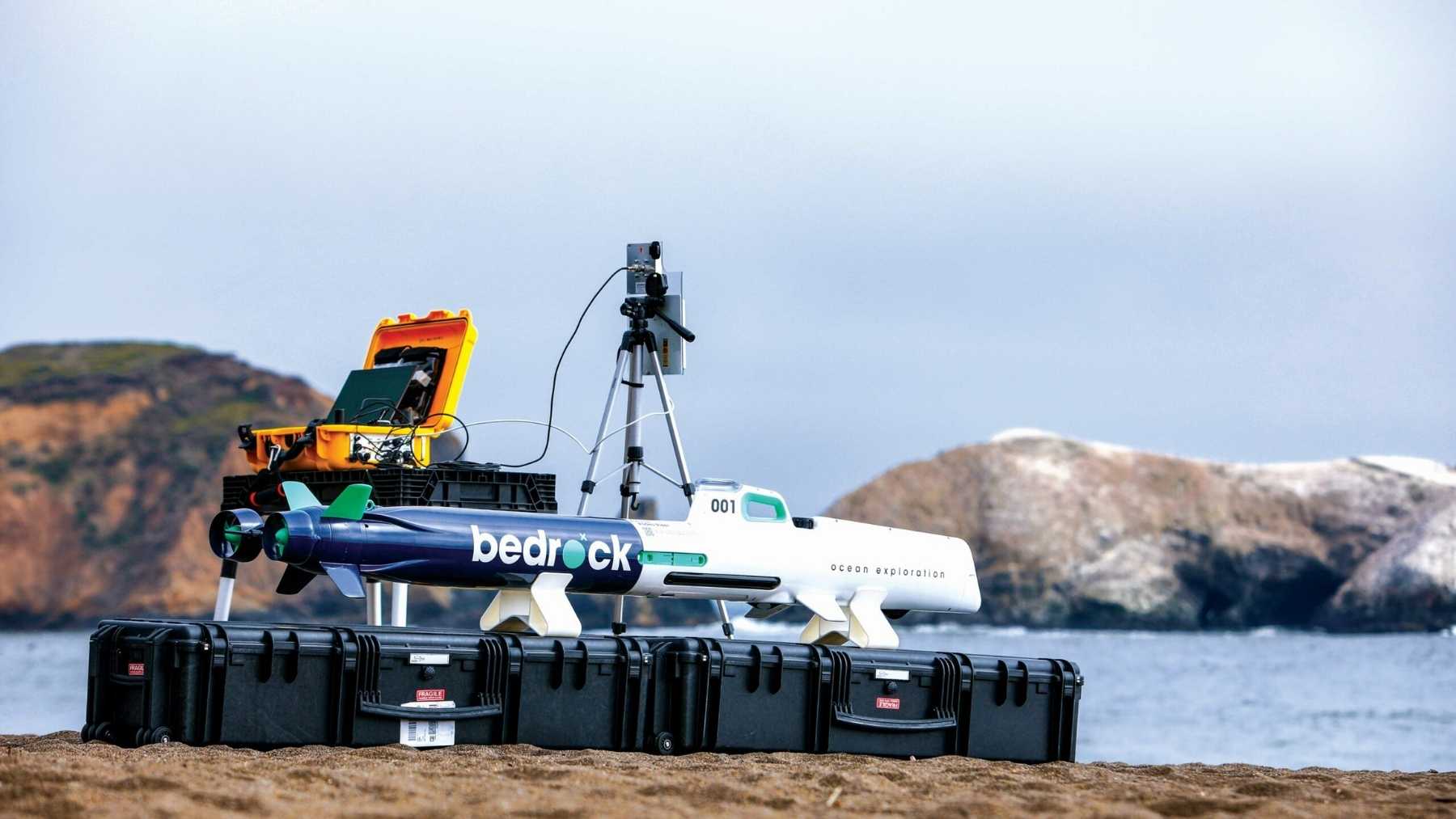
That is the context for a fairly dry announcement out of Richmond, California on August 6. Bedrock Ocean Exploration is shipping a full kit of its autonomous underwater vehicles to Aberdeen, Scotland, parking them at another company’s warehouse, and training that company’s engineers to run and maintain them. Each vehicle weighs 132 pounds.
The deal itself is ordinary. The number sitting underneath it is not.
The boat was always the expensive part
A week before the Aberdeen announcement, Bedrock published a case study on a North Sea job it ran with First Marine Solutions, the Aberdeen outfit it just signed with. FMS had been hired to survey anchor spreads for a semi-submersible drilling rig across several locations, checking the seabed for debris and hazards before the anchors went down.
Normally that work goes one of two ways. You charter an anchor handling vessel and put a work-class ROV over the side, or you charter a dedicated geophysical survey vessel. Both are large, both are crewed, and both are booked solid in a market where survey vessels are hard to get.
FMS did neither. It hired a platform supply vessel on the spot market, the maritime equivalent of grabbing whatever truck is free, and launched Bedrock’s AUVs off the back of it.
The savings the two companies put on that job: roughly 92% against the anchor handler and ROV spread, roughly 79% against a conventional survey vessel. Those are their own figures for their own project, published by the vendor, with no client named and no invoice attached. Read them as a claim, not an audit.
Even discounted heavily, they explain the Aberdeen deal completely. You do not build a permanent overseas base for a technology that shaves 10% off a line item.
What actually fits in the case
The vehicle is not exotic. Bedrock’s published fleet specification puts it at 2.4 meters long, 60 kilos in air, rated to 300 meters, cruising surveys at 3 knots. In American numbers that is 7 feet 10 inches, 132 pounds, 984 feet of depth rating and about 3.5 mph.
Power is a 3 kWh lithium-ion pack, and the important word in the spec sheet is swappable. You are not waiting on a charge cycle offshore, you are handing someone a battery. TechCrunch reported endurance of up to 12 hours per charge when it covered the company’s $25 million round in June 2025.
The sensors are where the money went. A NORBIT multibeam echosounder running 400 kHz across 512 beams, a Starfish side-scan sonar that the spec sheet says picks out contacts down to 30 centimeters, a three-axis magnetometer, and on the second configuration a parametric sub-bottom profiler for buried cable and unexploded ordnance work. Navigation runs off an Exail inertial unit paired with a Nortek doppler velocity log.
All of which matters because of one line on the company’s front page: the data is claimed to meet IHO Special Order.
That is a real standard, not a marketing tier. The International Hydrographic Organization publishes S-44, the standard every hydrographic survey is graded against, and Special Order is the strict end of it. Among other requirements, the survey system has to reliably detect a cubic feature one meter on a side sitting on the bottom. Order 1a, the next tier down, only asks for two-meter cubes.
Bedrock’s spec sheet claims Special Order to 60 meters and Order 1a to 140 meters. On the FMS job the delivered data came in at 0.25 to 0.5 meter resolution in water deeper than 100 meters. Those are the numbers a client’s engineer checks, and they are the reason this is a procurement story rather than a robotics story.
Aberdeen is the tell
The August 6 announcement is a multi-year arrangement, and the interesting clause is not the hardware. Bedrock is handing over data processing expertise and training FMS personnel so that most operations and maintenance happen in Scotland, without shipping vehicles back across the Atlantic every time something needs attention.
Matthew Tirman, who took over as Bedrock’s chief executive in April after a run at satellite imaging firm Satellogic, framed the point as delivering data across the UK and Europe “at the speed and cost the market needs.” FMS chief executive Steven Brown described the arrangement as letting his team offer offshore energy clients something the competition cannot.
Strip the language out and the model is a franchise. Bedrock builds the vehicles and the cloud platform, a regional operator supplies the boats, the crews and the client relationships, and nobody has to fly a technician six time zones to swap a sensor.
Founder Charles Chiau, who had been holding both the CEO and CTO jobs, moved to CTO full time when Tirman arrived. The company was founded in 2020 and describes its operations as spanning the Gulf of Mexico, the UK and the North Sea.
The incumbents are going the other way
While a 132-pound robot moves into Aberdeen, the two largest subsea contractors on earth are busy becoming one company. Saipem and Subsea7 are merging into an entity to be called Saipem7, with a combined backlog reported at around €43 billion, and on July 31 Saipem confirmed the US antitrust waiting periods had expired. We covered the robot sitting at the center of that merger when European regulators started asking harder questions.
Those two strategies are not in direct conflict. Saipem7 will keep doing heavy construction and deepwater work no 60-kilo vehicle will ever touch. But the survey layer underneath all of it is where the price is now moving, and it is moving down.
Norway picked a third route. A Norwegian uncrewed survey ship pulled into the Port of Aberdeen in June with nobody aboard, piloted from an office across the North Sea. That approach keeps the vessel and removes the crew. Bedrock’s keeps the crew and removes the dedicated vessel, borrowing whatever hull is already going that way.
The company draws its own line at 20 meters
Here is the part that gets left out of most write-ups, and it comes from Bedrock’s own website. The company estimates that over 80% of the geophysical survey work required for common infrastructure projects does not need deep seismic. For anything requiring penetration past 20 meters below the seabed, it tells prospective clients “we recommend a traditional provider for now.”
A vendor volunteering the boundary of its own product is not something you see often, and it sharpens what is actually happening here. This is not a replacement for the survey industry. It is the shallow, repetitive, high-volume 80% being pulled out from under the vessel operators, which happens to be the portion that offshore wind, port maintenance and cable routing generate endlessly.
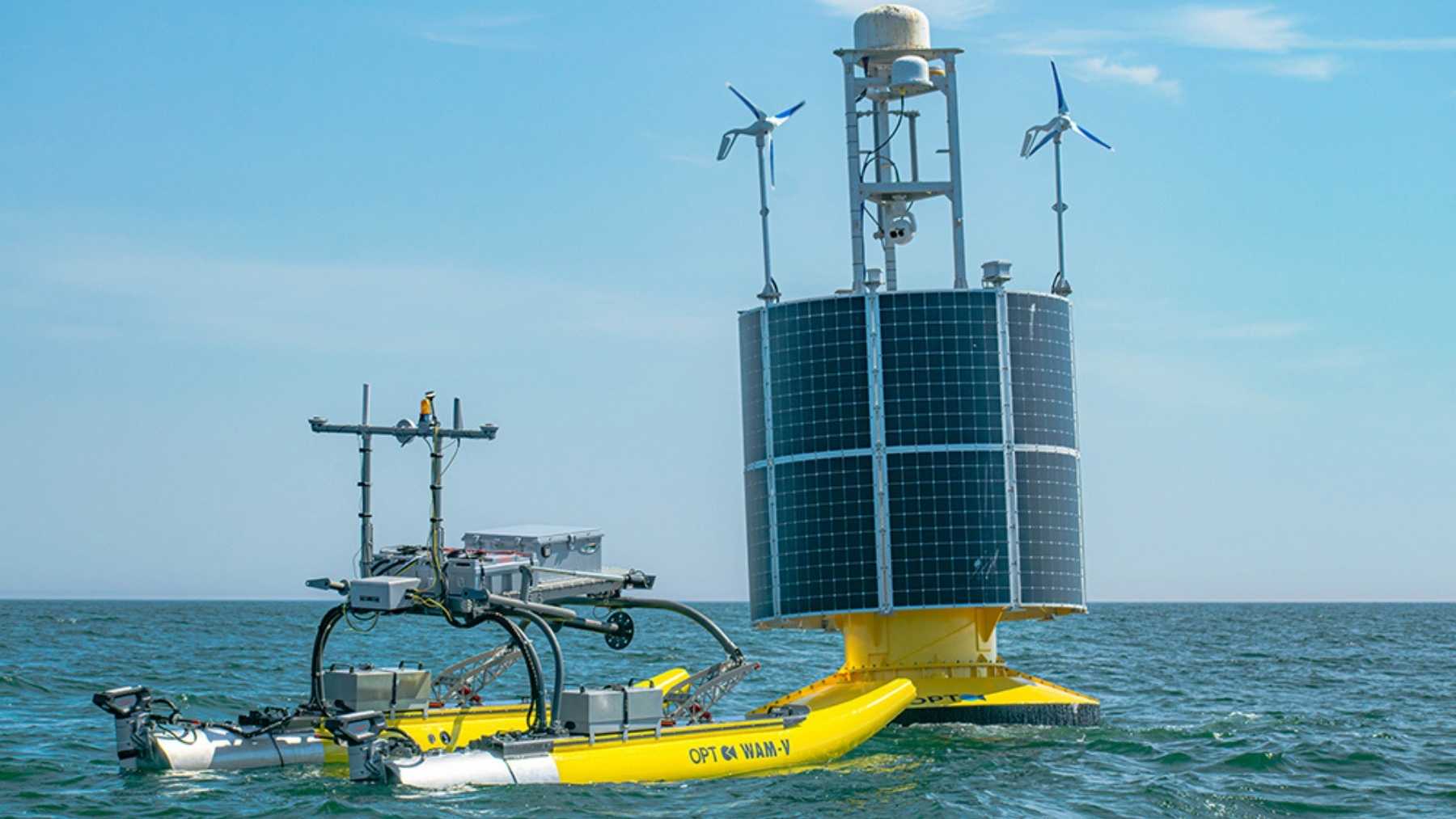
The same vehicles have been in front of the US Navy. Bedrock ran an autonomy demonstration alongside Integer Technologies and Boeing’s Liquid Robotics at Exercise Lanternfish 2026 in July, relaying data from Monterey Bay to Virginia under a Monterey Bay National Marine Sanctuary permit, with its AUVs feeding tracks up through a Wave Glider on the surface. That exercise, which ran six weeks across two continents, was the same event where Anduril and Ultra Maritime demonstrated seabed listening nodes.
What the numbers do not yet cover
The cost figures come from the vendor. No client has put its name to them, no third party has audited them, and one rig entry campaign in the North Sea is a data point, not a trend. Bedrock has also not published fleet size, revenue or utilization, so the claim to be building the largest private AUV fleet is unverified from outside.
The mapping backdrop is real enough. Seabed 2030 announced in April that 28.7% of the ocean floor has been mapped to modern standards, up from 27.3% a year earlier, with a 2030 deadline that arithmetic is not going to meet at five million square kilometers a year.
Brandon Mah, then the company’s chief operating officer, put the industry’s actual question to TechCrunch in June 2025: “can we replace traditional ships?” The Aberdeen deal does not answer that. It answers a narrower one, which is whether a regional contractor will bet its own warehouse space and its own engineers on the equipment. FMS just did, for multiple years, in the North Sea.
The rest is invoices, and those stay private.
 @bizdafookes ROOKIE2 months ago