
For about two and a half years now, the Baltic Sea has been the world capital of the suspicious anchor accident. A gas pipeline gets torn open here, a power interconnector goes dark there, a handful of internet cables snap in between, and every few months investigators board another commercial ship whose crew swears the anchor dragged itself. The pattern got reliable enough that NATO eventually stood up a permanent patrol just to watch the seabed.
The newest answer to all of it has spent the better part of two weeks underwater off Latvia, and nobody is inside. During NATO’s BALTOPS 2026 exercise, the US Navy’s Unmanned Undersea Vehicle Group 1 ran autonomous drone operations near the port city of Liepaja, working a seafloor crossed by the cables and pipelines that northern Europe depends on, according to Army Recognition. Official Navy imagery shows sailors recovering an Iver3 drone there on June 8, then doing it again on June 10, this time as part of a full multinational harbor-protection drill. So the unit built to fight underwater without people just got its live Baltic rehearsal, in the one sea where the seabed itself has become the story.
The Navy’s newest Baltic asset is a robot one sailor can carry
UUVGRU 1 is the Navy’s dedicated underwater drone command, based at Keyport, Washington. It started in 2017 as UUV Squadron 1 with a staff of 13 people, and by June 2024 it had grown past 100 sailors and was elevated to a full group, which in Navy terms is a promotion with budget implications. Rear Adm. Nicholas Tilbrook, then commander of Submarine Group 9, said at the ceremony that the unit was “forming the foundation of how we will fight in the undersea domain.” Its portfolio covers intelligence collection, mine countermeasures, anti-submarine warfare, seabed warfare and the protection of critical underwater infrastructure, per Army Recognition. Which reads like a list until you remember that every single item on it now applies to the Baltic.
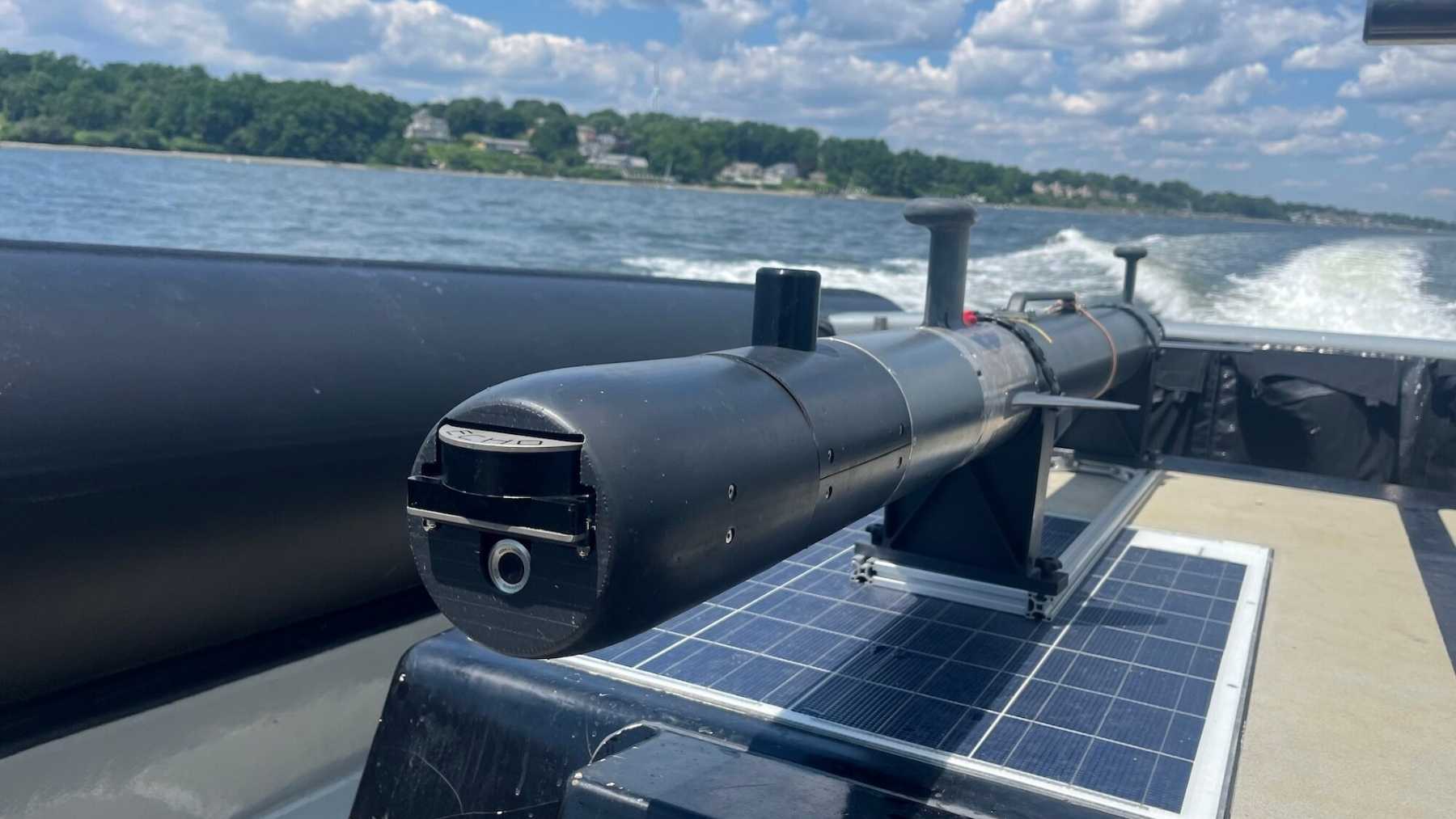
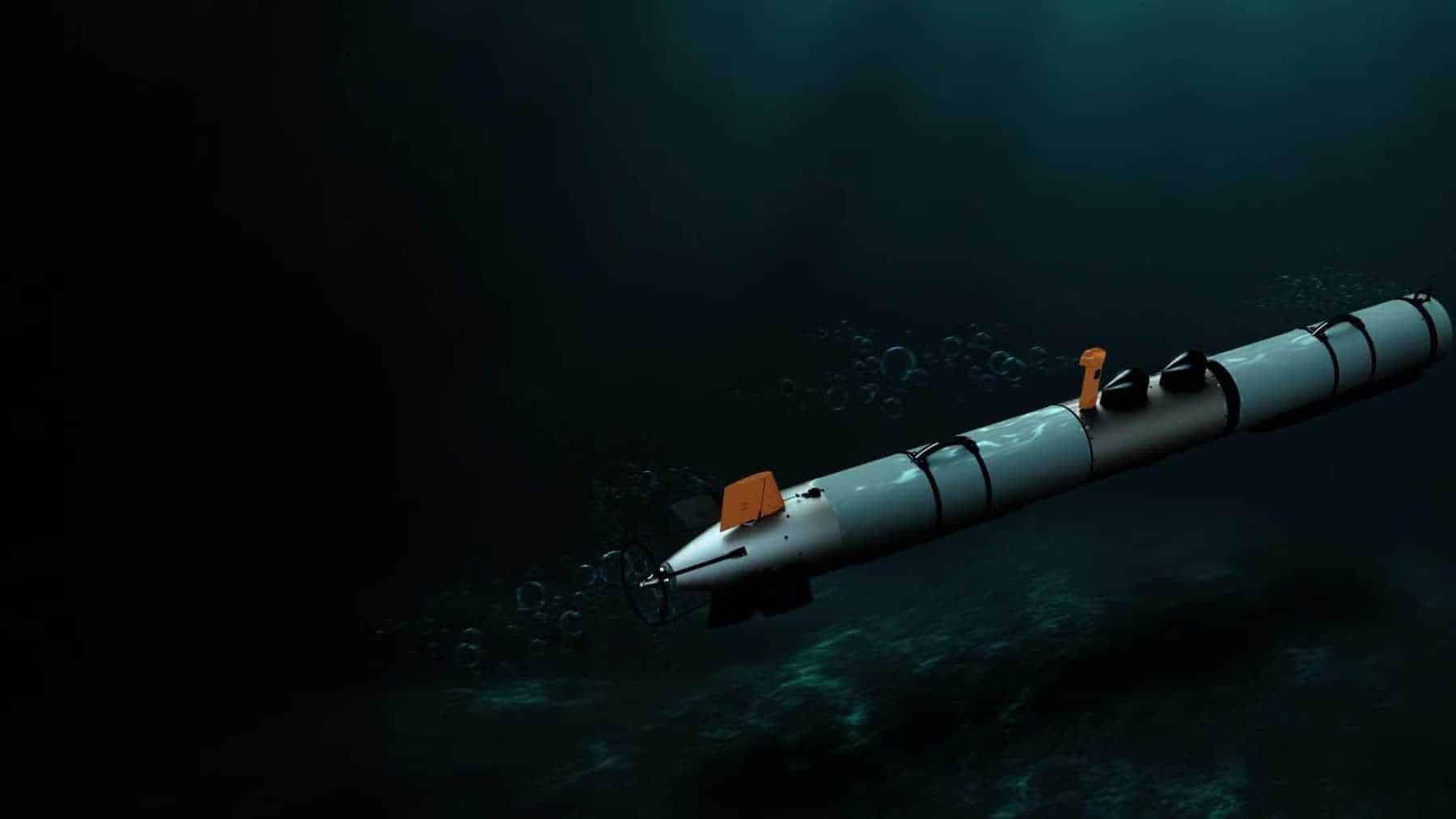
The drone in the June 8 imagery is the Iver3, a torpedo-shaped autonomous vehicle originally developed by OceanServer Technology and now sold by L3Harris, with well over 375 vehicles of the Iver family shipped to date. The current spec sheet lists a 200-meter (656-foot) depth rating, speeds between 1 and 3.5 knots, and five to six hours of endurance at 2.5 knots depending on payload, enough to cover more than a dozen miles of survey lines on a single charge. One sailor can carry it to the water and launch it from shore. At 3.5 knots flat out, it will not be chasing anything. That was never the job.
The job is the picture. An Iver3 carries side-scan sonar and precision navigation gear, maps the bottom, flags mine-like objects, and checks on cables and pipelines without putting a diver or a billion-dollar hull anywhere near the problem. The Baltic, shallow and crowded with infrastructure, is close to ideal territory for a coastal survey drone. You cannot tell whether something has been messing with your seabed unless you know exactly what your seabed looked like last week. This is the machine that knows.
The mapping is the quiet part. On June 10 the same unit paired up with Naval Surface Warfare Center Panama City to run a multinational harbor-protection demonstration off Liepaja, pulling in an underwater construction dive team, a Netherlands explosive ordnance disposal crew and a Latvian boat crew to rehearse what actually happens after a drone flags something it should not. That is the reason you bring the robots to a real exercise instead of a test tank. A survey vehicle that finds a suspicious object is only worth anything if the people and gear to deal with it are already standing by, and getting that many nationalities to coordinate in the same patch of water is harder than launching the drone.
Two years of cut cables turned the seabed into a crime scene
If the mission sounds paranoid, the recent history says otherwise. On October 8, 2023, the Balticconnector gas pipeline between Finland and Estonia was torn open by what Finnish investigators determined was the Chinese container ship Newnew Polar Bear dragging its anchor, with nearby telecom cables damaged in the same window. In November 2024, the C-Lion1 cable linking Finland and Germany and the BCS East-West link between Lithuania and Sweden were both severed, and the Chinese bulker Yi Peng 3 came under investigation after dragging its anchor across roughly 185 miles (300 kilometers) of seabed.
Then came Christmas Day 2024. The EstLink 2 power cable between Finland and Estonia failed along with four telecom lines, cutting cross-border electricity capacity from 1,016 to 358 megawatts. Finland seized the Eagle S, a Cook Islands-flagged tanker linked to Russia’s shadow fleet, on suspicion of dragging its anchor for nearly 62 miles. A month later, a fiber cable between Latvia and the Swedish island of Gotland went down and Sweden boarded the bulk carrier Vezhen. Four separate incident clusters, three different flags, one identical excuse.
NATO’s answer in January 2025 was Baltic Sentry, a standing patrol of frigates, aircraft and naval drones dedicated to watching the seabed. It mostly worked. The region went quiet for nearly a year, until December 31, 2025, when Finnish police boarded the cargo ship Fitburg, en route from Russia to Israel, on suspicion of anchor-dragging a telecom cable between Helsinki and Estonia. Apparently the Finnish special forces have stopped taking New Year’s Eve off. No court has issued a final ruling on any of these cases, and the operators have generally denied wrongdoing, but the operational pattern is consistent enough that nobody in a NATO uniform treats it as coincidence anymore.
Russian submarines never left the neighborhood
Anchors are only half of the Baltic’s underwater problem, and frankly the easier half, because a tanker on the surface is visible to anyone with a radar. Submarines are the other half. On April 10, 2026, Swedish JAS 39 Gripen fighters intercepted a Russian Kilo-class submarine transiting the Kattegat toward the Baltic and tracked it in coordination with allied forces, according to a Swedish Armed Forces press release. With Sweden and Finland inside NATO since 2024 and 2023, a Russian boat now gets watched from the moment it enters the corridor, handed off between coastal radar, ships and aircraft like a package with tracking enabled.
Transiting in international waters is perfectly legal, and nobody alleges otherwise. The concern, as Army Recognition frames it, is that rising Russian submarine activity overlaps with a seabed full of fragile, expensive infrastructure that has already been damaged repeatedly. Drones like the Iver3 feed into distributed underwater sensing networks designed to detect and track exactly this kind of activity. A robot that loiters below the surface for hours does not get tired, does not need a galley, and does not show up on anyone’s deck-watching photos. So the surveillance gap that submarines have exploited for a century is quietly shrinking.
The Russian side is not sitting still on the robot front either. The same design bureau that draws up Russia’s ballistic-missile submarines, Rubin, is building a 5.5-ton seabed drone of its own, officially a science platform, with a modular bay rated for sensors that happens to be rated for explosives too. Which is the uncomfortable subtext running under all of this: the same machine that inspects a cable can be told to do something else to it entirely.
BALTOPS turned 55, and the robots are the new kids
The exercise hosting all this is no pop-up. BALTOPS has run annually since 1972, and the 55th edition kicked off on June 4 when some 20 NATO ships departed Gdynia, Poland, per the US Navy. Fifteen allied nations and roughly 6,000 personnel are taking part through June 19, under the command of the US Sixth Fleet together with STRIKFORNATO. For the first time since the exercise began in 1972, the whole thing is being command-and-controlled from NATO’s Allied Joint Force Command in Brunssum, a wiring change meant to make the drill mirror how the alliance would actually run a Baltic fight, according to USNI News. The classics are all still on the schedule: submarine hunting, mine clearance, air defense and amphibious landings. What is new is the doctrine layered on top, with dedicated uncrewed units treated as core capability rather than science fair projects.
And the shopping spree backs it up. The same Navy flying Iver3s off Latvia just took delivery of the Australian-built Speartooth drone submarine, a long-range strike and surveillance machine that ships inside a standard commercial container. The AUKUS pact, fresh off its latest restructuring, quietly funded a whole program of seabed drone payloads aimed squarely at protecting cables and pipelines. Canada’s defense agency, meanwhile, owns a hydrogen-powered drone that parks itself on the seabed for 16 days to stare at a single cable junction. Three different programs, three different navies, one conclusion: the seafloor stopped being neutral ground, and everyone is buying robots for it.
The week that mattered was a boring one
Nothing exploded off Liepaja, no cable was cut during the exercise, and the most dramatic published image is a few sailors in a small boat lifting a six-foot yellow tube out of gray water. That is sort of the point. The contest for the Baltic seabed has so far been fought with anchors, ambiguity and deniability, and the counter to ambiguity is not a bigger torpedo. It is a fresh, accurate map and someone checking it every day. Two weeks of drone runs off Latvia buys exactly that: yesterday’s seabed picture, so that the next “whoops, my anchor” finally has a witness. The witness runs on batteries and fits in a pickup bed.
 @oscargoldman ROOKIE5 months ago