
Ontario’s grid operator posts a table every day showing what every big power plant in the province put onto the wires, hour by hour. I went and pulled the one for September 30. The row for Pickering Unit 6 reads 290 megawatts overnight, 260 from breakfast on, a single 4 early in the afternoon, and then zeros all the way down the page.
So that’s that.
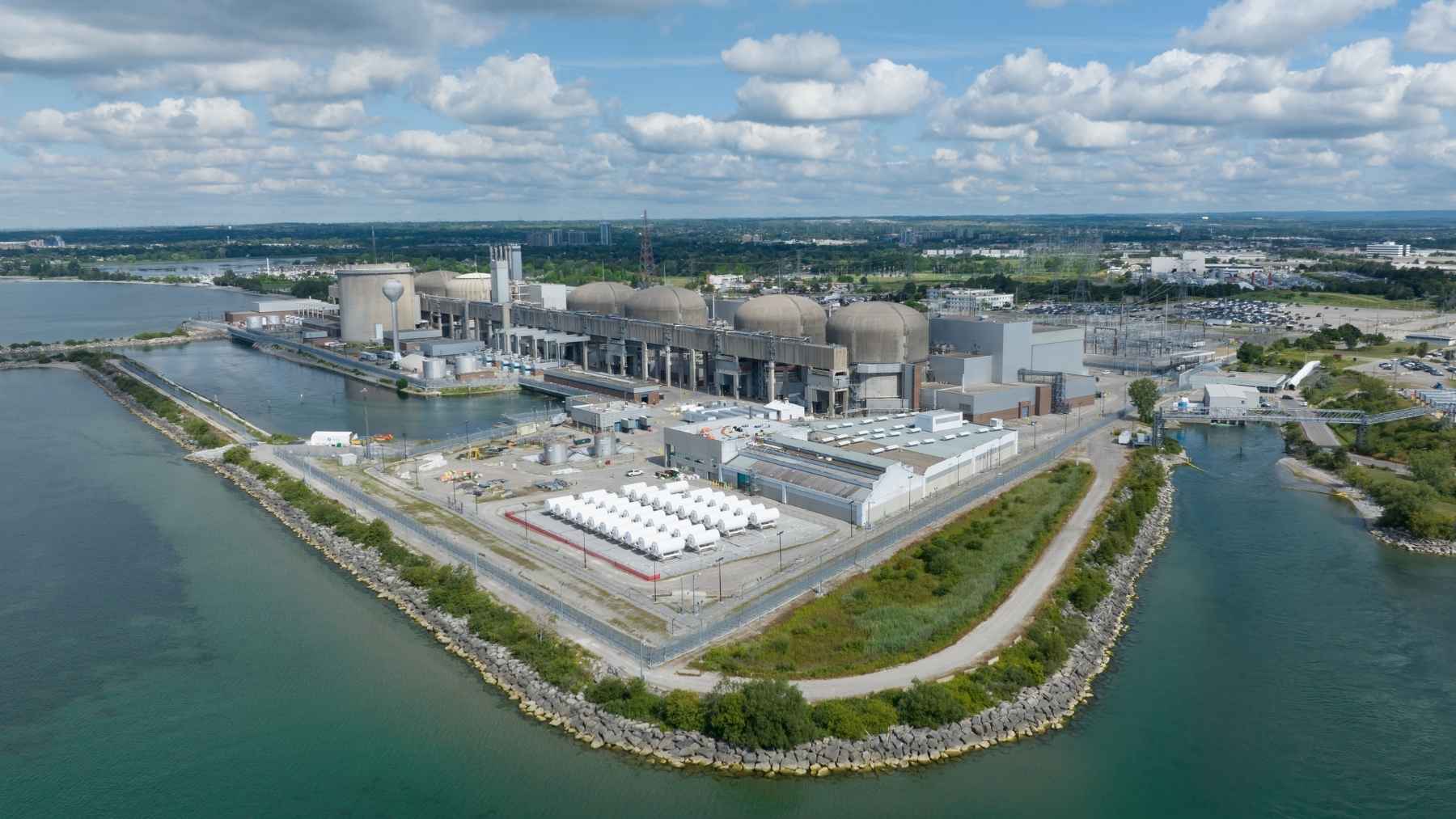
Unit 5 went first, on September 22, according to The Globe and Mail. Units 7 and 8 were already sitting at zero on the 30th, and I’ll be honest, I can’t tell you the exact day either of those two came off. But by the afternoon of September 30, the four reactors that make up Pickering B, about 22 miles east of downtown Toronto, were all off the grid. The Globe reports they’re expected back between 2031 and 2034, Unit 5 first.
If you’ve been following along, we wrote in September about why these particular reactors can be rebuilt at all, which comes down to their fuel sitting in hundreds of replaceable tubes rather than one giant steel pot. This piece is about what happens now that they’re cold. And it turns out the parts list is longer than the one we had back in August.
So what actually comes out of them?
Most coverage quotes two numbers, 1,520 fuel channels and 48 boilers, and both are real. OPG’s own project page uses them. But the contracts the province announced on September 21 fill in the rest of the shopping list, and it’s a pretty long one.
According to World Nuclear News, the Aecon and Siemens Energy Canada consortium is putting 14 new steam turbine rotors into the four units, overhauling all four generators, including what the industry calls a stator rewind, and fitting new auxiliary systems plus a new control and monitoring system. OPG’s page says the generator work, along with new turbine controls and improved magnets, is good for about 30 extra megawatts per unit. Four units at 30 each is roughly how a 2,064-megawatt station comes back at 2,100 to 2,200.
A quick word on that rewind, because it sounds like something you’d do to a lawnmower. A generator is a spinning magnet inside a stationary ring of copper windings, and that ring is the stator. Decades of heat and vibration cook the insulation on the copper, so a rewind means pulling every coil out of the frame and laying new ones in. Rewiring the house without moving the walls, basically.
Then there’s the water.
Why a pipe almost a mile into the lake?
Pickering sits right on Lake Ontario, and every reactor there has always drunk from it, because a nuclear plant is essentially a very expensive kettle. The reactor boils water, the steam spins a turbine, and then something has to cool that steam back into water so it can go around again. At Pickering, that something is the lake.
The refurbishment adds what OPG calls a deep-water intake, similar to the one Darlington already has, reaching about 1.5 kilometers (0.9 miles) out from shore. So why go almost a mile out instead of a few hundred feet? Deeper water is colder water, and the colder the water on the cold side of a steam plant, the more electricity you squeeze out of a given amount of reactor heat. I’d argue it’s the least glamorous item on the list and one of the more sensible ones, since it quietly bumps the output of all four reactors at once.
Who’s doing it, and what it costs
Two contracts, both announced September 21. A 50-50 joint venture of Aecon and Candu Energy, which belongs to AtkinsRéalis, got CAD 1.7 billion (about $1.2 billion US) for the retube, feeder and boiler work on Unit 5, with matching work on 6, 7 and 8 to be contracted in later phases. Aecon and Siemens Energy Canada got CAD 1.3 billion (about $900 million) for the turbine-generator work across all four. Together that’s a bit over CAD 3 billion, or roughly $2.1 billion US.
The full project is budgeted at CAD 26.8 billion with interest and escalation included, a figure OPG states plainly on its own page. Darlington’s four-unit rebuild, the one OPG finished in March, came in under a CAD 12.8 billion budget. So at 26.8 against 12.8, Pickering is a touch more than double, for fewer megawatts, and you don’t need me to tell you that’s the number the critics keep pointing at.
OPG’s answer is experience. The company says it’s carrying more than 8,000 lessons over from Darlington, and it’s finishing a 200,000-square-foot training and mock-up building this December where more than 2,800 tradespeople will practice on full-size replicas of Pickering’s insides, including the lower boiler assembly, before anyone touches a real one. That’s on top of the concrete dome mock-up where crews rehearse cutting through the top of a reactor building to get the boilers out. Stephen Lecce, Ontario’s minister of energy and mines, called the whole thing “Canada’s largest clean energy infrastructure project.” Fair enough. OPG’s own page goes one further and calls it the largest infrastructure project in Canada, period.
Environmental Defence told The Canadian Press the province will lean harder on natural gas for most of the next decade while the reactors are out, and frankly that’s not a crazy read. Darlington, the station that’s supposed to carry more of the load, had one of its four units sitting at zero on the grid report I pulled for October 5, and The Globe and Mail reported in September that it’s had several unplanned outages this year. The report doesn’t say whether that October outage was planned, and I’m not going to guess.
So is it approved yet?
Not quite. The province signed off in November. The Canadian Nuclear Safety Commission, which is who actually decides whether anyone gets to cut open a reactor, is still working through it.
Here’s where it stands. OPG is licensed to run units 5 through 8 until December 31, 2026, or 305,000 equivalent full-power hours, whichever comes first. It has applied for a new 10-year license that would cover the refurbishment, and the CNSC is hearing that application in two parts. Part 1 was June 23 in Gatineau. Part 2 runs October 6 to 9 at the Durham Convention Centre in Ajax, the next town over from the plant, with Indigenous nations, local residents and other intervenors getting their turn at the microphone. CNSC staff have already said they’re satisfied OPG is qualified to do the work. The commissioners decide.
My guess is yes, and I’d be a little surprised if it weren’t, given the staff recommendation and the fact that OPG just finished an identical job next door. But the regulator doesn’t pre-announce, and the units are off either way.
If the CNSC signs off, OPG’s plan is to start opening up Unit 5 in January 2027, with all four reactors back in service by the mid-2030s. The hearing in Ajax wraps up on October 9.