
Every air conditioner you have ever owned works the same way. It burns electricity to move heat out of a room and dump it into air that is already hot, which is why grid operators across the Northeast and Ontario spend every July watching the demand curve climb.
Toronto mostly skips that step. The downtown core is cooled by water pulled off the bottom of Lake Ontario, and once that water has finished chilling a hospital, an arena and a run of office towers, it goes into the city’s drinking supply.
The system is not new. It has been running since 2004. What is new is what got plugged into it this spring, and how hard the last few weeks have leaned on it.
Temperatures in and around Toronto hit 36 C, close to 97 F, on July 14, during a heat event that put warnings across most of Ontario, according to CBC News. Ontario’s Independent Electricity System Operator had published its summer outlook on June 18, forecasting a normal weather peak of 23,593 megawatts and an extreme weather peak of 25,888. Cooling is the reason those numbers exist.
The lake does the job a chiller would normally do
Enwave Energy Corporation runs the network. Three intake pipes reach roughly three miles out into Lake Ontario, and a fourth was commissioned in 2024. They draw water at 4 C, about 39 F, from a depth of around 270 feet, where the lake holds that temperature all year no matter what the surface is doing.
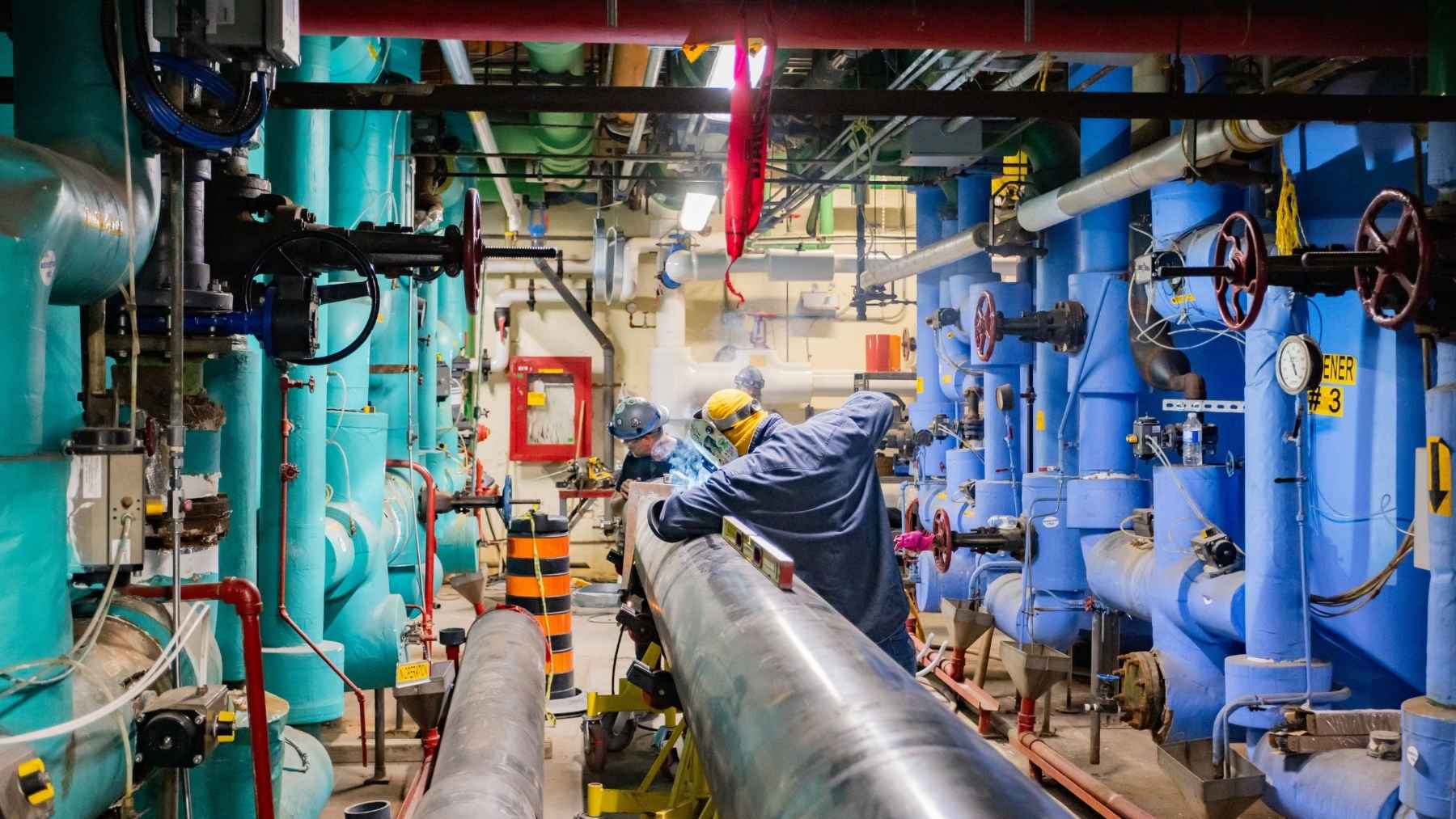
That water never touches the water in the buildings. It runs through plate heat exchangers, which are stacks of thin metal sheets with two separate flows either side, and the cold crosses the metal into a closed loop that circulates through downtown pipes.
Enwave says a building on the network uses around 80 percent less electricity for cooling than one running its own chiller. The other saving is floor space. Cadillac Fairview connected the TD Centre towers early and converted the room that used to hold the mechanical plant into a penthouse, which is a fairly aggressive rate of return on an HVAC decision.
The fourth intake, commissioned in August 2024, added a three-kilometre pipe and lifted cooling capacity by 60 percent, with room for 40 more buildings. Enwave puts the saving at 832 million litres of water a year, or 220 million gallons, and says the system avoids more than 60 megawatts of peak electrical demand on Ontario’s grid.
The water that cooled the arena is the water in your glass
This is where Toronto stops resembling every other district cooling scheme on earth. The cold water is not pumped in solely to run air conditioning. It is the city’s raw drinking water intake.
Per Enwave’s own description of the arrangement, the intake pipes deliver cold lake water to the Island Filtration Plant, operated by Toronto Water, where it is treated to drinking standards. Only after that does it reach the John Street Pumping Station, where the heat exchangers sit.
Enwave describes the result in one line: “the potable water for the City is minimally heated as water supplied to downtown buildings is chilled.”
Toronto was going to pump and treat that water regardless. The city wanted a deeper, farther-out intake, and water from that depth arrives colder than a distribution system really wants in summer. Enwave shares the utility infrastructure and takes the cold on the way through.
Enwave says more than 100 buildings are served by the deep lake system specifically, including Union Station, Mount Sinai Hospital, Scotiabank Arena and the Fairmont Royal York. The wider downtown thermal district it belongs to connects roughly 200. Both figures come from the company, and they are not the same number, which is worth keeping straight.
AI racks now dump their heat into Toronto’s tap water
On May 12, Telehouse Canada announced it had finished deploying direct liquid cooling across its downtown Toronto data centre campus. The company, a subsidiary of Japanese telco KDDI, says the deployment supports cabinet densities of up to 120 kW per rack.
Liquid to chip cooling pulls heat off the processor itself instead of blowing cold air at a room full of them. Telehouse says it removes up to 80 percent of the heat directly from high power server components, which takes the load off computer room air conditioners and server fans.
The heat still has to go somewhere. Telehouse says it is transferred to Enwave’s closed loop district energy system, captured through a fully isolated process, and used to help heat Toronto’s municipal drinking water rather than being vented into the air above the city.
Two of the three Telehouse sites, 151 and 250 Front Street West, were already sitting on the deep lake cooling network. So the sequence now runs from an AI inference job to a cold plate, to a coolant loop, to Enwave, to somebody’s kitchen faucet. It is a more elegant answer than most of the industry has managed, though not the only one: a California facility has spent two years cooling 1,800 GPUs with the water dripping out of its own fuel cells.
America built one of these and then stopped
Cornell University switched on Lake Source Cooling in July 2000, drawing water from 250 feet down in Cayuga Lake at around 39 F. The university calls it the first major deep water cooling system in the United States.
Twenty five years later it cools more than 100 buildings and over 8 million square feet across the Cornell campus and Ithaca High School, including the Cornell High Energy Synchrotron Source. Cornell puts the average saving at 29 million kilowatt hours a year against the chillers it replaced, and roughly 400,000 tons of carbon dioxide avoided over the full 25 years.
The environmental question got asked, at length. In 2024, New York’s Department of Environmental Conservation concluded the system has had no demonstrated impact on the health of the southern shelf of Cayuga Lake.
After that, the American record is mostly a list of things that did not get built. Honolulu Seawater Air Conditioning spent 16 years and $25 million chasing a 4.7 mile pipeline that would have drawn 44 F water from more than 1,700 feet down. It had every major regulatory approval and signed customers. In December 2020 it folded, after construction estimates climbed from $275 million to $400 million, the Honolulu Star-Advertiser reported.
The physics was never the obstacle. The capital cost, due up front and in one lump, was. Cold is cheap to use and brutally expensive to reach, which is the same problem you find at the other end of the thermometer, where an Arizona copper mine would need more than 140 megawatts of refrigeration to make its deepest rock survivable.
Geneva is tearing up its lakefront to run the same play
Switzerland is building its version now, on Lake Geneva, under the name GeniLac. SIG, the canton’s utility, draws water at 45 metres, about 148 feet, where it sits at roughly 7 C, or 45 F, year round.
The digging is live. A stage that opened on February 9 sank a shaft at the entrance to the rue du Rhone to drive a microtunnelling machine under the quai du General-Guisan toward the Pierre-Fatio exchange station, the sort of boring machine work that usually gets reserved for subway tubes. Another stretch on the rue Francois-Versonnex started June 22 and runs to the end of December. Pipe reinforcement along the motorway closed on and off ramps overnight on July 13 and again on July 27. Central Geneva stays open-heart until spring 2028.
There is a published price, which is rarer than it should be for this kind of infrastructure. Since January 1, 2026, SIG’s regulated cooling tariff has averaged 21.9 Swiss centimes per kilowatt hour and held flat, while heat supply tariffs came down by an average of 0.5 centimes, about 3 percent.
Sixty megawatts against a 25,888 megawatt peak
None of this rescues a grid by itself. Enwave says the deep lake system keeps more than 60 megawatts off Ontario’s peak. The IESO’s extreme weather forecast for this summer is 25,888. Sixty against that is a rounding error, and anyone selling it as a climate solution should say so out loud.
What it does do is remove a slice of the worst load permanently, in the densest square miles of a city, using cold that was already sitting at the bottom of a lake doing nothing. Toronto got there because it needed a deeper water intake anyway and someone was willing to pay for the plumbing in exchange for the temperature. Honolulu had the depth, the approvals and the customers, and still got nothing.
 @jamesdalziel ROOKIE2 months ago