
Most beach litter identifies itself. A bottle cap, a lighter, half a flip-flop, a knot of fishing line.
Neil Baldwin found something harder to place along the high tide line at Redcar, on the northeast coast of England. Bright blue rubber balls, dozens of them, sitting in the sand at the Majuba Bay end. Baldwin has lived near that shoreline for 20 years and told the BBC he keeps finding them. He filled an empty plastic bottle as he walked back. By his own count on social media, picked up by GB News, he collected 41 in half an hour.
The balls came from a nuclear power station on the other side of the Tees estuary. They were doing a job in there.
The balls scrub the tubes while the plant keeps running
A condenser is a box packed with thin metal tubes. Seawater runs through the tubes. Steam leaving the turbine hits the cold metal, drops back to water, and the vacuum that creates lets the turbine pull its full output. Anything growing inside those tubes sits between the steam and the cold water. Backpressure climbs, megawatts fall, and someone has to clean the metal.
Cleaning it the old way means shutting the machine down and opening it up. A German company called Taprogge has sold the alternative since the 1950s: soft rubber balls dropped into the cooling water, scrubbing as the flow carries them along.
Each ball is slightly wider than the bore of the tube it enters, so it wipes the wall on the way through. EPRI’s condenser cleaning guide, written for nuclear plant maintenance crews, lays out the loop. Balls go in upstream of the condenser inlet, against the flow, so they spread across the tubesheet. They get pushed through the tubes. A strainer downstream catches them, and pumps send them back to the injection point. Deaerated balls sit at roughly the same density as the water, so they go wherever the water goes.
A charge equal to 5 to 15 percent of the tube count gets every tube a ball every 5 to 10 minutes. The maker’s catalog lists 17 ball types in three hardness grades, 0.55 to 1.9 inches across (14 to 48 mm).
Getting every ball back is the hard part
Balls wear down in service. EPRI’s guide is direct about where they end up. Undersized balls slip through the strainer catch screens. Full-size balls lodge behind debris or collection grids and disappear during a routine backwash. Others hide at stagnation points, where the water slows enough to let a ball stop moving. Catch rates under 90 to 95 percent count as poor performance. Crews collect the charge, size the balls by hand against a pan of drilled holes, and replace the lot every four weeks.
The guide also lists, among the drawbacks of the system, that “a major escape of balls into a body of water can cause problems.”
EDF says the releases are down
EDF Energy runs Hartlepool. The company told the BBC it had “significantly reduced the number of releases over the past 18 months,” and that tide patterns can carry debris onto nearby beaches. It said no similar finds had been reported to it since April. It gave no figure for how many balls it recovered over the past year, and it did not answer the BBC’s questions about possible faults in the system. EDF says the balls biodegrade in seawater, and asks finders to report the exact location to the company or the Environment Agency.
This was not the first batch. Teessiders reported thousands of them in 2023 along Redcar, Saltburn, Marske, Seaton Carew, South Gare, Skinningrove and Whitby. More came ashore after rough weather in September 2025, when EDF told Teesside Live it had staff on the beaches almost every day and had reported the matter to the Environment Agency. That report put full breakdown of a ball at about two years.
John Stevens, who litter-picks at Saltburn, said he had no idea what they were when he started 14 months ago. He now treats them as an ingestion risk for wildlife. Baldwin’s worry is dogs and seabirds.
American plants run the same balls
Taprogge’s hardware reached the United States under another name. Amertap supplied the strainer sections here from the 1950s through the mid-1980s, and EPRI’s 2007 guide still carries a full operating procedure for Taprogge (Amertap) equipment. The utility engineers on the advisory group behind it came from Duke Energy’s Catawba, Dominion’s Millstone, TVA’s Sequoyah and OPPD’s Fort Calhoun.
Any American plant drawing cooling water off a bay or a river meets the fouling Hartlepool meets, and EPRI calls the sponge ball system the most common on-line answer to it. One Mississippi intake wires a dozen live mussels as sensors, which is the other way to handle what the water brings in.
Hartlepool just got two more years
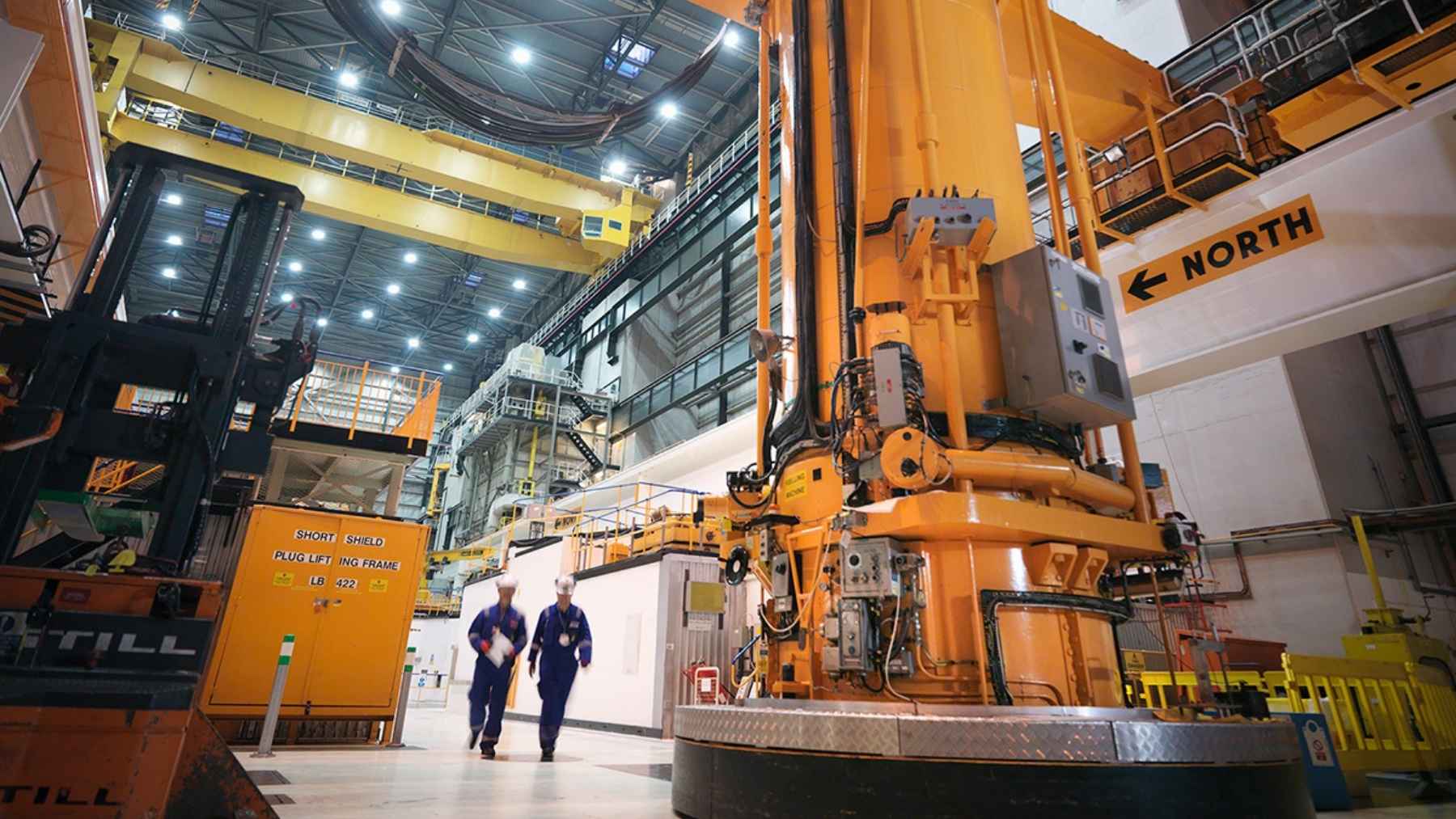
Hartlepool has been generating since 1983. Two advanced gas-cooled reactors put 1,185 megawatts on the grid, against 1,155 megawatts at Heysham 1. Carbon dioxide cools the reactors, and that gas never touches the sea. It heats the boilers, the boilers raise steam, the steam turns the turbine. Only then does the steam meet condenser tubes with the North Sea on the far side of the metal. The balls work on the seawater side of that wall. American once-through plants on salt water, Oyster Creek on Barnegat Bay among them, were built on the same layout.
A review published in September 2025 had the station stopping in March 2028. EDF and Centrica then announced another two-year extension for Hartlepool and Heysham 1, taking both to March 2030. EDF put the extra output at 28 terawatt-hours across the two stations and credited graphite core inspections for the decision.
EDF and Centrica confirmed that extension on July 22, 2026. Baldwin’s 41 balls came off Redcar beach in the first week of August, and the walk took him half an hour.