
You don’t need to read defense blogs to know the Bayraktar TB2. Turkey’s homegrown combat drone has been described as pivotal in conflicts from Nagorno-Karabakh to Ukraine, and its maker, Baykar, has signed TB2 export deals with 36 countries while leading the world in drone exports for three straight years. Domestic, affordable by military standards, and available to buyers the big Western primes tend to ignore: that was the formula, and it worked well enough to change how smaller countries think about air power.
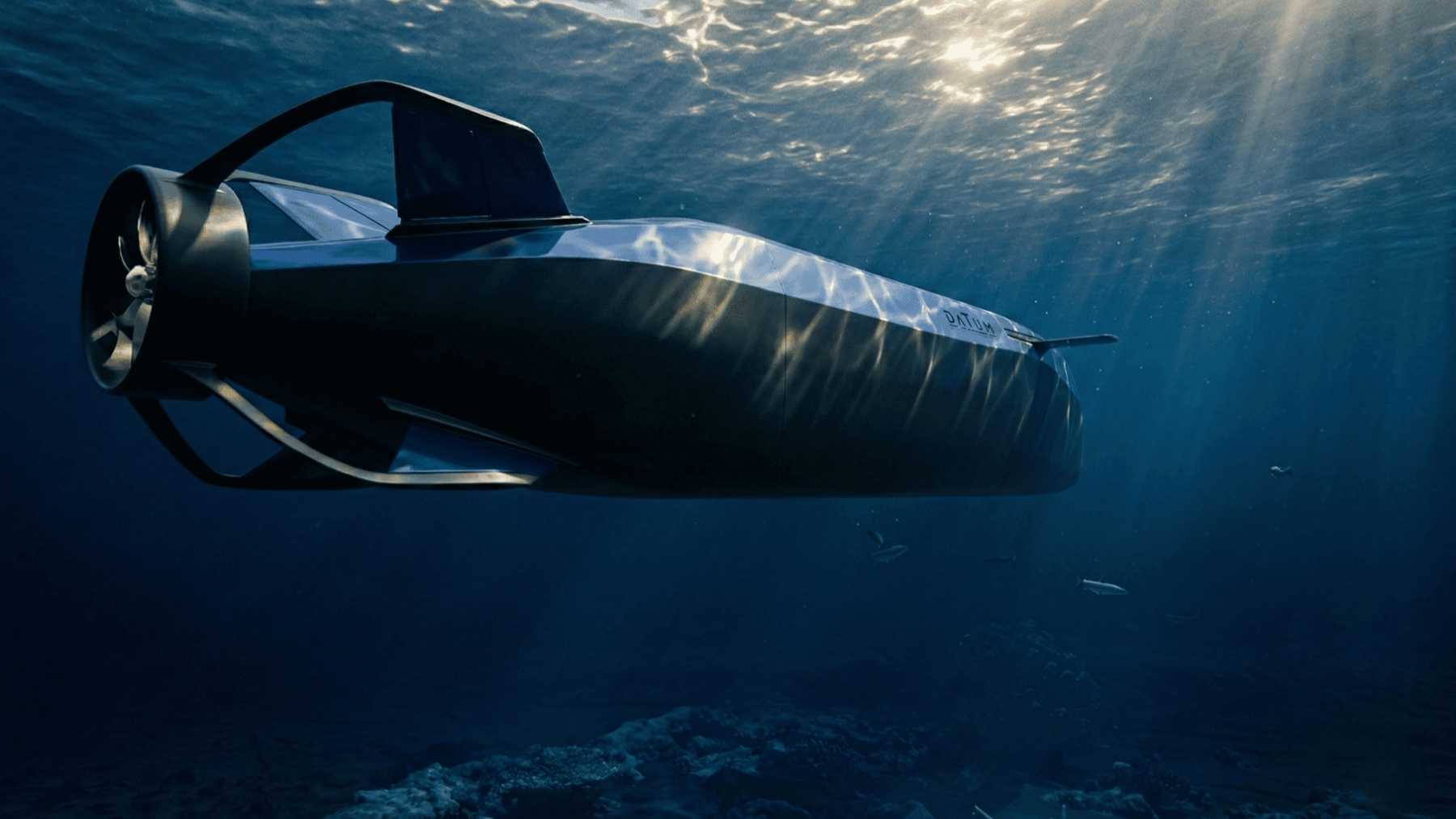
So when a Turkish firm shows up at a defense expo with yet another drone, that alone is not news. The news is where this one is built to operate. At SAHA Expo 2026 in Istanbul, which ran May 5 to 9, Datum Submarine Technologies unveiled the Sinarit, a 19.8-ton (18 metric tonnes) uncrewed submarine designed to launch FPV attack drones, anti-ship missiles, land-attack missiles, torpedoes and mines while staying underwater. Nobody rides along. Nobody steers from a periscope. The entire point is that there is no one on board at all.
One caveat before anyone gets carried away, and it’s the honest kind: the Sinarit is a concept. What Datum brought to Istanbul was a scale model and computer renderings, and every capability on the spec sheet is the company describing what it intends to build. That’s normal for this corner of the industry. Hold onto it anyway while we walk through the hardware.
A submarine drone that launches its own air force
The Sinarit belongs to a category the industry calls XLUUV, for extra-large uncrewed undersea vehicle. Datum, which designs both manned and unmanned mini-submarines, built the concept around a swappable cargo section measuring 12.5 feet (3.8 meters), so the same hull can be reconfigured depending on the job. For reference, that bay is over four feet longer than the longest bed Ford will sell you on an F-150. According to Naval News, Datum says the vehicle can accept up to 12 different payload configurations, spanning intelligence gathering, mine laying, mine countermeasures, torpedo work and strike missions.
“Sinarit is an underwater pickup truck,” Datum board chairman Munir Cansin Ozden, who is also a faculty member at Istanbul Technical University, said in remarks reported by Interesting Engineering. Whatever you load into that bay, his pitch goes, the vehicle hauls it underwater, quietly, to wherever it needs to be. A chairman comparing his strike submarine to a work truck is easily the most relatable thing the naval drone world has produced in years.
The cargo manifest reads like a guided tour of Turkey’s defense industry. Per the company’s SAHA Expo materials, options include Roketsan’s Akya and Orka torpedoes, Atmaca and Çakır anti-ship missiles, the TUBITAK-developed Gezgin land-attack missile, Gökdoğan surface-to-air missiles, Malaman smart bottom mines, Aselsan electro-optical sensors and Meteksan synthetic aperture sonar. Interesting Engineering reports the list extends to Baykar swarm-drone launch systems, and Datum’s own renderings show the boat releasing one-way FPV attack drones from beneath the surface. Those are the same cheap, expendable aircraft that have wrecked the cost math of air defense on land, the kind Germany is now strapping lasers to robots to burn down. A vehicle that surfaces nothing but a drone swarm, then slips away, is precisely the scenario air defense planners lose sleep over.
The numbers are small on purpose
Now the spec sheet, with the standing reminder that these are the manufacturer’s design targets. Per Baird Maritime, the Sinarit will run 37.7 feet (11.5 meters) long, make 12 knots on the surface and 8 knots submerged, and be rated for operations down to 328 feet (100 meters). It’s a diesel-electric design intended for long autonomous missions, either fully pre-programmed or supervised remotely, which in practice means parking off a chokepoint or a coastline for extended stretches with no crew to feed, rotate or rescue.
If those figures sound modest next to a real submarine, that’s the design brief talking. The whole vehicle is built to travel inside a standard shipping container and fly in an Airbus A400M cargo plane, so it can leave a Turkish factory on a truck and reach another hemisphere within days. Compare that with the reference beast of the category: Boeing’s Orca XLUUV for the US Navy measures 85 feet and roughly 80 tons. The Orca is a small building. The Sinarit is cargo.
Underwater is the one place radar still can’t follow
Small also buys discretion, which is the real product here. “Cannot be detected by radar, cannot be tracked by satellite,” is how Ozden described a submerged Sinarit to Türkiye Today, adding that a low sonar cross-section and quiet running would make acoustic detection close to impossible. That last part is the company grading its own homework, and undersea detection is a scientific arms race all of its own. Still, the underlying physics is friendly to his case: radar dies at the waterline, and the same satellites that catch Chinese shipyards floating sail-less mystery submarines can’t see anything cruising a hundred meters down.
Hiding underwater remains the cheapest stealth in existence, which is saying something now that China sells radar-absorbing coating by the kilogram. An aircraft has to be shaped, coated and maintained into invisibility. A submarine just has to dive. Which is exactly why navies that can’t afford a billion-dollar attack boat keep circling the uncrewed version of the idea: most of the stealth comes free with the ocean.
ÇAMD is the one actually in the water
And this is where the announcement deserves more attention than the average expo rendering. Strike-capable XLUUVs have a brutal record of being announced and then not quite existing. Boeing’s Orca was ordered in 2019, arrived three years late and 64 percent ($242 million) over its original estimate according to a GAO audit, and by mid-2025 government auditors were openly questioning whether the program would survive at all after roughly $885 million spent. That’s Boeing, working with the US Navy’s checkbook. The renderings are the easy part of this business.
Datum, though, brought receipts to Istanbul. Alongside the Sinarit model, the company presented its ÇAMD mini submarine, which it bills as Turkey’s first domestically built mini sub, and that one already swims. ÇAMD completed its first dive on April 14 in the Sea of Marmara off Karamürsel, running unmanned, with Turkish defense procurement officials and Türk Loydu surveyors watching from the pier. The 39-foot (12-meter) boat is rated for nearly 1,000 feet (300 meters), reaches about 10 knots, and is more than 80 percent Turkish-built per the company, down to the pressure hull, the motor and the propeller.
ÇAMD’s day job might matter more than its spec sheet. Datum says the boat will serve as a test bed for systems headed to MİLDEN, Turkey’s national submarine program, letting the navy trial Aselsan sonars and Roketsan’s Orka lightweight torpedo without tying up a crewed boat. So the unassuming little submarine is quietly doing the homework that the flashy armed one will eventually need. The Sinarit concept sits on top of that work, not on a blank sheet of paper.
Step back far enough and the playbook looks familiar. Turkey built an aerial drone industry on domestic components, export pricing and a willingness to sell to countries the established primes overlook, and Baykar’s 36-country order book is the proof the approach works. A containerized, 18-tonne armed submarine with an all-Turkish weapons catalog reads like the same pitch redirected at navies that will never afford a crewed submarine, its crew, or the decade of training both require. Whether the Sinarit ever launches anything in anger depends on years of testing that haven’t started yet. The customer list, on the other hand, practically writes itself.