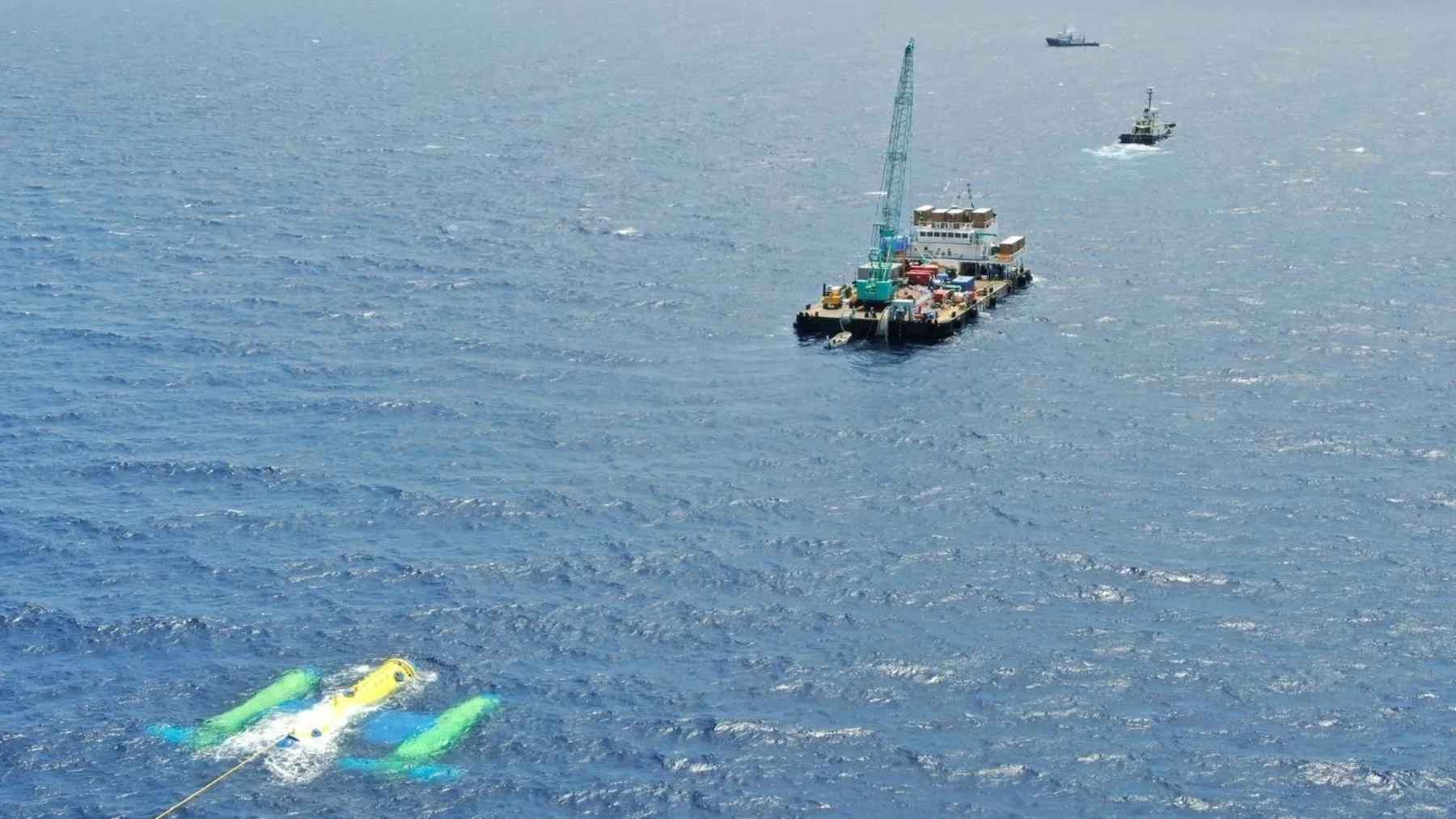

Every renewable energy source comes with an asterisk. Solar quits at night and sulks under clouds, wind drops whenever the weather feels like it, and hydro still needs the rain to show up. There’s one exception nobody spends much time on, mostly because it sits somewhere annoying to reach: the deep ocean, where enormous rivers of water shove in the same direction every hour of every day, typhoon or no typhoon. Japan has spent more than a decade trying to tap one of those rivers, and the machine it built to do it is a 330-ton contraption shaped like an airplane that flies underwater without ever going anywhere.
It’s called Kairyu, which translates roughly to “ocean current,” and the design really is strange up close. Two counter-rotating turbine rotors sit where an airplane’s engines would be, bolted to a central fuselage stuffed with a buoyancy system, and the whole thing is tethered to the seabed and left to hover in the flow. IHI Corporation, the Japanese heavy-machinery maker behind it, ran the unit for three and a half years in the Kuroshio Current off Japan’s southwest coast before wrapping the demonstration in February 2022. The numbers it’s chasing are the interesting part, and they’re a lot bigger than one test machine.
An airplane that flies underwater and never moves anywhere
The “flying” part isn’t marketing. Kairyu doesn’t sit on the bottom or bob on the surface; it’s suspended in open water roughly 50 meters down, held by a single mooring line running to an anchor on the seabed. The body is positively buoyant, so it rides the current like a kite on a string, with the flowing water spinning the rotors as it passes through. The two rotors turn in opposite directions on purpose, which cancels out the twisting torque each one would otherwise generate and keeps the machine from slowly rolling over like a badly thrown paper plane.
Each rotor measures about 11 meters across, and the body itself is roughly 20 meters long and 20 meters wide, built from three cylindrical floats: a central one and two outer pods carrying the generators. When something breaks or needs cleaning, the crew adjusts the buoyancy and lets Kairyu float up to the surface, then sinks it again afterward. In the flow speeds the Kuroshio actually delivers, somewhere between two and four knots (roughly one to two meters per second), the demonstration unit was rated to produce about 100 kilowatts of steady power. That’s not much on its own. It’s enough to run a handful of homes, not a city. The point was never the 100 kilowatts.
Japan doesn’t have great sun or wind, but it has the Kuroshio
Here’s the problem Kairyu is trying to solve. Japan is a crowded, mountainous string of islands without the wide-open sunny plains that make solar cheap, and it doesn’t have anything close to the offshore wind resource of the North Sea. What it does have, running right along its eastern coast, is the Kuroshio, one of the strongest ocean currents on the planet and the Pacific’s rough equivalent of the Gulf Stream. In places it’s up to 62 miles (100 kilometers) wide, and at its strongest point off the southeast coast it shoves something like 65 million cubic meters of water past every single second, as New Atlas laid out when the test results first landed.
All that moving water adds up to a serious amount of theoretical energy. Japan’s New Energy and Industrial Technology Development Organization, the government agency known as NEDO that co-funded the project, has estimated the Kuroshio could hold as much as 200 gigawatts of potential, roughly 60% of the country’s entire generating capacity. Nobody is suggesting you could actually capture all of that, and the honest version of the pitch is more modest: ocean current power is steady in a way solar and wind never are, which makes it valuable as baseload even at smaller scale. The current doesn’t care whether it’s noon or midnight, and unlike a tidal flow it doesn’t stop and reverse a few times a day. That predictability is the whole selling point.
Fifty meters down, because typhoons
You’d think the smart move would be to put the turbine as close to the surface as possible, where the Kuroshio runs fastest and there’s the most energy to grab. IHI agrees, in theory. The problem is that the same warm water feeding the Kuroshio also feeds typhoons, and the western Pacific averages around 25 of them a year. During a bad storm, surface waves in this area can top 65 feet (20 meters), which is the kind of force that turns expensive marine hardware into scrap.
So Kairyu lives deep on purpose. Fifty meters down, the storms overhead barely register, and the trade-off is accepting a slower, less energetic flow in exchange for not having your power station ripped apart twice a typhoon season. It’s the same logic that pushes a lot of offshore engineering toward “boring but survivable” over “efficient but fragile.” A turbine that generates a little less and lasts twenty years beats one that generates more and lasts until the first big blow.
The demo worked. The hard part hasn’t started
This is where the honesty has to kick in, because Kairyu is not about to start powering Japanese homes next year. The three-and-a-half-year demonstration that wrapped in February 2022 was exactly that, a demonstration. IHI hung the unit from a vessel in the waters around the Tokara Islands, first dragging it through the water to create an artificial current and later suspending it in the real Kuroshio. According to IHI’s own technical account, the machine did what it was supposed to: hold its attitude, stay put, and turn out its rated 100 kilowatts of stable power across a range of flow speeds. Proving the concept is one thing. Building a commercial industry on it is another.
The next step is a full-scale system rated at two megawatts, with rotors closer to 40 meters across instead of 11, which IHI has said it’s aiming to have in commercial operation sometime in the 2030s. The company has suggested that at scale, ocean current power could land somewhere near the cost of Japanese solar, and it sees early use as a low-cost supply for remote islands before anything bigger. Ken Takagi, a professor of ocean technology policy at the University of Tokyo Graduate School of Frontier Sciences, summed up the appeal plainly: “Ocean currents have an advantage in terms of their accessibility in Japan,” he said in comments reported by The Seattle Times. He’s also been candid that Japan has nowhere near Europe’s decades of offshore-construction experience from the North Sea oil industry, and that installing and maintaining hardware underwater is far harder than bolting it down on land. None of that is a dealbreaker. It’s just a long road, and Kairyu has only walked the first part of it.
Japan isn’t the only one chasing this current
The Kuroshio doesn’t belong to Japan alone. It starts up near the Philippines, sweeps past Taiwan, and only then runs along Japan’s coast, which means more than one country has looked at all that moving water and done the math. Taiwanese researchers have been developing their own floating Kuroshio turbine, a smaller 20-kilowatt design with counter-rotating rotors and a hydrofoil-shaped float, and they were still publishing sea-trial results and reporting real-sea anchor tests off the island of Xiaoliuqiu as recently as 2025, in work published in the Journal of Energy and Power Technology. The scale is tiny next to IHI’s ambitions, but it’s a sign the underlying idea hasn’t gone quiet.
It also fits a broader pattern of Japan poking at the ocean from several directions at once. The country has chased tidal power, wave power, and ocean thermal energy, and there’s even a Japanese project tapping the salinity gradient where freshwater rivers meet the salty sea, which we covered in our look at Japan’s osmotic power plant. Ocean current turbines like Kairyu are a different animal from the tidal platforms being tested elsewhere, like the floating tidal turbine on trial in Canada, which rides a flow that reverses with the tide instead of one that runs one way forever. Different physics, same basic dream of pulling clean power out of water that’s already moving.
Today Kairyu is a finished proof of concept, and the version that might actually matter, the two-megawatt one, mostly lives on paper. But the resource it’s built around is the rare renewable that never clocks out, and Japan is short enough on easy energy that a weird airplane parked in a sea current counts as serious research instead of a novelty. Whether it ever scales is an open question. The current, at least, isn’t going anywhere.