
Wind turbines keep getting taller for one boring, unavoidable reason: the wind up high is stronger and steadier than the wind near the ground, and a taller tower puts the blades where the better wind lives. The catch is that steel towers have a practical ceiling. Past a certain height the foundation, the crane and the logistics stop penciling out, which is why even the tallest land turbines top out around 200 meters. A Hamburg company called SkySails Power looked at that ceiling and decided the tower was the part worth throwing out.
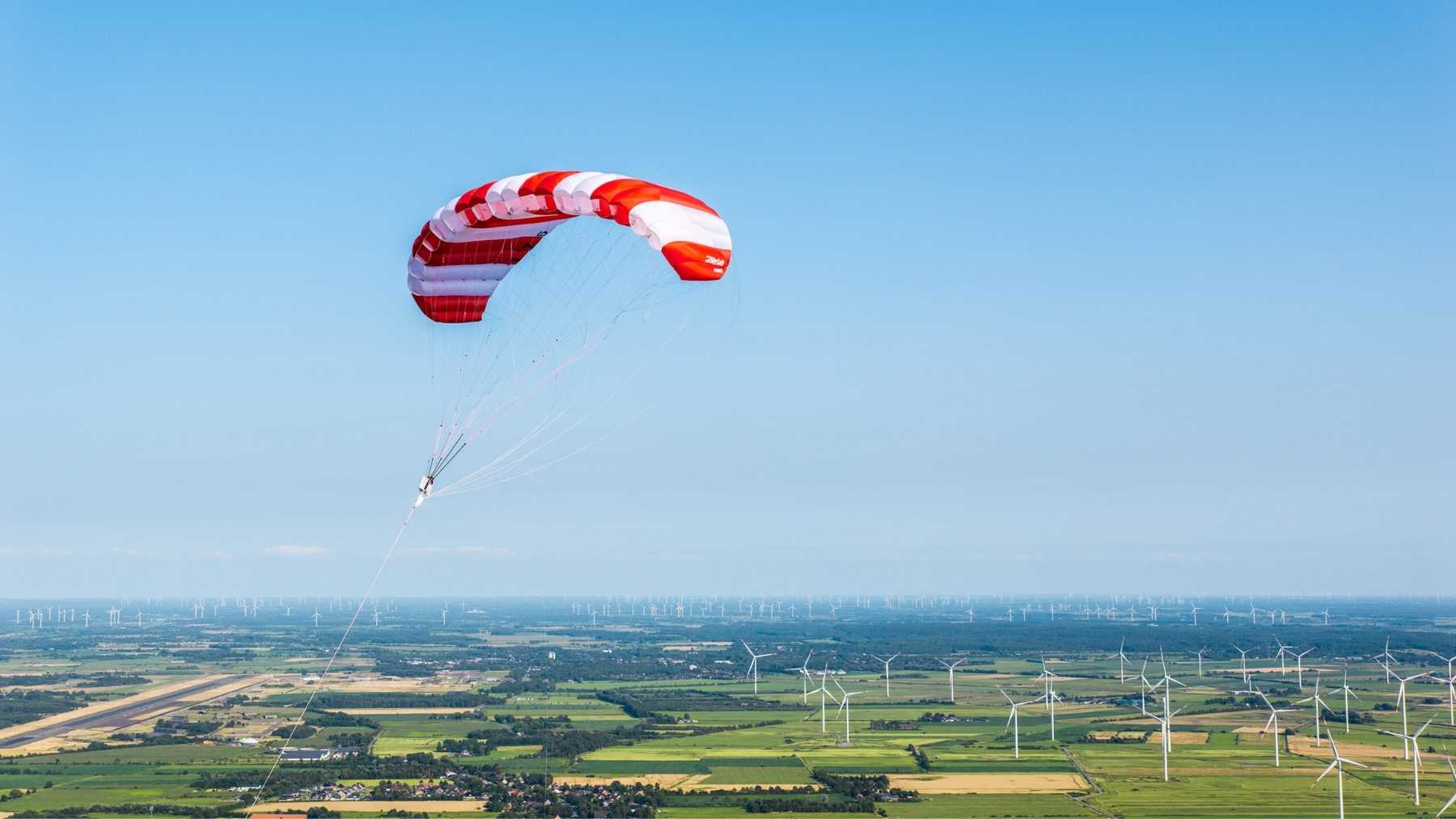
Instead of a 200-meter mast, it flies a kite on a tether up to 750 meters (about 2,460 feet) into the air. The kite climbs, dragging a line off a winch on the ground; the winch spins a generator; the line plays out to its full length, the kite dives back, and the winch reels it in using a fraction of the power it just made. Founder and CEO Stephan Wrage once described the motion to Hamburg’s business portal in four words: “It’s a bit like a yo-yo.” No tower, no concrete foundation, and no render: a 120-square-meter kite has been feeding the grid in Mauritius since 2022.
The tower was the part they threw out
SkySails’ whole pitch starts with subtraction. A conventional turbine needs a tall steel tower, a deep concrete foundation, a crane to assemble it and roads to bring all of that in. This system needs none of it. The whole setup (kite, winch, generator, control electronics) packs into shipping containers and sits on a simple three-legged steel frame on small concrete pads. The company says the approach uses up to 90 percent fewer material resources than conventional renewables, and that a site can be running quickly because there is nothing to pour and cure.
The kite itself flies a repeating figure-eight pattern, which sounds decorative but isn’t. The looping keeps the kite moving fast across the wind, and that speed is where the pulling force comes from. As it climbs and weaves, it unspools roughly 800 meters of tether from the ground winch, and that pull turns the generator. Once the line is out, the kite dives, the winch hauls it back in, and the cycle restarts. The tether is high-modulus polyethylene rope, the same family of fiber used in crane and elevator rigging, which Wrage has noted is about ten times lighter than steel of the same strength. If you’ve read about a 28-ton kite flying figure-eights to feed the grid in the Faroe Islands, that’s a different animal. Minesto’s machine flies underwater and harvests tides. SkySails’ kite does the opposite: it’s in the air, chasing wind.
Here’s why anyone bothers with the contraption. Wind power scales with the cube of wind speed, so when the wind doubles, the energy in it goes up roughly eightfold. Go higher and the wind is both faster and more constant, which is why SkySails says something like 80 percent of the world’s wind potential sits above 200 meters, untouched by anything with a tower. High-altitude wind also delivers more usable hours: the company quotes up to about 5,000 full-load hours a year, which is a strong number for a wind device.
A kite has been working over Mauritius since 2022
The reason to take this seriously instead of filing it under “clever lab demo” is flying over a field of sugar cane in the Indian Ocean. Since 2022, a 120-square-meter SkySails kite has been working over Mauritius and feeding electricity into the island’s grid. It’s run by SkySails Power Indian Ocean, a joint venture between the German company and the Mauritian firm IBL Energy Holdings, and it only went live after the island’s grid operator, the Central Electricity Board, signed off on its grid compliance. The project was awarded through Mauritius’s national scheme for new renewable-energy technologies, run by the Mauritius Renewable Energy Agency.
Now the unglamorous part. One kite is not a power plant. SkySails has put the Mauritius unit’s output at around 400 megawatt-hours a year, enough to cover somewhere between 200 and 400 households depending on the season, and it says it wants to roughly double that as it tunes the control system and the kite. That’s a few hundred homes, not a city. But the point of Mauritius was never raw scale. It was to prove the thing can run autonomously, in a real climate, hooked to a real grid, for years. Islands that currently burn imported diesel for power are exactly the customers SkySails is chasing, and the same logic covers any off-grid site that would otherwise truck in fuel: a remote construction camp, a research station, a charging point at the end of a very long road.
Taiwan got Asia’s first one, and the 450 kW model is on sale
On July 1, 2025, SkySails flew the first kite of this kind in Asia, at a site in Lukang, Taiwan, with a local partner called AiSails Power, a subsidiary of the electronics manufacturer Wistron. That September the two companies deepened the arrangement, folding in artificial intelligence and pointing the partnership at the wider Asia-Pacific market, with an eye on localizing and mass-producing the hardware. Taiwan is the second commercial site. Klixbüll in northern Germany, the long-running test field where the company has flown kites since 2019, counts as the third.
The Mauritius and Taiwan kites are SkySails’ smaller Venyo system. The one the company actually wants to sell at volume is Kyo, which it unveiled in June 2025 and bills as the first 450-kilowatt airborne wind turbine. Kyo flies up to 700 meters, uses a kite as large as 450 square meters, and packs into two standard 40-foot containers. SkySails says it can produce up to 1,780 megawatt-hours a year, roughly 600 households, and targets a levelized cost of energy below 10 cents per kilowatt-hour, which would put it in range of ordinary renewables rather than premium boutique power.
There’s a catch, and it’s a big one. Sales are open, but the first Kyo systems aren’t expected to ship until the second half of 2028. So you can place an order today and wait three years for hardware. SkySails has also sketched a bigger machine above Kyo, called Fujun, rated up to 1.3 megawatts with a 1,200-square-meter kite, though that one is still listed as “to be announced,” which is corporate for “not yet.”
Google tried flying kites for power and walked away
If a kite that makes electricity sounds like something that should already exist, that’s because plenty of people have tried. The cautionary tale is Makani, the airborne-wind project owned by Google parent Alphabet. Makani built a 26-meter drone-kite, flew a 600-kilowatt demonstrator tethered to a buoy at sea, and pulled in investment from Shell. Google shut it down in 2020, citing the cost of getting it to commercial scale. When a company with Alphabet’s resources decides the math doesn’t work, it’s fair to keep a hand on your wallet.
SkySails isn’t alone in still trying. The Dutch company Kitepower, spun out of work at TU Delft, already sells a 40-kilowatt system that fits in a container and is working toward a 100-kilowatt model called the Falcon, which, according to IEEE Spectrum, it has aimed at the market in 2025 or 2026. The appeal across all of these is the same enormous number: a 2013 study estimated the steady winds around 500 meters up could in theory supply something like 1,800 terawatts, far more than the planet actually uses. Germany in particular keeps poking at unconventional renewables, having recently approved a swarm of small turbines anchored in the Rhine to keep generating after the sun sets and the wind drops.
The practical wall is the sky itself. Fly a tethered kite up to 750 meters and you’ve put a moving object into airspace that aircraft also use, which means anything operating below roughly one kilometer has to be planned and coordinated with aviation authorities. Wrage has been blunt that Germany’s crowded airspace makes this a real constraint at home, which is one more reason the early commercial sites are islands and remote regions where the sky is emptier and the diesel is more expensive.
So this is not the part where kites replace wind farms. SkySails frames Kyo as a complement to the energy mix, not a substitute for turbines, and for now the whole company adds up to three operating sites and an order pipeline it values in the hundreds of millions of euros, which is real but small. The bet is narrower and more interesting than “reinventing wind”: for an island running on diesel, or a site where you physically cannot truck in a 200-meter tower, a container that unfolds a kite in a day and feeds the grid is a genuinely different option. The Kyo deliveries in 2028 will be the real test of whether the economics hold at scale. Until then, the strongest argument SkySails has is the boring one: a kite has been flying over the Mauritius sugar cane for more than three years now, quietly making power, which is more than Google’s better-funded version ever managed.