
Hydrogen has been pronounced dead as a passenger-car fuel about three times now, and defense engineers keep quietly building their entire future around it anyway, on both sides of the Atlantic. We’ve already covered the U.S. Army locking in a hydrogen-powered drone and a German consortium’s Greyshark underwater drone, a robot sub rated to stay down for sixteen weeks. But the strangest hydrogen submarine in the water right now isn’t a drone, and it isn’t German. It’s a crewed Spanish boat that makes its own hydrogen as it sails, out of the same alcohol that gets blended into your gasoline.
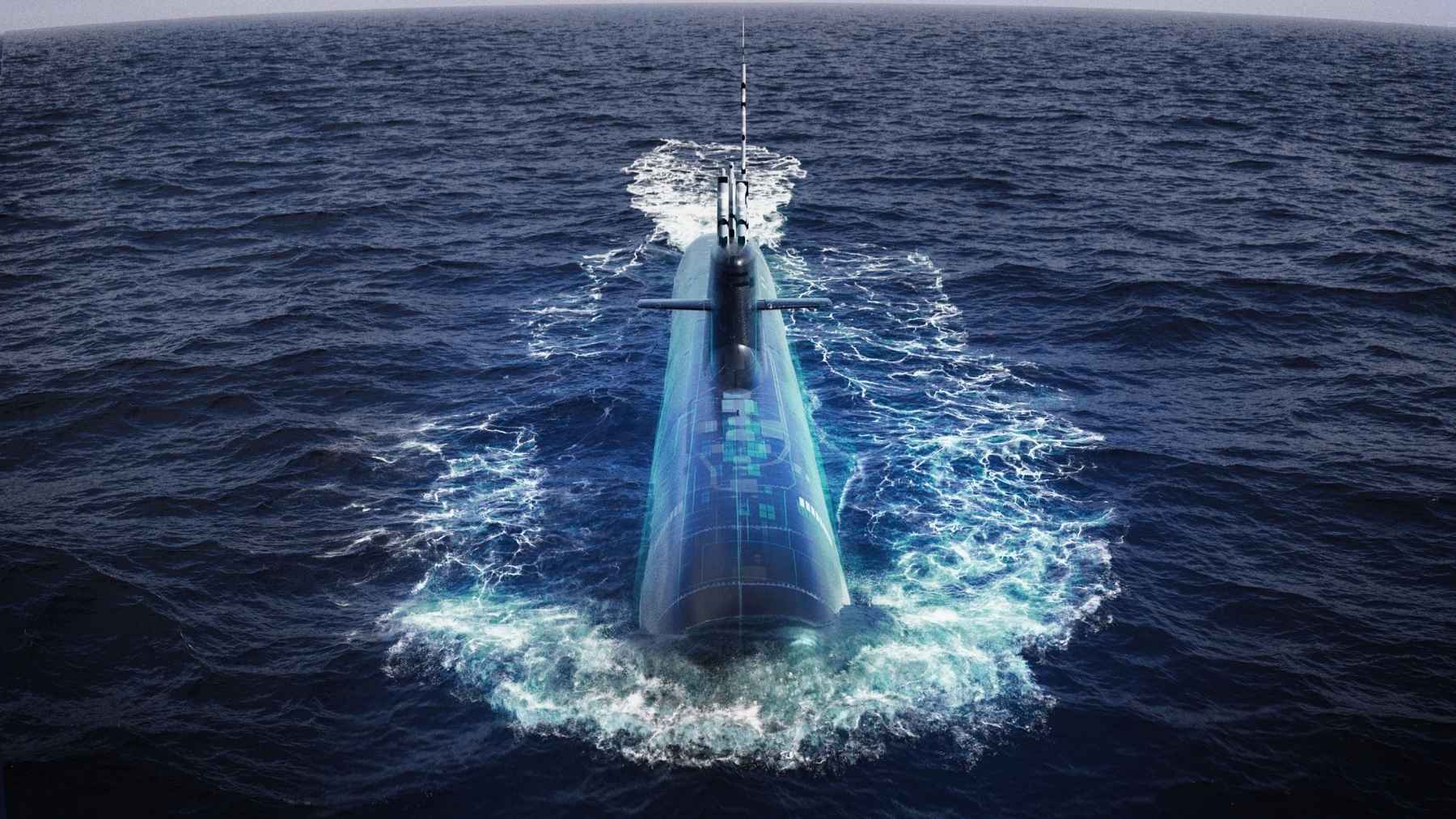
The boat is the S-80 Plus, built by the state shipyard Navantia in Cartagena, and the trick has a name: BEST, for Bio-Ethanol Stealth Technology. Navantia calls it the only submarine in the world designed to brew its hydrogen from bioethanol on board instead of carrying the gas pre-loaded in bottles, a claim laid out on the company’s own S-80 spec page. The first boat of the class, the S-81 Isaac Peral, just spent the better part of a month at sea with NATO. The second, the Narciso Monturiol, fired up its diesels for the first time in late February.
The boat runs on the alcohol that’s already in your gas tank
Here’s the problem every non-nuclear submarine has lived with forever. A conventional diesel-electric boat runs submerged on batteries, and those batteries die in a few days. To recharge them it has to come shallow and stick a snorkel above the surface to feed air to its diesels. The moment it does, it’s loud, warm and easy to find: radar sees the mast, infrared sees the heat, and sonar hears the engines. Air-independent propulsion, or AIP, is the workaround. It lets the boat make electricity underwater without surfacing, and Navantia’s BEST system does it with chemistry instead of stored gas.
The fuel is bioethanol, the same renewable alcohol mixed into gasoline at the pump, plus a tank of liquid oxygen chilled to keep it dense. A reformer (basically a small chemical plant in a hull section) heats the ethanol and strips out hydrogen. That hydrogen feeds a fuel cell, where it reacts with the pure oxygen to make electricity, and the only thing left over is distilled water. Navantia rates the cell at 300 kW, built from six 50 kW stacks. That’s roughly 400 horsepower of clean power, generated and consumed entirely underwater. The AIP doesn’t replace the batteries, by the way. It keeps topping them up so the boat can stay down. And the leftover carbon comes off as CO2, which the system dissolves into the seawater as a clear liquid so it never bubbles up to give the boat away.
Germany stores its hydrogen. Spain brews it.
Germany has been running hydrogen fuel cells in crewed submarines since the mid-2000s, in the Type 212 and its export cousin the Type 214, and those boats can also sit submerged for around three weeks. The difference is where the hydrogen comes from. The German boats carry it pre-loaded, stored in metal-hydride cylinders and paired with liquid oxygen. Germany did develop a reformer that makes hydrogen from methanol instead, but Navantia’s director of hydrogen, Amos Fuentes, has said methanol is highly toxic and that the methanol system isn’t in service even with the German navy.
That toxicity is the whole reason Spain went with ethanol. Methanol can blind or kill a crew if it leaks inside a sealed hull. Bioethanol is essentially the same alcohol people drink (denatured so nobody tries), it’s far safer to handle, and there’s an industry making it in nearly every port on earth. Spain’s fuel cell was also built to swallow the hydrogen-rich gas that comes straight out of the reformer, which Fuentes has described as a stream that “isn’t 100% pure.”
That last detail matters more than it sounds. The German cell needs pricey palladium membranes to scrub its hydrogen up to high purity before it can use it. Spain’s cell skips the membranes entirely, which removes a delicate, expensive part from a machine that has to work flawlessly hundreds of feet down. The fuel-cell approach hasn’t been trouble-free for everyone, either. A December 2025 Korea Times op-ed described how the Type 214 fuel cells Greece bought reportedly overheated and fell short of their promised submerged endurance. None of that proves Spain’s chemistry will hold up at sea. But “we have a fuel cell too” and “our fuel cell works” are different sentences.
The chemistry started in a Buenos Aires lab in 1991
The most surprising thing about a Spanish stealth submarine might be that its core chemistry is Argentine. In 1991, a CONICET researcher and University of Buenos Aires professor named Miguel Laborde worked out a method to pull hydrogen out of ethanol in a catalytic-processes lab. In 2005 the Spanish energy firm Abengoa licensed the technology through an agreement with CONICET to use it in fuel cells, a lineage documented by the institute itself. Navantia spent the years since turning a benchtop idea into a system rugged enough to run inside a warship.
So the headline-grabbing piece of Spanish naval tech is really a thirty-five-year relay: an Argentine lab, a Spanish solar-and-biofuels company, and a state shipyard that figured out how to make the whole thing survive the kind of pressure that lives a few hundred meters down.
Spain has the technology. It hasn’t sold a single submarine.
For all of that, here’s the part the press releases skip: Navantia hasn’t actually sold an S-80 to anyone. The boat has been pitched to the Netherlands, India, Canada and Poland, and shown off to Turkey, Egypt and the Philippines. It has lost the ones that have decided. India eliminated the S-80 from its six-boat Project 75(I) competition and chose Germany’s TKMS Type 214 with Mazagon Dock, and defense reporting at the time said the Spanish bid was knocked out because key technologies couldn’t be demonstrated on an operational boat. Canada dropped it last summer. Poland picked Sweden’s Saab A26 in November.
That phrase from the Indian decision, “couldn’t be demonstrated on an operational boat,” is the catch, and it explains the rest. The bioethanol AIP has only ever run in a one-of-a-kind test building in Cartagena, where Navantia bolted a full 12-meter, roughly 400-ton hull section onto a rig that simulates depth and forward speed. It has never been to sea. The first two boats, the Isaac Peral and the Narciso Monturiol, were both delivered without the AIP section, and they won’t be retrofitted with it until major overhauls late this decade. The first S-80 that will actually carry BEST underwater is the third boat, the S-83 Cosme García, due around 2027.
Which puts that NATO deployment in its proper context. When the Isaac Peral logged more than 446 hours submerged and 2,043 nautical miles on its Noble Shield rotation this March, as the Spanish Navy reported, it did all of it on conventional diesel-electric power and batteries. That’s a strong showing for a brand-new boat. It is not a demonstration of the hydrogen trick, because that boat doesn’t have the hydrogen trick yet.
What it would take to flip the pitch
A navy buying a submarine is buying decades of risk, and “trust us, it works in the warehouse” is a hard sell against a German boat that’s been in the water for twenty years, even one whose fuel cells have given other customers grief. Spain’s argument gets a lot stronger the day the S-83 stays down for three weeks on bioethanol in open ocean and comes home quiet. Until then, the S-80 Plus is the most interesting submarine almost nobody has bought: a crewed boat that brews its own hydrogen from the alcohol in your gas tank, built on an idea from a Buenos Aires lab, sitting in Cartagena waiting for its first real dive. The chemistry is finished. The sales pitch still needs salt water.