
Solar power has one problem no amount of clever engineering has fully solved: the sun goes down. Panels that pump out gigawatts at noon are dead weight by midnight, which is why nearly every large solar farm on the planet leans on something else, whether gas, coal, or a hungry grid connection, to keep the lights on after dark. Abu Dhabi is now spending around $6 billion to build a plant designed to skip that handoff entirely.
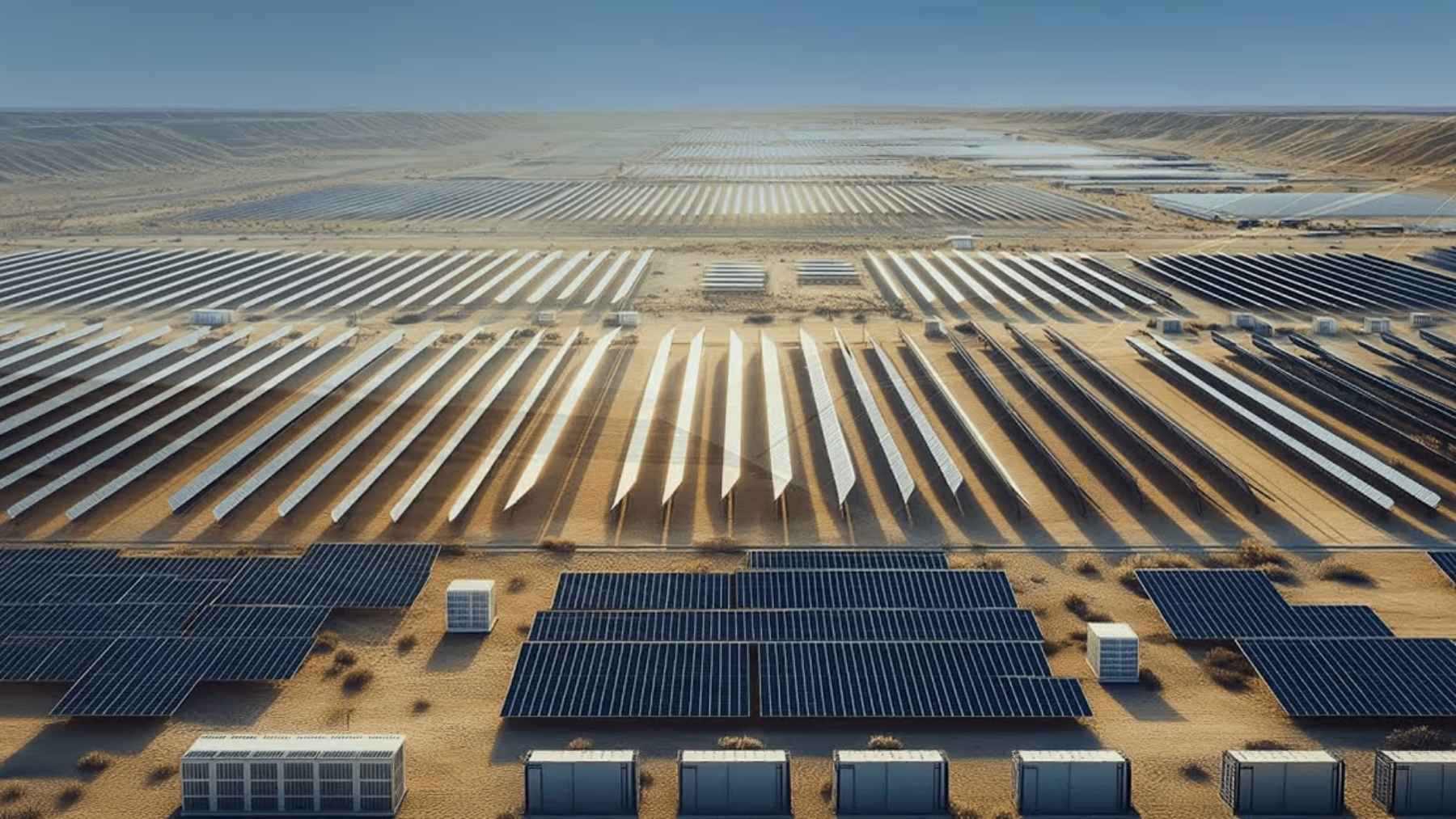
The project, developed by the state-owned renewables company Masdar with Emirates Water and Electricity Company (EWEC), pairs a 5.2-gigawatt solar array with a 19 gigawatt-hour battery and is engineered to deliver a steady 1 gigawatt of power around the clock, day and night, every day of the year. It broke ground outside Abu Dhabi in October 2025 and is scheduled to start running in 2027. If it works the way it’s drawn up, it would be the first renewable project anywhere built to push a full gigawatt of baseload, the boring always-on kind of power usually associated with gas and nuclear stations, straight off sunshine and stored electrons.
The battery is the whole point
Strip away the solar headline number and the interesting part is the storage. The 19 GWh battery, which Masdar calls the Al Azeezah system after the site it sits on, is the largest ever ordered for a power utility project, and it’s the piece that makes the round-the-clock claim possible. The array generates far more than 1 GW while the sun is up, sends a slice of that straight to the grid, and pours the rest into the battery. After sunset the battery takes over and holds the 1 GW steady until the panels wake up again.
Masdar says the plant will run on more than brute storage. It’s being built with grid-forming and black-start capability, which means it can help stabilize the grid and even restart it after a blackout instead of just leaning on it, plus a virtual power plant layer and AI-driven forecasting that decides when to bank power and when to release it. The panels themselves are reportedly coming from Jinko Solar and JA Solar, two of the largest module makers in the world, using TopCon cells. None of that is exotic hardware on its own. What’s new is the size of the order and the fact that all of it is wired to behave like a single dependable power station.
It’s the opposite of the approach you see almost everywhere else. China’s enormous “Solar Great Wall” in the Kubuqi Desert, for instance, still fires up coal plants when clouds roll in. Abu Dhabi is betting that a big enough battery makes that backup unnecessary.
It isn’t the first solar plant that runs at night
Here’s where the marketing needs a small asterisk. You’ll see this project called the “world’s first” round-the-clock solar plant, and that’s true only if you read the fine print. Solar paired with storage that keeps running after dark already exists. Smaller hybrid plants in the US, Australia, Chile and elsewhere already store daytime sun and dispatch it at night. What nobody has done before is do it at this size. As the trade outlet Energy-Storage.news put it when the project was unveiled, it’s undoubtedly the largest such effort announced to date, but round-the-clock solar itself isn’t a brand-new trick.
The honest way to describe it, then, is a scale jump rather than a science breakthrough. A 19 GWh battery feeding a flat 1 GW is roughly an order of magnitude beyond the hybrid plants utilities have been quietly building for years. For comparison, the only bigger battery currently on the books is the 42 GWh system planned for SunCable’s Australia-Asia Power Link, according to Blackridge Research, and that one is a transmission-export megaproject built to pipe power to Singapore, not a baseload plant for the local grid. Australia has its own appetite for this kind of scale, as the country’s push for the world’s largest renewable network shows.
The catch is the price tag
The reason every utility on Earth isn’t already copying this is money. Wood Mackenzie flagged the project in its “Global solar: Key things to look for in 2026” outlook, and the firm’s number is sobering: at current costs, the plant runs about six times the price of a new gas-fired combined-cycle plant for the same dependable output. Michelle Davis, Wood Mackenzie’s global head of solar, said the project is currently too expensive to replicate broadly, but that successful execution and continued cost declines could redefine baseload power.
That “six times” figure is the whole story in one number. It’s why this is being built by a sovereign-backed developer in a country with deep pockets and cheap empty land, and not by a regional utility in Ohio. Battery prices have been falling fast, which is the only reason an order this size was thinkable at all, and if they keep sliding, the math that looks absurd in 2026 could look ordinary by the early 2030s. That’s the bet. It just happens to be a $6 billion one.
Why Abu Dhabi is building it anyway
A petrostate sinking $6 billion into solar that costs six times what gas does sounds like a contradiction until you look at what it’s meant to power. Dr. Sultan Al Jaber, the UAE’s Minister of Industry and Advanced Technology and chairman of Masdar, tied the project directly to the energy demand coming from data centers and artificial intelligence, industries that need power that never blinks and increasingly want it clean. According to Masdar’s launch announcement, Al Jaber called it “a first step that could become a giant leap for the world.”
There’s a national strategy underneath the AI pitch, too. Abu Dhabi wants 60% of its power from renewable and clean sources by 2035 and net zero by 2050, and in May 2026 Masdar and EWEC signed a framework committing the emirate to 8 GW of battery storage, a sign the round-the-clock plant isn’t a one-off showpiece. The UAE has been pouring money into ambitious solar ideas for a while now; out in the same desert, researchers are even testing whether a big enough solar farm can make its own rain. When commissioned, this plant is expected to create more than 10,000 jobs and offset roughly 5.7 million tons of carbon a year.
Whether it redefines anything depends almost entirely on the price of batteries, not the price of panels. Solar got cheap years ago; storage is the part still coming down the curve. If it keeps falling, that line about solar stopping at night quietly stops being true, and the idea of a fossil plant idling in the background just to cover sunset starts to look dated. If it doesn’t, Abu Dhabi will have built a very expensive, very impressive monument to a good idea that showed up a decade early. Either way, it’s a $6 billion experiment with a 2027 deadline, and the rest of the industry will be running the same math right alongside it.
 @jimgiordano ROOKIE3 months ago