
Engineers have been ripping off the animal kingdom for as long as they’ve been building things that move. Airplane wings borrow from birds, submarine hulls borrow from whales, and just about every robotics lab on the planet has tried to copy a fish at some point. So a robot built to swim like a manta ray isn’t, by itself, news.
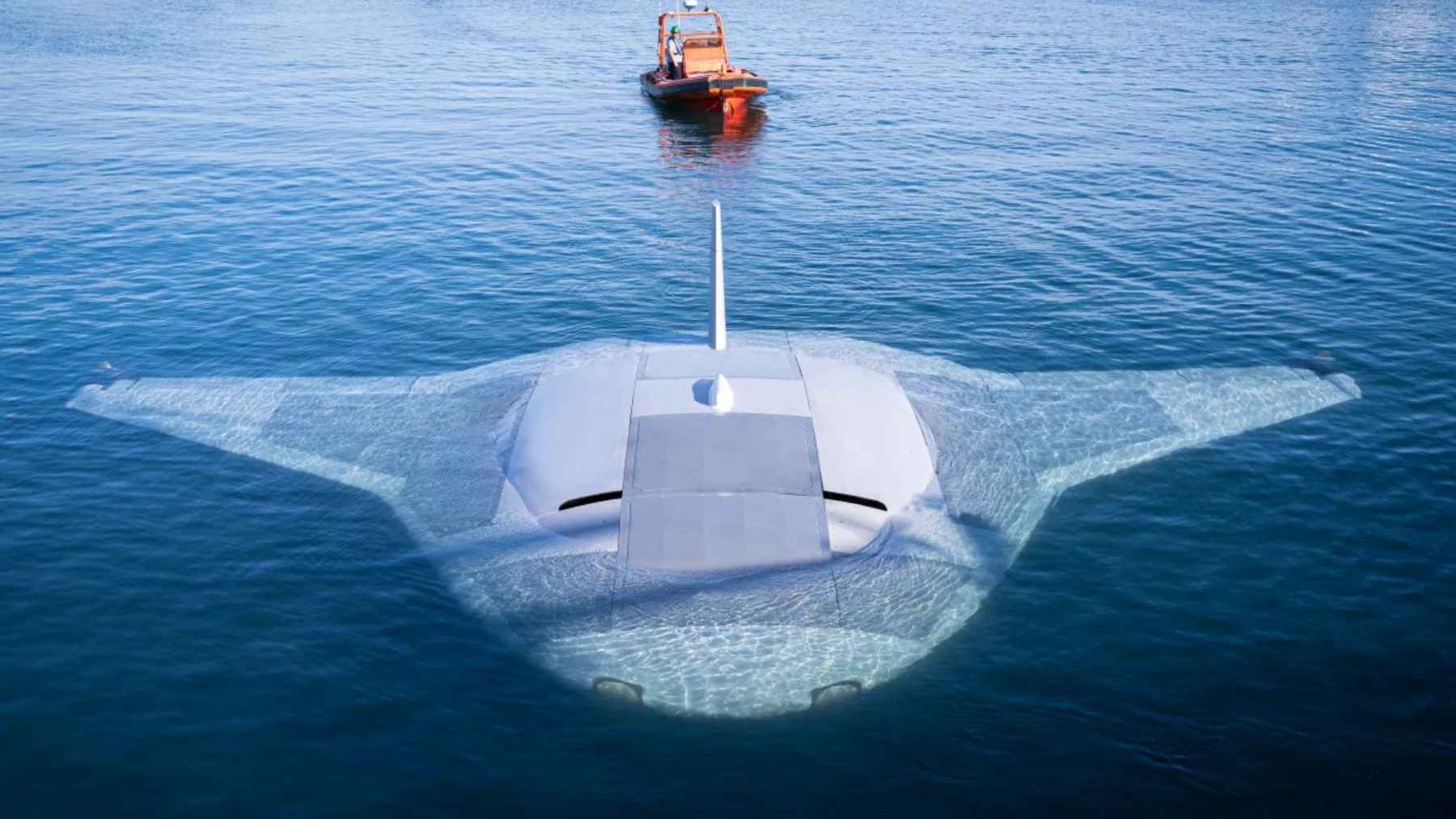
What put this particular one on Chinese state television is what its makers say it did in the dark. On March 27, 2026, the military channel of CCTV News aired footage of a soft-bodied bionic manta ray submersible detecting and locking onto simulated underwater explosive devices in water with less than one meter of visibility, a “world’s first” according to the report, which the state-run Global Times wrote up the same day. That “first” is China’s own framing, not an independent finding, and the distinction matters, because almost everything below traces back to the same handful of state outlets.
The pitch is a mine hunt in water you can’t see through
The demo CCTV ran was a mine hunt. The submersible carries a forward-looking sonar to pick targets out of the blackness and a set of side-scan sonars that map the seabed underneath it as it goes, and it pipes whatever it identifies straight back to a command terminal in real time, according to the broadcast. In water with under a meter of visibility, that’s the whole trick: finding something you physically cannot see.
The manta ray shape isn’t decoration. A normal fish wags side to side to swim, which is a lousy way to carry a precision instrument around. A manta ray keeps its body almost still and ripples its big pectoral fins instead, closer to a flag in the wind than to a swimming animal. CCTV’s argument is that this buys two things: a stable platform that doesn’t jostle sensitive sonar gear, and a roomy flat body with internal space for payloads. Whether you find that convincing or not, it’s at least a coherent reason to copy this specific animal rather than, say, a tuna.
The hardware claims get ambitious fast
From there the numbers start climbing. CCTV says the core electronics sit inside a high-pressure hull rated to roughly 200 atmospheres, which is about the pressure you’d feel near 2,000 meters down, deep enough that most things humans build simply implode. On endurance, the broadcast claims dozens of hours at full speed covering hundreds of kilometers, stretching to thousands of kilometers when the craft stops swimming and glides by adjusting its buoyancy, riding currents the way the Pentagon’s version is designed to.
Two claims stand out. First, the report says that even if the manta ray’s wired communication link is severed, it won’t lose its bearings and can keep navigating and close on its target on its own. Second, and stranger, CCTV says multiple manta rays can chain together into a sonar “local area network,” relaying signals between themselves and converting satellite signals into sonar pulses that carry deep underwater, where radio waves can’t follow. Earlier CCTV coverage tied that satellite link to China’s BeiDou constellation, and it echoes other Chinese experiments that try to bridge satellites and undersea hardware. If it works as described, that’s less a single drone and more a mesh, which is exactly the kind of swarming the field has been chasing for years.
Figures as described by China’s CCTV and Global Times. None has been independently verified outside Chinese state media.
The lab behind it isn’t new to this
This is the part that’s easiest to check, because it predates the mine-hunting footage by years. The manta rays come out of Northwestern Polytechnical University in Xi’an, a school with deep defense ties, and the program is run by Professor Cao Yong. CCTV traced the broader effort back to 2006, when it started as coral-reef monitoring, and the broadcaster says the family now spans six variants ranging from 10 to 720 kilograms. Back in 2024, a Global Times report said the submersibles had begun what it called “practical deployment” in the South China Sea, with larger armed-reconnaissance variants under development as part of China’s wider push into underwater drones and uncrewed submarines.
You don’t have to take state TV’s word for the engineering, though. A peer-reviewed review published in the journal Biomimetics in March 2026 lays out Northwestern Polytechnical’s prototype lineage in detail: a 10-kilogram, 0.8-meter proof-of-concept in 2019, a gliding-wing design built for 1,000-kilometer, month-long endurance, a 2021 model rated for 1,000-meter depths, and a heavy-payload deep-sea platform by 2023. The academic record and the military framing don’t perfectly line up on dates. The journal’s documented engineering trail starts in 2019, not 2006. But both agree the hardware is real and the team has been iterating on it for the better part of a decade.
As for where it’s headed, the 2024 reporting was blunt about the ambition: Cao’s team is working toward ton-class craft that can carry heavier payloads farther, with CCTV describing larger variants intended for armed reconnaissance still in development. So the mine-hunting demo sits on top of a long, openly discussed military roadmap rather than appearing out of nowhere.
The Pentagon has its own manta ray, and it swam off California first
Here’s the context the headlines tend to drop: the United States has been building the same thing, and its manta ray got wet first. The Defense Advanced Research Projects Agency runs a program literally called Manta Ray, and in February and March 2024 a full-scale prototype built by Northrop Grumman completed in-water testing off the coast of Southern California. DARPA’s own announcement describes an extra-large uncrewed glider that ran through every mode of propulsion and steering it has, including buoyancy, propellers, and control surfaces. Program manager Dr. Kyle Woerner called the result a “first-of-kind capability for an extra-large UUV.” A second contractor, PacMar Technologies, spent 2024 testing the energy-harvesting system meant to let one of these machines loiter for very long stretches without refueling, and DARPA has said it’s in talks with the Navy about what comes next.
The two programs aren’t identical. DARPA’s Manta Ray is a rigid extra-large glider closer in spirit to a small submarine, while Northwestern Polytechnical’s headline trick is the soft, flapping body. But the strategic logic is the same on both sides of the Pacific: cheap, long-endurance, autonomous machines that can sit on the seafloor or drift for months, then wake up to hunt mines, track submarines, or relay communications. Neither navy invented the idea. Both are sprinting at it.
Almost all of this traces back to one source
Strip out the peer-reviewed engineering and the DARPA parallel, and the specific mine-hunting demonstration rests almost entirely on one March 2026 CCTV broadcast and the Global Times write-up of it. No navy, lab, or analyst outside China has confirmed the “world’s first” claim, the sub-one-meter visibility figure, or the satellite-to-sonar mesh. State media isn’t automatically wrong. But it isn’t a neutral referee either, and “we filmed it doing this” is a different thing from “an outside party watched it do this.”
Even China’s own framing keeps the door open on what the thing is actually for. Zhang Junshe, a military affairs expert quoted by Global Times, pitched it cautiously, saying it “may be applied in defensive scenarios, such as against submarines and other surface vessels under complex and high-threat environments.” That’s hedged, careful language, and it’s a long way from a confirmed, fielded weapon.
So here’s the honest read. Northwestern Polytechnical’s manta rays are real, documented machines, and the fact that the Pentagon is pouring money into its own version is the best evidence going that China’s interest is rational rather than theatrical. What nobody outside China can confirm yet is whether this particular soft-bodied drone does everything one CCTV segment says it does, in the conditions it says, at the scale it implies. The distance between a polished demo reel and a deployed capability is wide, and right now a demo reel is most of what’s on the table. Take it seriously. Just don’t mistake the footage for the finished article.