
Solar power has one problem you don’t need an engineering degree to spot: the sun goes down. Rooftop panels stop making electricity the moment it gets dark, which is fine right up until you notice how much of what Americans plug in wants power at 2 a.m. as badly as it does at noon. The car charging in the garage. The data center humming all night. The grid operator trying to keep the lights on after the evening solar drop-off. There’s a whole different kind of solar plant that was built to fix exactly this, and the way it’s playing out in the Mojave versus the Gobi is about as stark a split as you’ll find in clean energy right now. America’s two big mirror-and-tower plants are both in trouble. China just brought another one fully online and broke ground on the next.
The idea is to store the sun as heat, not electricity
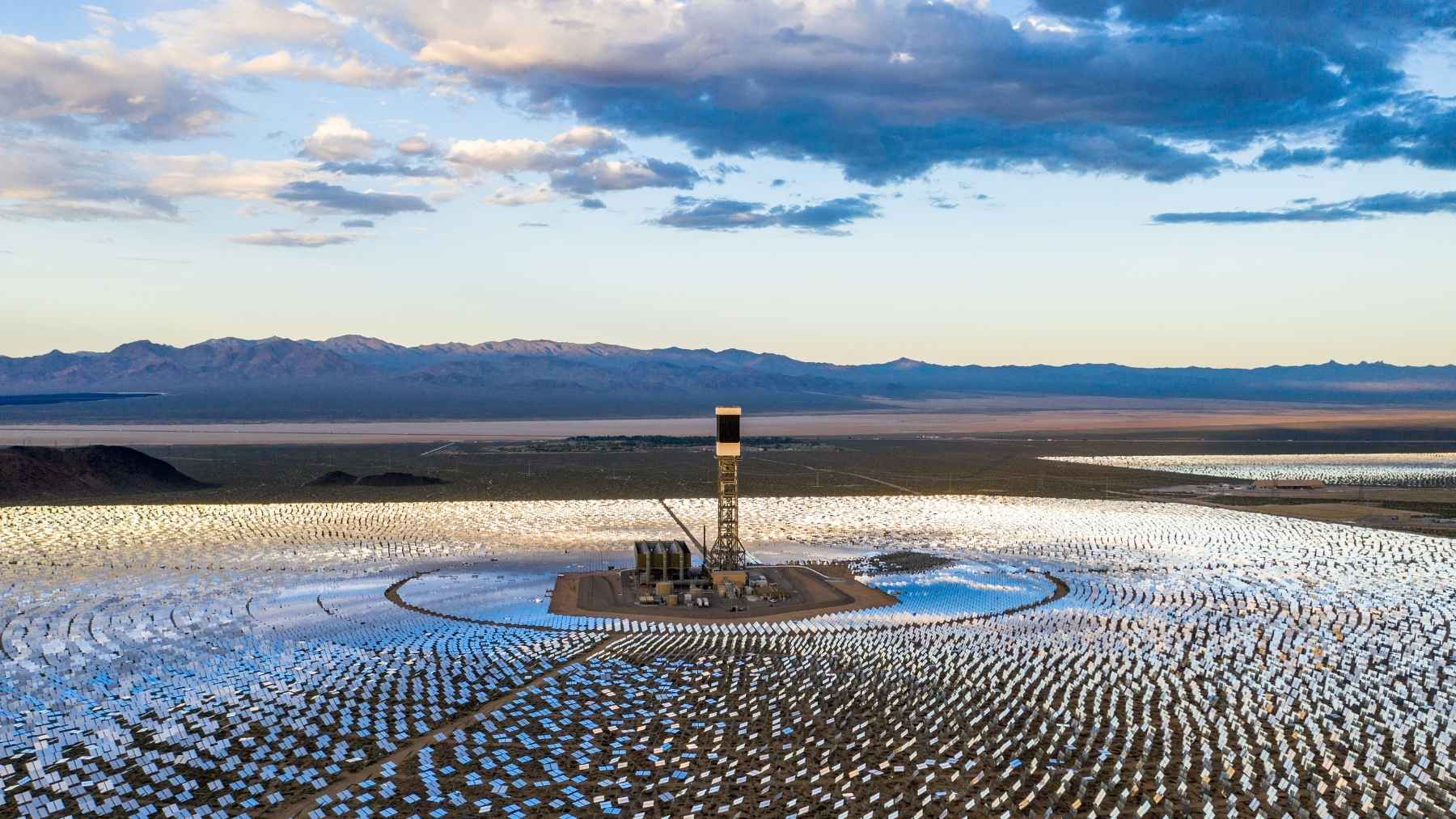
A regular solar panel turns sunlight straight into electricity, and if you want that electricity later you need a battery sitting next to it. Concentrated solar power does something stranger. Instead of panels, you build a field of mirrors, called heliostats, that all tilt to bounce sunlight at a single point on top of a tower. That concentrated beam gets hot enough to do real industrial work. In the older designs it boils water into steam to spin a turbine, the same basic move a coal plant makes, just with sunshine instead of a furnace.
The clever versions swap the water for molten salt. The mirrors heat the salt to somewhere around 565°C, hot enough to stay liquid, and that salt gets pumped into a giant insulated tank. Now you’ve got a thermal battery. When the sun sets, you pull the hot salt back out, run it through a heat exchanger to make steam, and keep the turbine turning for hours. The plant generates electricity at night without a single chemical battery in sight. That’s the entire pitch: solar power that doesn’t clock out at sunset. Desert solar has gotten big enough lately that researchers are even testing whether arrays this size can change the local weather, but the storage problem is the one that actually decides whether a plant earns its keep.
It’s a genuinely good idea. The problem, as America found out twice, is that good ideas and working power plants are not the same thing.
America built both kinds of mirror plant, and both are stuck
Start with Ivanpah, the giant field of mirrors you can see from Interstate 15 on the drive out of Las Vegas. It opened in 2014, cost about $2.2 billion to build with $1.6 billion of that backed by federal loan guarantees, and it’s rated at 392 megawatts across three towers. Here’s the catch that matters for this story: Ivanpah has no salt and no storage at all. Its mirrors heat water into steam directly, which means it mostly makes power only while the sun is up, and it has leaned on natural gas to warm its boilers for morning startups. It is, in other words, exactly the version of this technology that the salt towers were built to replace.
Ivanpah’s own customers wanted out. In January 2025, Pacific Gas & Electric filed to terminate its contracts for two of the three units, years ahead of their original 2039 expiration, on the straightforward logic that plain solar panels had gotten so cheap the plant no longer made financial sense. Then it got complicated. California’s Public Utilities Commission rejected the termination, pointing to grid reliability, the hundreds of millions of dollars already sunk into transmission lines, and rising demand from data centers and vehicle charging. As of this spring the deal is, per CleanTechnica’s reporting, on ice. So the country has a CSP plant nobody especially wants to keep running, that nobody is allowed to close, sitting in regulatory limbo in the desert.
Then there’s Crescent Dunes, up near Tonopah, Nevada, which actually did the smart thing. It was the first utility-scale plant in the country built with molten salt storage fully integrated: 110 megawatts with enough salt for around 10 hours of generation, backed by a $737 million federal loan. On paper it was the future. In practice a hot salt tank sprang a leak in October 2016 and took the plant offline for eight months, and by 2018 it was running at a 20.3% capacity factor against a planned 51.9%, according to federal energy data. It last sent power to the grid in 2019. Its owner filed for bankruptcy in 2020, climbed out, and then filed for Chapter 11 a second time in January 2026. In March a bankruptcy court approved the plant’s sale to a construction company for $7 million in cash, with no competing bids. A plant that cost the better part of a billion dollars went for the price of a nice house in the suburbs.
The brutal number sitting underneath all of this: Crescent Dunes was selling power at roughly $135 per megawatt-hour while new photovoltaic farms in Nevada were signing contracts closer to $30. Cheap panels plus cheap batteries simply outran the mirrors.
China’s flagship is two 200-meter towers feeding one turbine
Now look at the Gobi. In Guazhou County, in Gansu Province, China Three Gorges Corporation and its partner SunSum built what they call the world’s first dual-tower solar thermal plant, and it’s a genuinely different layout. Instead of one tower, there are two, each about 200 meters tall and roughly a kilometer apart, with nearly 27,000 mirrors arranged in two overlapping circles between them. The mirrors in the overlapping zone can aim at either tower depending on the time of day, which is the whole point of building it this way. According to plant project manager Wen Jianghong, speaking to state broadcaster CGTN, that shared-mirror design is expected to lift efficiency by 24 percent compared with a single tower.
Both towers run on molten salt, stored at up to 570°C, doing the same thermal-battery job that keeps the plant generating after the sun drops. China’s State-owned Assets Supervision and Administration Commission reported that the project reached full-system trial operation, with both towers firing at once, in October 2025. The CSP block sits inside a larger 700-megawatt clean energy complex that also folds in wind and conventional panels, which the developer says will produce around 1.8 billion kilowatt-hours a year. Those output figures come from the company and Chinese state media rather than an independent auditor, so treat them as the project’s own accounting. The hardware being switched on, though, is real and documented.
And it’s only fair to say plainly that none of this means China invented night-time solar. The molten salt trick has been around for years, and the United States, as we just covered, built one of the early large-scale versions itself. The difference is entirely in what each country did next.
China has been at this since 2018, and it hasn’t stopped
The dual-tower plant didn’t come out of nowhere. Out near Dunhuang, also in Gansu, the company Shouhang has been running a 100-megawatt molten salt tower since it connected to the grid in December 2018. It uses a single 260-meter tower, which its builder billed as the tallest molten salt heat-collection tower in the world, ringed by about 12,000 mirrors, with 11 hours of salt storage that lets it generate around the clock. It’s the same core idea as Crescent Dunes, built in the same era, and according to the China Solar Thermal Alliance it has logged stretches of continuous operation running into hundreds of hours. One obvious difference in outcome: it’s been quietly operating for years rather than sitting in a bankruptcy docket.
The building hasn’t slowed down either. In April 2026, China General Nuclear broke ground on what it says will be the highest-altitude trough-style CSP plant in the world, perched at 4,550 meters in Damxung County in Tibet. It’s a 50-megawatt plant using parabolic troughs rather than a tower, paired with six hours of molten salt storage so it can run into the evening, and it’s tucked inside a combined project that also includes 400 megawatts of regular panels. Per Xinhua, the site is so high and cold that crews can only build from April to October, working with oxygen supply and a hyperbaric chamber on hand. If you want one image for how differently the two countries are treating this technology right now, it’s the US arguing in front of regulators over whether its existing mirror plant is worth keeping, while China is hauling oxygen tanks up a Tibetan mountain to pour the foundations of a new one.
US figures from court and California regulatory filings; Chinese capacity and efficiency figures from the developers and state media, attributed as such.
This is a bet, not a victory lap
Before anyone hands the salt towers a trophy, the same economics that flattened Crescent Dunes are still in the room. Photovoltaic panels keep getting cheaper, lithium batteries keep getting cheaper, and the two of them together can now do a lot of what molten salt storage promised, often for less money and with far fewer moving parts that can spring a leak. China is building staggering amounts of plain solar too, including a 250-mile “great wall” of panels along a desert edge and the world’s largest solar farm, which grew so much grass under the modules that the operator brought in thousands of sheep to keep it down. The salt towers are a deliberately chosen, relatively small slice of a much bigger buildout, valued mostly because they put out steady, dispatchable power that helps balance a grid swamped with intermittent panels and wind.
What you’re actually watching, then, isn’t a tidy story about one country racing ahead and another falling behind. It’s two different bets on the same hard problem. The US largely decided that concentrated solar with storage wasn’t worth the cost and the headaches, got burned at Crescent Dunes, and is now stuck babysitting Ivanpah because closing it turned out to be its own kind of expensive. China decided the dispatchable power was worth paying for and kept building, failures and economics notwithstanding. Whether that bet pays off there depends on whether cheap panels and batteries eventually undercut the salt towers the same way they did in the Mojave. The mirrors are still going up in the Gobi. The ones in California are just waiting to find out what happens to them.