
Most solar farms aren’t built with a tractor in mind. The rows are packed in tight, the solar panels usually sit a few feet off the dirt, and once the fence goes up, about the biggest machine that ever drives in there is a mower.
So when someone pitches a farmer on growing food under solar panels (the industry calls it agrivoltaics), you can probably guess what the farmer asks first. Can I still get my equipment in?
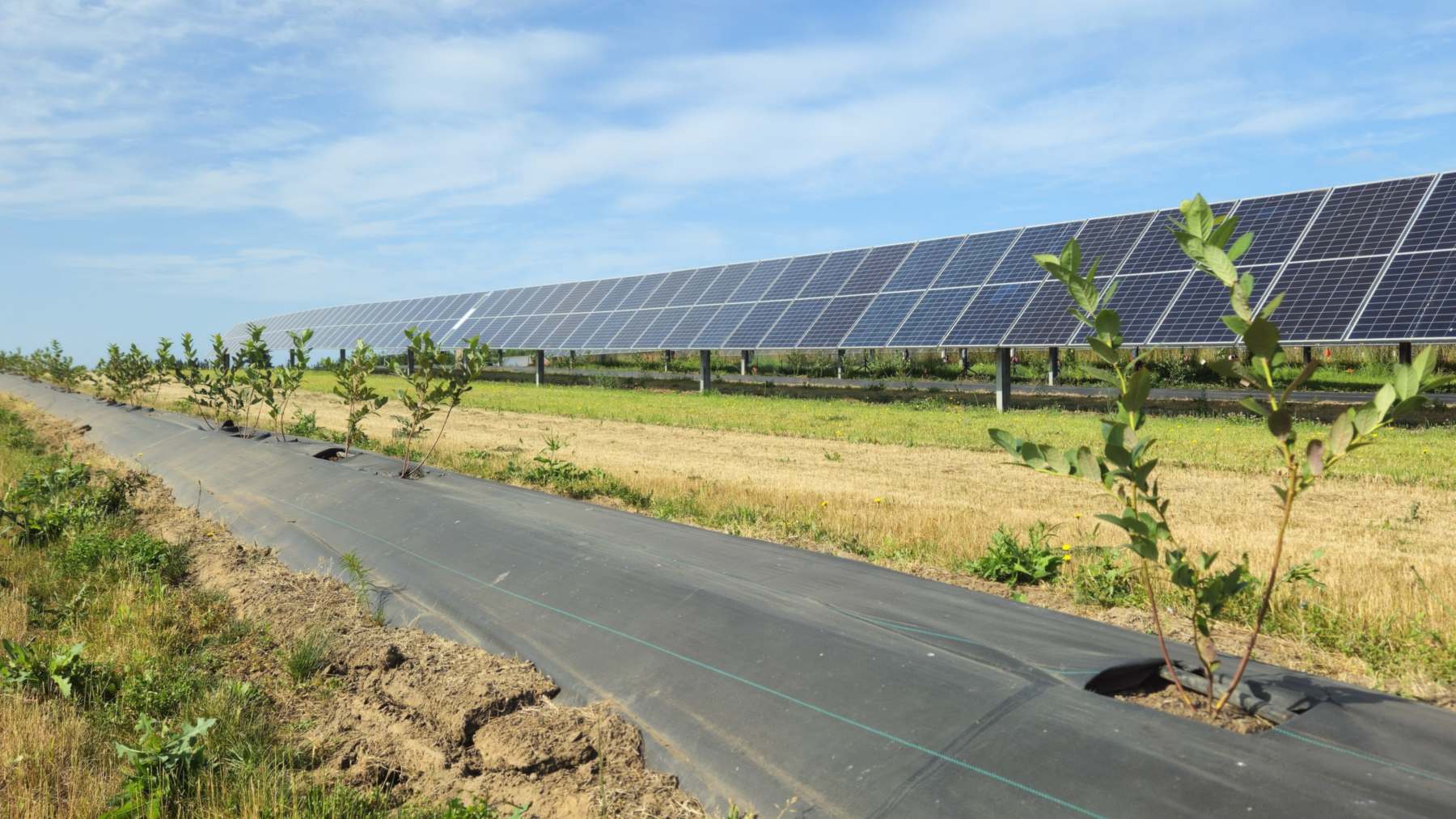
Oregon State University has a five-acre solar array about 20 miles south of Portland that was laid out to answer that. Its rows of solar panels are spread farther apart than usual, and the panels can rotate to a nearly vertical position so farm equipment can drive through.
Right now it’s being tested with blueberries, which get picked by one of the more awkward machines in farming.
So what’s planted there?
Two rows of blueberry bushes, basically. OSU’s page for the trial says Scott Lukas, who holds OSU’s endowed professorship for Northwest berry production and management, planted one row inside the solar array and one row outside it. Both went in the ground in October 2024, and both are a variety called Calypso.
It’s about as simple as a field experiment gets. The soil and the weather are the same for both rows, and one of them spends part of the day in the shade of solar panels. If the shaded bushes grow differently, you can pretty much pin it on the array.
Calypso wasn’t picked at random, either. OSU says growers are planting it widely because of its large berries, high yields and flavor, and because it ripens in the middle to late part of the season. Frankly, that makes it a better test subject than some variety hardly anyone grows.
OSU says it’s tracking growth rate, yield, berry size and sugar content in both rows as the plants mature.
Why does the harvester matter so much?
Because picking blueberries by hand is expensive. Oregon growers harvest roughly 150 million pounds of them a year, according to OSU Extension, and a big share is headed for the fresh market.
The machine that replaces all those hands is called an over-the-row harvester. If you’ve been through a drive-through car wash, picture that, except the car wash is what’s moving and the car is a blueberry bush. It’s a tall, tunnel-shaped machine on wheels that straddles the row and drives straight down it, shaking the ripe fruit loose and catching it as it goes.
Machines like that have picked berries headed for processing for a long time, and an OSU Extension team led by berry agent Wei Qiang Yang has been testing soft-catch versions that are gentle enough for fresh fruit. OSU puts hand-picking fresh-market berries at about $0.60 a pound, against about $0.15 a pound by machine.
You can see why a machine like that is a headache around solar panels. It needs a clear lane on both sides of the bushes and open air above them, and a regular solar array doesn’t leave room for either.
OSU built the spacing in from the start. According to a case study from the AgriSolar Clearinghouse, a program run by the National Center for Appropriate Technology, the team used the research station’s own tractor to work out how far apart the solar panels needed to be, so a farmer copying the layout wouldn’t have to buy special equipment. I think that’s arguably the smartest decision in the whole project.
OSU’s trial page says the spacing allows machine harvest using an over-the-row harvester, and it shows a photo of one with a caption saying it fits between the rows of solar panels.
We’ve seen this problem solved the other way around. A Spanish olive grove we covered is raising its solar panels 13 feet in the air so an 11.5-foot straddle harvester can drive underneath them. Oregon State went with wider lanes and panels that tilt out of the way instead.
I’d love to give you the lane width and the height of the machine, but OSU hasn’t published those, or the harvester’s make. I also can’t find a photo or a write-up of it working a row inside the array. To be fair, there wouldn’t be much for it to pick yet.
The bushes won’t be picked until 2027
Blueberry bushes take a while to get going. OSU’s plan treats the first two years, 2024 through 2026, as a test of whether the plants establish themselves as well inside the array as they do outside it. Year three is when the fruit gets compared.
So will a blueberry bush put up with that much shade?
Nobody knows yet, and I’d be pretty wary of anyone who says they do. Sweet corn under a raised array in Massachusetts came in at about 80 percent of the open rows next door. Pears under a solar roof in Belgium gave up about 15 percent of their harvest three years running. They’re different crops under different hardware, so you can’t really carry either number over to a Calypso bush in Oregon.
The plot’s doing double duty, too. When blueberry bushes are young, growers usually pull most of the flower buds off by hand, sometimes every one of them, so the plant puts its energy into growing. Lukas’s team is spraying an off-the-shelf gibberellic acid product, which is a hormone the plant already makes on its own, in the first summer and fall the bushes are in the ground. They want to see if it cuts the bud count enough that nobody has to hand-prune in winter. So that’s a second labor bill this one plot is trying to shrink, and I’d argue growers care about that at least as much as the shade.
How big is the array? That depends on who you ask
I went looking for the array’s capacity and came back with three answers.
The first figure comes from OSU’s own announcement, and the second is on the Oregon Public Utility Commission’s certification order. Solar panels make direct current, and inverters turn it into the alternating current the grid runs on. Arrays usually carry a bit more panel capacity than their inverters can push out, so the AC number comes in lower.
As far as I can tell, that’s the gap between 326 and 300, but OSU doesn’t spell it out, so treat that as my read. The 320 looks like a typo to me, since a kilowatt-hour measures energy used over time, like on your power bill, and arrays are rated in plain kilowatts.
Whichever number you pick, it’s a small array, and it’s been feeding the grid for more than three years. OSU says 10 percent of the power goes to the research station, 40 percent goes to lower-income subscribers and the other half goes to community subscribers who buy it through the Oregon Clean Power Cooperative, which developed the array.
Chad Higgins, the OSU associate professor who got the array built, has a pretty blunt view of where this is headed. “There is, in my opinion, no need to stop farming under solar panels ever,” he told Capital Press.
That’s a bold line, and a crop that needs a tunnel-shaped harvester is a pretty fair test of it. OSU says the first side-by-side comparison of yield and fruit quality comes in 2027, when the Calypso bushes fruit in their third year.