
Fish ladders are the standard answer to the question of how a salmon gets past a dam. You’ve probably seen one: a staircase of little concrete pools climbing the side of a spillway, with water tumbling down each step so the fish can jump their way up. They work fine as long as the water on both sides stays put.
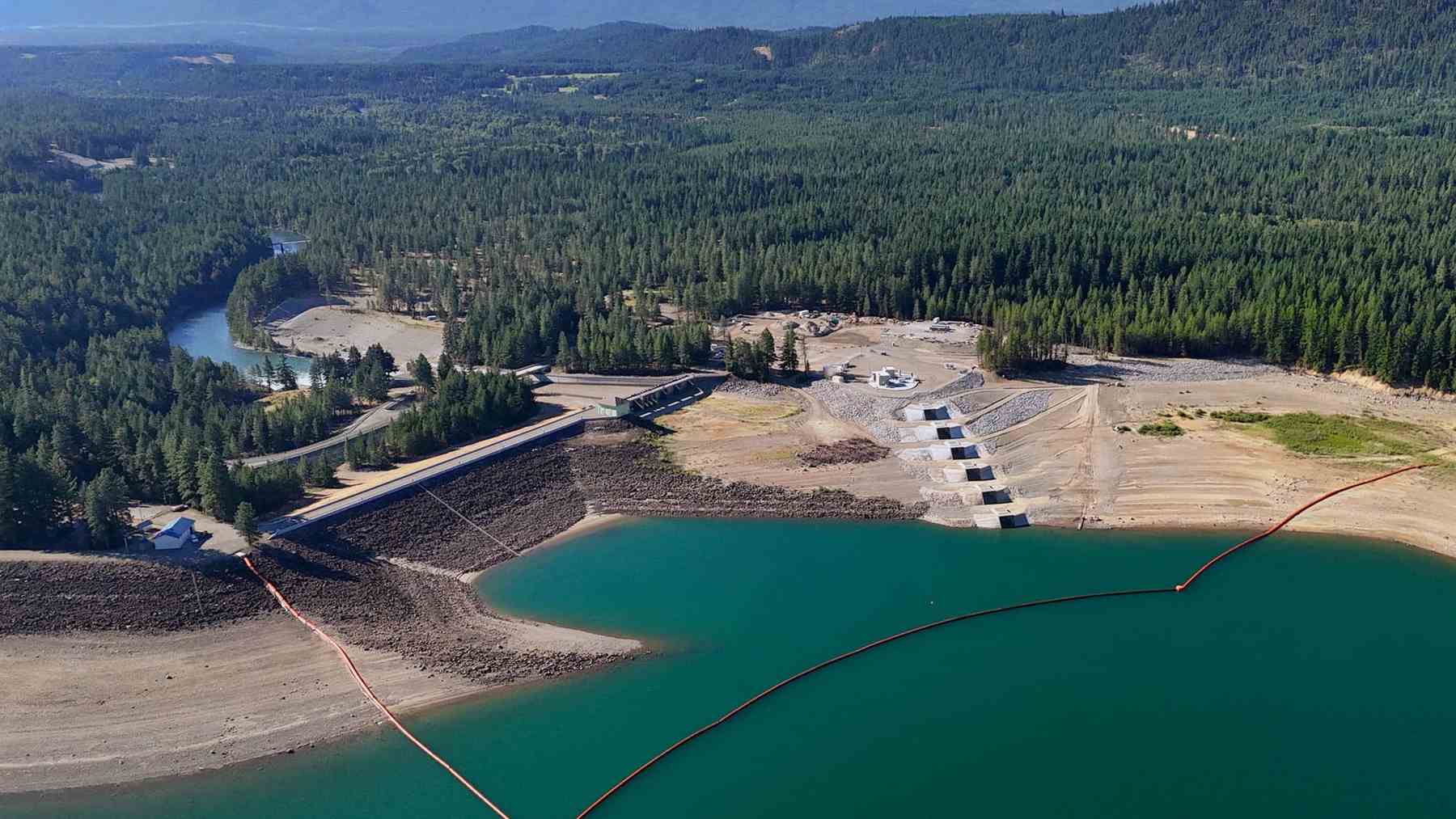
Cle Elum Dam in Washington doesn’t have that luxury. It’s a 165-foot earthfill dam that the Bureau of Reclamation finished in 1933 to store irrigation water for the Yakima Valley, and the lake behind it drops about 100 feet every year as farmers draw it down through the summer. A ladder built for a full lake is a ladder to nowhere by August.
So Reclamation built something else. Instead of a staircase going up, it bored a spiral going down, eight stories deep into the lakeshore, and gave it six separate front doors stacked on top of each other so that at least one of them is always at water level.
The agency calls it a helix. Pretty much everyone else involved calls it a water slide, which is closer to the truth.
So what does a fish water slide actually look like?
From the lake side, the young salmon swim into whichever intake happens to be open. The six intakes sit one above the other, and only one runs at a time, because juvenile salmon tend to travel within 8 to 10 feet of the surface and there’s no point pulling water from 60 feet down. Operators pick whichever level matches the lake, and that’s the one they open.
Behind each intake is a gate chamber with a 7-by-7-foot knife gate, and behind that comes the spiral itself. The flume is made of 117 precast concrete pieces hung on structural steel inside a shaft whose floor sits around 120 feet below ground, according to Garco Construction, the general contractor. The pieces were cast upside down in custom molds at a precast yard in Spokane Valley, the Spokane Journal of Business reported, because any seam or pocket in the surface could hurt a fish going by at speed.
At the bottom, the spiral feeds into a tunnel 7 feet across that runs roughly 1,250 feet to a portal below the dam, then about 400 feet of plastic pipe carries the fish into an outfall pool in the Cle Elum River. From there they’re on their own, headed for the Columbia and eventually the Pacific.
Garco finished its part in October 2024. The company’s listed contract value was $88,255,487, which is a surprisingly precise number for a hole in the ground with a corkscrew in it.
Why do the fish go down backward?
This is the bit I couldn’t picture at first. The Washington Department of Ecology says the fish travel down the helix tail first at up to 25 miles per hour, and the trip through the dam takes about a minute.
Tail first sounds like something’s gone wrong. It isn’t. Juvenile salmon migrating downstream in a fast river naturally point their heads into the current and let it carry them backward, swimming just hard enough to keep control. The helix was designed to let them do exactly that, so instead of tumbling down a chute they ride it the way they’d ride a spring flood.
Reclamation worked this out at its hydraulics lab in Colorado, and the early test subjects were apparently hot dogs and Nerf balls, per the Seattle Times. When live fish finally went through in 2024, the biologists watching saw them orient backward and slide down with their gills flared, which is roughly what you’d want a fish to look like if you’d spent a decade designing a slide for it.
Chad Stuart, who manages Reclamation’s field office at the dam, stood inside the spiral during a tour this spring with the water roaring past and told KNKX it “looks faster than it is.” I’ll take his word for it. No one’s offering rides.
Before this, the fish waited for the lake to fill
Sockeye were wiped out above Cle Elum when the dam went in, and the Yakama Nation started putting them back in 2009 by trapping adults at Priest Rapids Dam on the Columbia and trucking them up to the lake. The adults spawned. The problem was their offspring.
Young sockeye could only leave the lake when it was completely full and water was going over the spillway, and some years it just didn’t happen. The interim fix was a plywood ramp. A Yakama Nation fish passage biologist told the Yakima Herald-Republic in 2023 that sockeye using the spillway survived at a rate of 60 to 70 percent, which is the kind of number that makes you build a $255 million helix.
Or $288 million. KNKX reported the higher figure in May and the Seattle Times the lower one in June, and I can’t find an official breakdown that settles it. Either way it’s state and federal money, and either way it’s a lot for one dam.
The six-door system used one door this year
So did the six-door trick get a workout this spring?
Not really, and I find that kind of funny. The whole argument for the helix is that it works when the lake is low. This spring the lake wasn’t low.
Washington’s snowpack came in at 52 percent of the median on April 1, bad enough for a fourth straight drought emergency, but the Yakima reservoirs were above normal anyway, because near-normal precipitation had come down as rain instead of snow. So Reclamation’s own slides from a June 10 workgroup meeting record that Intake Level 1, the top one for a full pool, ran from March 23 to June 8, and the other five sat there.
I’d call that insurance that didn’t get used, which is pretty much what you want from insurance. The years that matter are the ones where the lake never fills, and Washington has now declared drought four years in a row.
Reclamation’s early read on the fish is encouraging but not finished. The same slides say fish passing through the helix “appear to have high survival,” based on acoustic tags on hatchery Chinook and on sockeye captured in the lake. They also say some fish left the reservoir through the old dam outlet instead, some tagged fish haven’t left the reservoir at all, and none had been detected downstream in the Roza Canal by the time of the meeting. The Seattle Times put the first cohort at an estimated 1 million sockeye, most of them about a year old. Reclamation hasn’t published a survival percentage yet, and I’d be a little wary of anyone who gives you one before it does.
The helix also only solves half the problem. It gets young fish out. Adults coming back still get trapped at Roza Dam and trucked almost 60 miles to the lake, and will until the adult collection facility at the base of Cle Elum Dam opens, which Ecology has pegged for late 2026 or early 2027. Once that’s running, the truck ride shrinks to about a thousand feet over the dam.
Ecology projects the full project could lift sockeye returns to the basin from 20,000 a year to 100,000. That’s a projection, not a count, and the 10-year average for all salmon and steelhead coming back to the whole Yakima basin is a little over 11,000, so there’s a long way to go. If you want the opposite case, a 930-megawatt reactor in Africa had to drop to half power when dead sardines packed its seawater intake, and Libby Dam in Montana is spending its construction money on a spare 120-megawatt generator rather than on fish.
So far the slide has done its job in the easy case. Reclamation’s June 10 materials list the 2026 intake season as March 23 through June 8, the adult trap at the foot of the dam is nearly built, and all six doors won’t get a proper test until the next time Cle Elum Lake fails to fill.