
I spent part of my weekend reading a nuclear plant’s newsletter, which probably tells you all you need to know about my weekends. The plant is Fessenheim, a retired one in eastern France, right by the German border. Its September issue reads a lot like a small-town paper, with a photo exhibit, a new communications chief and an old fire pump the plant donated to a nearby village’s fire station.
Then you get to page 2. That’s where EDF, the state-owned French utility that runs the plant, mentions that it recently had a piece of steel weighing about 1,455 pounds cut out of the pressurizer on one of the plant’s two reactors. EDF wants to know what more than four decades on the job did to it.
So why take a laser to a nuclear plant that’s already shut down?
Because it’s shut down. EDF is studying whether its other reactors can keep running past 60 years, and you can’t exactly carve a chunk out of a pressurizer that’s still holding pressure. The newsletter makes the same point a little more politely, explaining that a closed plant lets EDF analyze materials it can’t get to in one that’s running.
So what’s a pressurizer?
Fessenheim’s two reactors are 900-megawatt pressurized water reactors, the same basic type as most of the reactors running in the US. The water that cools a reactor like that gets hundreds of degrees hotter than a pot of boiling water, and the only reason it doesn’t turn to steam is pressure, lots of it. Your car’s radiator cap pulls the same trick on a much smaller scale, since coolant under pressure can get hotter before it boils.
The pressurizer’s job is to keep that pressure where it should be. It uses electric heaters to raise the pressure and water sprays to lower it, and it’s a separate tank from the reactor vessel, the big steel pot that holds the fuel. So nobody was cutting into the reactor itself. We’ve covered the inside of one of these before, when a Swedish plant had to fix 30 melted heaters through a single 16-inch hatch.
EDF’s sample came from the bottom section of the pressurizer’s shell, at a circular weld that runs hotter than anywhere else on the tank, according to Onet Technologies, the French contractor that did the cutting. Fessenheim’s second reactor ran for more than four decades before it shut down for good in 2020. So that weld’s had a long, hot career, and starting with the hardest-working part of the tank makes pretty good sense to me.
Onet says the piece is made of steel and stainless steel, and it’s a big one. It’s just under 4 feet long and just under 2 feet wide, and it’s more than 7.8 inches thick. Big pressure tanks like this are usually thick steel with a stainless lining on the inside, where the water touches, which would explain the mix. EDF calls the job a first for its nuclear fleet.
So how do you cut steel that thick by remote control?
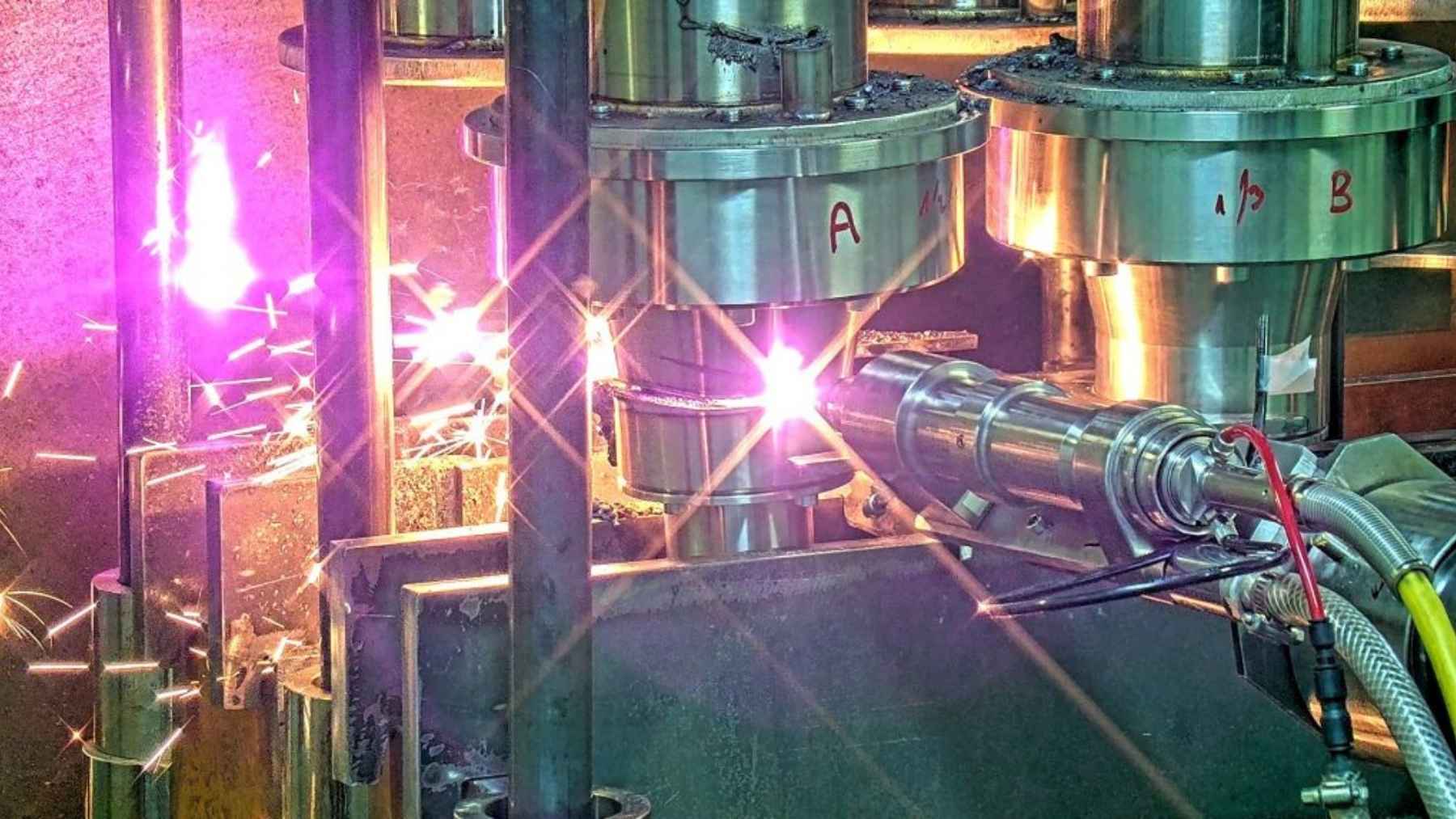
The setup paired a high-power laser with a cutting head built for nuclear work, and the head rode on a robotic arm that operators ran remotely. A laser cutter basically melts a narrow line through the metal while a jet of gas blows the molten stuff out of the way. The cut itself took a few hours, according to Onet. The prep took almost 18 months.
That probably sounds lopsided, but I’d argue it’s the right way around. You only get one shot at a sample like this, and Onet says the cutting and the extraction both happened in a particularly cramped space.
The job wasn’t only cutting, either. Onet’s team also had to take the cover off the pressurizer’s manway, a hatch big enough for a person to climb through, and then put it back on, like any decent mechanic would. Once the sample was cut free, it was pulled out, decontaminated and packed up for shipping.
Onet hasn’t said how powerful its laser is, just that it’s a high-power one. Neither company has said what day the cut happened, and EDF’s September newsletter only calls it recent.
Figures: EDF, Onet Technologies.
EDF is sampling about 20 kinds of material at Fessenheim
EDF runs all of this through a project it calls Durée de Fonctionnement, which translates to something like operating life, and it launched the project to work through the technical side of running its plants past 60 years. Fessenheim’s role is basically organ donor.
The pressurizer piece is one item on a long list. Anne-Françoise Cotte, one of the people running the project, told the newsletter that EDF is sampling around 20 different kinds of equipment and materials at Fessenheim. That covers electrical connectors, lengths of cable several yards long, fire dampers (the flaps that seal off air ducts in a fire), cores drilled out of the concrete and chunks of the casings from the big pumps that push water through the reactor. It even covers sand. EDF didn’t say what it’s hoping to learn from the sand, and frankly, I’m curious.
Once the samples are out, they go to a lab. EDF says it regularly passes the results on to the ASNR, France’s nuclear safety regulator, and works them into its studies. It also fits the sampling in around the teardown so it slows the dismantling as little as possible. EDF hasn’t said which lab is getting the pressurizer piece or when the results will be ready.
And Fessenheim is definitely coming apart. On May 1, the French government signed the plant’s dismantling decree, and crews have started cutting away the piping and flooring built around the steam generators inside a reactor building. EDF says Fessenheim is the first plant built on the same reactor technology as the rest of France’s working fleet to be taken apart. I’d guess that’s a big part of why its metal is so useful to EDF.
Some American reactors are cleared to run for 80 years
If you’re reading this in the US, you’ve got a stake in what that lab finds. The NRC has been approving licenses that let some American reactors run for 80 years, and Florida’s St. Lucie plant got its pair in April. Nobody’s run a big commercial reactor that long yet, so metal that’s actually aged on the job is pretty valuable evidence.
Results from Fessenheim have already reached US regulators. At a technical meeting between the NRC and the US nuclear industry last year, a presentation on cracking in reactor piping passed along EDF’s results from Fessenheim’s other reactor. EDF had cut open eight welds from the pipe that links that reactor’s pressurizer to the rest of its cooling loop, and it found no cracks in any of them. My guess is American plant owners will want a look at the new pressurizer results too.
The pressurizer piece won’t be the last thing to leave Fessenheim in a shipping box. EDF says it’ll keep pulling samples out of the plant until 2034.