
Tools are supposed to match the job. Nobody rents a crane to hang a picture frame, and nobody plans to clear 880 metric tons of melted nuclear fuel with a gadget that brings back samples smaller than a raisin.
Yet that gadget, a telescoping rod nicknamed Telesco, has been the only thing to actually touch the melted fuel inside the wrecked reactors at Fukushima Daiichi. Two trips in two years, and its lifetime haul stands at less than a single gram.
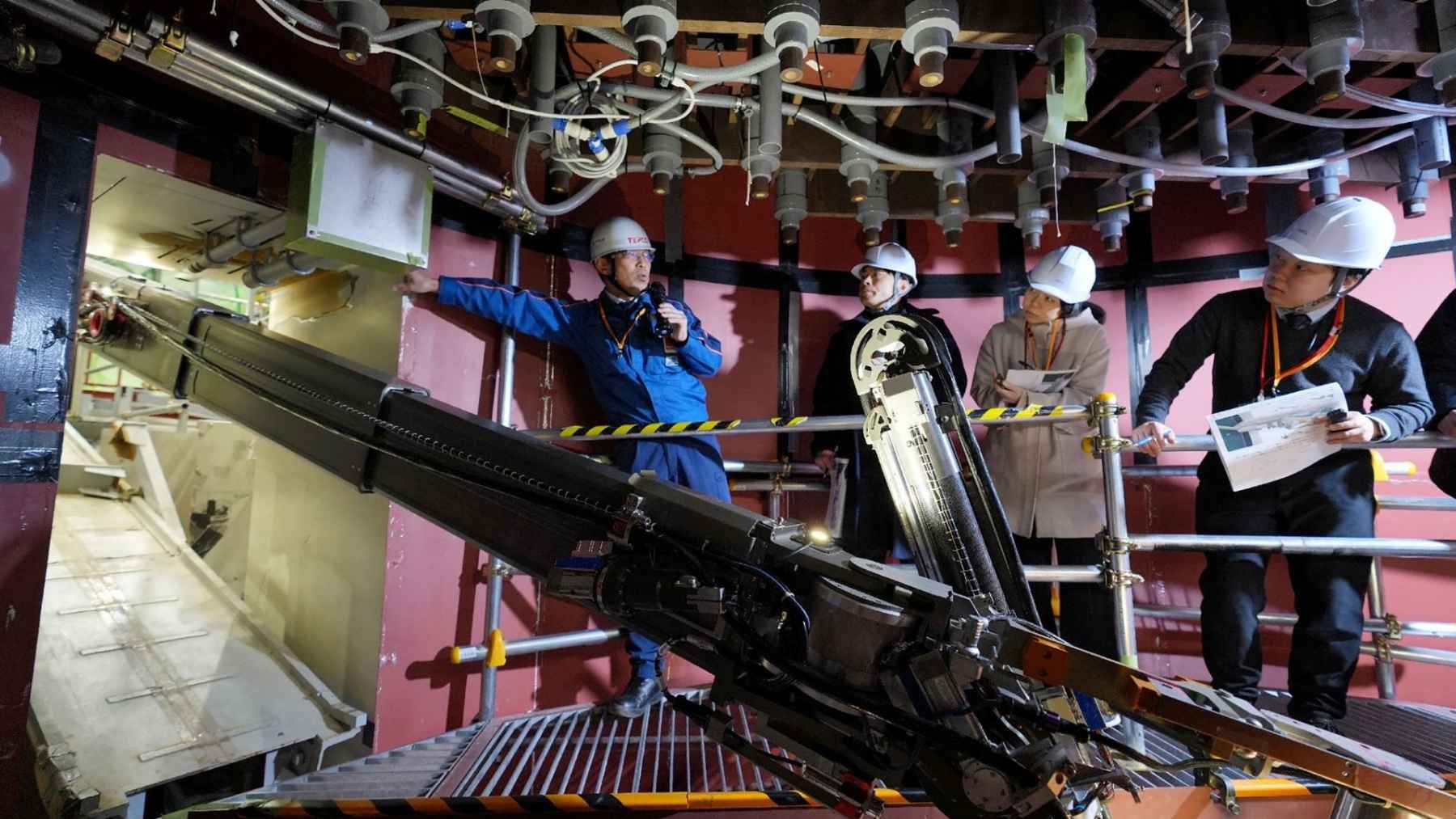
So TEPCO, the utility stuck with arguably the worst cleanup job in the industry, has rolled out the tool it always wanted: a 22-meter robotic arm weighing 4.6 tons, unveiled in late February at a test facility in Naraha, Fukushima Prefecture. According to The Japan Times, setup at the plant was scheduled to begin in March, and the arm is expected to attempt its first grab inside the No. 2 reactor this fall.
The mismatch between those two figures, a 4.6-ton machine for cargo measured in fractions of a gram, is the entire Fukushima story right now. And it makes more sense than it sounds.
The fishing rod era ends with less than a gram
Quick recap on how we got here. The 2011 earthquake and tsunami knocked out power and cooling at Fukushima Daiichi, and the fuel in Units 1 through 3 melted, slumped, and fused with steel and concrete into a material the industry calls fuel debris. TEPCO estimates about 880 metric tons of the stuff sits at the bottom of those three containment vessels.
Nobody can go get it. Radiation inside the vessels remains far too intense for humans, so every ounce of progress runs through machines. The first machine to bring anything back was Telesco, an extendable device that works like a fishing rod, pushed in through a 55-centimeter opening in the containment wall known as the X-6 penetration.
Its debut did not go smoothly. The 2024 trial, already delayed since 2021, stopped once because pipes had been assembled in the wrong order and again when the cameras quit, which TEPCO suspects was the radiation cooking them mid-mission. In November 2024 the rod finally delivered a 0.7-gram sample, roughly the size of a grain of rice. It was also, at that point, the most consequential grain of rice in the nuclear industry.
The second run, completed in April 2025, came back with even less: a 0.187-gram fragment measuring about 5 by 4 millimeters, grabbed a meter or two closer to the center of the pedestal, according to the American Nuclear Society, citing TEPCO’s analysis. Early tests picked up signals of europium, a fingerprint of nuclear fuel. Add both trips together and you get under a gram. Total.
A 4.6-ton arm built to fit through a 22-inch hole
The new arm has been in the works since 2017 under the International Research Institute for Nuclear Decommissioning, with Mitsubishi Heavy Industries and UK-based Veolia Nuclear Solutions doing the engineering. IEEE Spectrum describes a boom-style design, not unlike the robotic arms on the International Space Station, built mostly from stainless steel and aluminum and capable of moving along 18 degrees of freedom.
The party trick is the packaging. The whole 22-meter assembly folds up accordion-style inside a sealed enclosure box, then threads itself through that same 55-centimeter X-6 penetration, which is a hair under 22 inches. Picture parallel-parking a school bus through a manhole, remotely, in a room you can never enter to fix a mistake.
At the tip, interchangeable tools do the actual work, including a brush-like device designed to sweep up fragments of melted fuel. During a February media demonstration in Naraha, the arm picked up sand standing in for debris. The robot carries a camera and “is better at retrieving information” than previous devices, TEPCO spokesman Isao Ito told AFP.
Snake-shaped machines that squeeze into places rigid hardware can’t are having a moment, from this arm to the 6-meter drone snake Norway parks on the seabed to inspect pipelines. The difference is that the Norwegian eel gets to work in seawater. This one works in a room that kills electronics.
The napkin math on 880 tons
Here’s the arithmetic nobody at TEPCO puts on a slide. Two trips have recovered 0.887 grams combined, call it 0.44 grams per trip. At that pace, clearing 880 metric tons would take roughly two billion trips. Run one trip per day and you’d finish in a little over five million years, give or take an ice age.
Nobody plans to do it that way, and that’s precisely the point. The trial retrievals were never about volume. They exist to characterize the material, map where it sits, and prove the access routes, so that engineers can design full-scale removal equipment around real data instead of guesses. The new arm is the bridge between sampling and something that finally moves mass.
The honest timeline still stings. Last July, TEPCO pushed the start of full-scale debris removal at Unit 3, the designated first mover, to fiscal 2037 at the earliest, per World Nuclear News, a slip of more than a decade from the old early-2030s target. The company says it needs 12 to 15 years to knock down radiation levels and build the facilities first. The official goal of finishing decommissioning by 2051 still stands on paper, while some outside experts figure the whole job could run a century.
And retrieval is only half the problem, because everything that comes out needs somewhere to go, permanently. For a sense of what permanent looks like in this business, Finland just finished the world’s first deep geologic tomb for nuclear fuel, engineered to sit untouched for 100,000 years. Japan hasn’t picked its equivalent yet.
The rest of the site stopped waiting around
While the arm gets bolted together, June 2026 turned into the busiest month at Fukushima Daiichi in years, on a completely different front: the spent fuel pools. Quick distinction, because it matters. Spent fuel is intact rod assemblies parked in cooling pools upstairs, nasty but manageable with cranes and casks. Fuel debris is the melted mess downstairs. The pools are the warm-up act.
On June 2, TEPCO started pulling the 615 fuel assemblies out of Unit 2’s pool, using a remotely operated crane because radiation on that floor still runs 3 to 5 millisieverts per hour, too hot for workers to linger. The job should wrap by fiscal 2028.
Then on June 22, crews began full-scale rubble removal on top of Unit 1, per TEPCO, clearing roughly 1,200 tons of explosion wreckage off the building’s top floor under a giant cover finished in January. That opens the path to Unit 1’s own pool, with fuel removal penciled in for fiscal 2027-28. Fifteen years to reach the point where you can start picking up the roof is the kind of schedule this site runs on.
None of it is glamorous. All of it is the same playbook you see wherever nuclear hardware gets swapped at scale, like the Canadian crew that cut a hole in a working reactor’s roof and craned out eight 100-ton steam generators. The difference is that at Bruce Power the machines helped humans. At Fukushima, the machines are the workforce.
What the third trial actually decides
So the fall trial at Unit 2 is worth watching for one number: grams. If the arm comes back with meaningfully more than Telesco’s rice-grain hauls, and its cameras survive long enough to map the debris field, the 2037 start date begins to look like a plan instead of a placeholder. TEPCO also wants proof that operators can run the thing entirely through a virtual-reality twin of the reactor, since nobody gets to look through a window.
If it jams, floods the schedule with repairs, or loses its electronics the way Telesco did, the timeline slips again. TEPCO’s schedules have slipped before, which is the polite version of the plant’s entire history. The machine finally matches the mission. Now it has to survive the room.