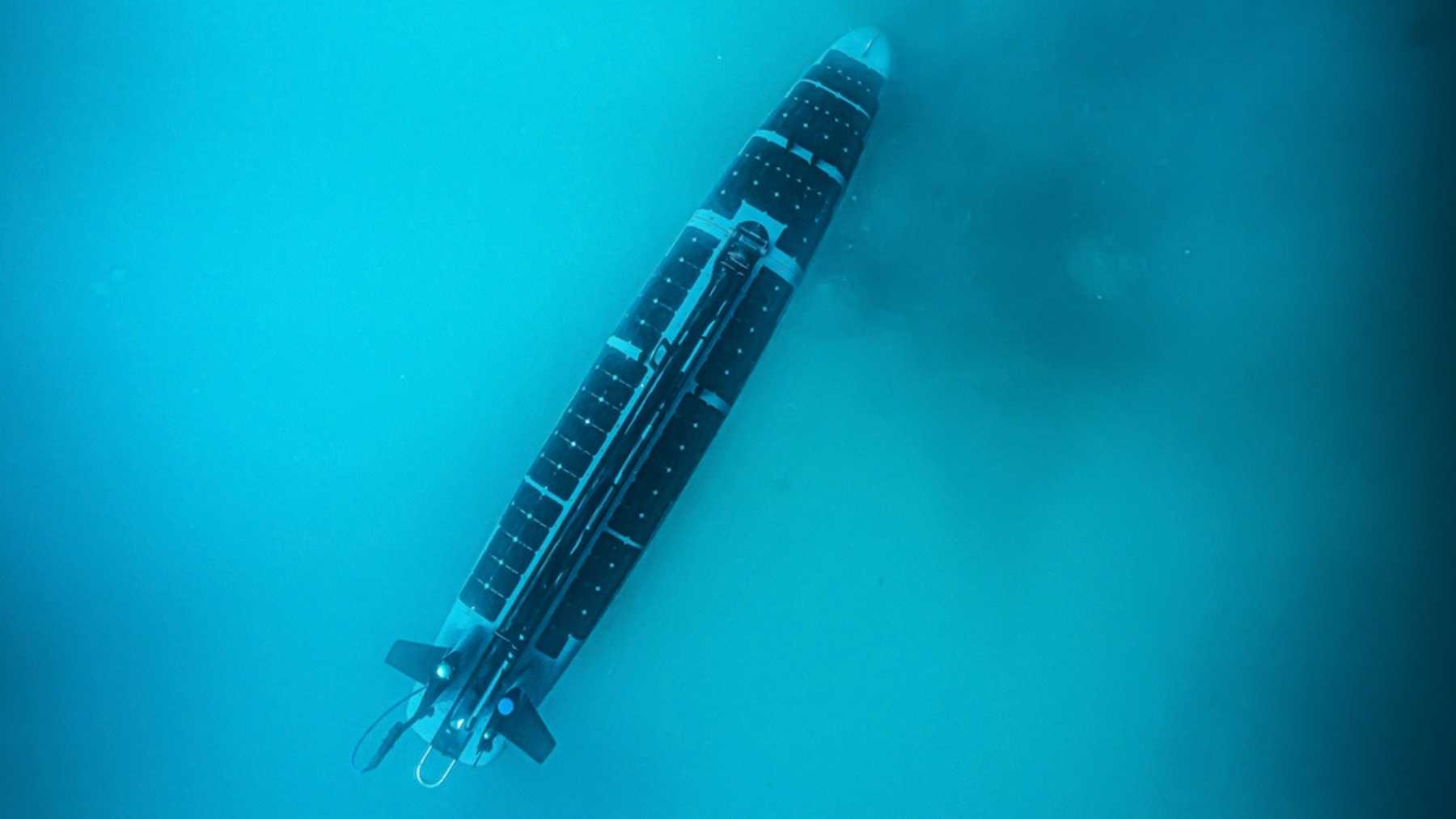

A sailboat and a submarine are about as opposite as two machines can get. One only works because of the big mast sticking up into the wind, and the other one’s entire job description is having nothing stick up anywhere. So when a company from Gulfport, Mississippi says it builds a drone that is genuinely both, some healthy squinting is in order. The machine is called the Triton, the company is Ocean Aero, and the squinting gets harder to maintain once you learn that one of these has been scanning the bottom of an American port twice a week since May 2025, and that its maker spent this spring publicly campaigning to send a fleet of them after the Iranian mines currently strung across the Strait of Hormuz.
The timing is not subtle. Secretary of State Marco Rubio told a Senate committee on June 2 that Iran has mined “large segments” of the strait. A week later, a robot boat from the Navy’s Task Force 59 pulled two downed Apache crew members out of the water near that same strait, a first for unmanned vessels. Sea drones are suddenly a growth industry. The strangest one of the bunch runs on sunshine.
A sailboat on top, a submarine underneath
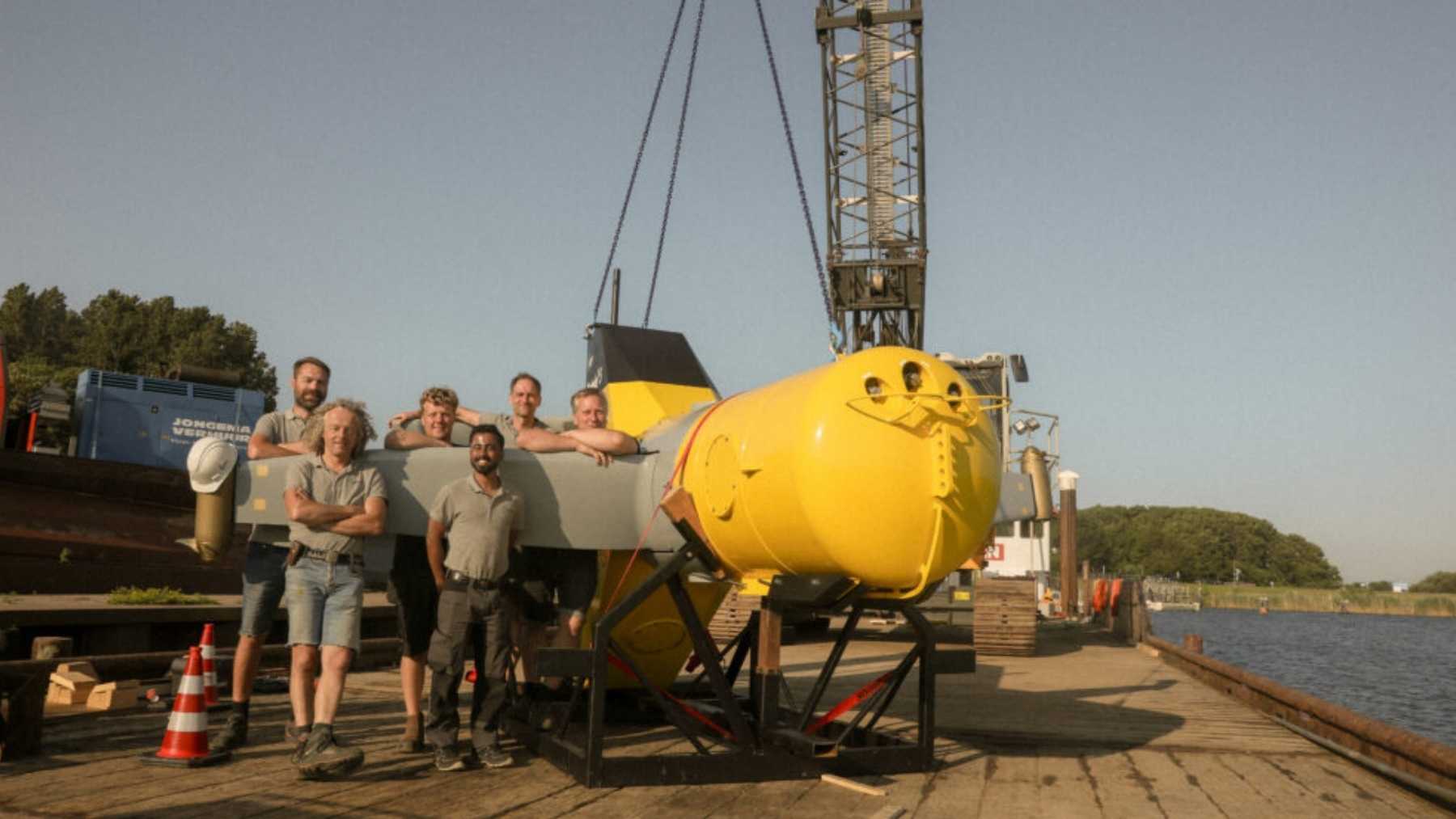
Ocean Aero bills the Triton as the world’s only autonomous vehicle that both sails and submerges, a category the company had to invent a name for: Autonomous Underwater and Surface Vehicle, or AUSV. Per the figures the company published in March 2026, the current generation is nearly 15 feet long and weighs 1,500 pounds (680 kg), which means this entire surveillance platform weighs less than a Miata. On the surface it sails on wind and solar power for 30-plus days at up to 5 knots, topping up its batteries as it goes. When it wants to disappear, it folds the wing sail into the hull, dives to 328 feet (100 m), and stays down for 10-plus days, creeping along at about 2 knots.
The stealth math is the company’s favorite part of the brochure. Ocean Aero claims the Triton’s radar cross-section effectively vanishes beyond a quarter mile, and that its paint scheme breaks up visual detection at about 330 feet (100 m) out. If something does come looking, the drone’s escape plan is the one thing speedboats can’t follow: sink on purpose. Launch and recovery takes one or two people with a davit or a shore ramp, and the whole thing runs missions on pre-programmed waypoints, phoning home over Iridium, WiFi, or mesh radio.
The payload bay is modular, covering surveillance, communications relay, anti-submarine work, and mine countermeasures. In 2024 the company picked UK-based Forcys to supply the serious sensors, pairing Wavefront Systems’ Solstice multi-aperture sonar with Sonardyne’s compact SPRINT-Nav Mini, a unit that fuses acoustic and inertial guidance so the drone keeps its bearings underwater. So a thing that looks like a regatta escapee carries roughly the same class of seabed-imaging gear as a proper naval mine hunter.
Gulfport gets its harbor floor checked twice a week
The operational résumé starts at home. In May 2025, the Port of Gulfport in Mississippi switched on what Ocean Aero and the port billed as the world’s first continuous autonomous subsea surveillance program, built around a single Triton. The routine is almost boring, in the best possible way. The drone runs a full scan of the harbor twice a week with three sensors: side-scan sonar, a magnetometer, and a bathymetric depth mapper, building high-resolution before-and-after maps so software can flag anything new sitting on the bottom. A hull-shaped shadow, a dragged anchor, a box that wasn’t there Tuesday. Operators keep tabs on it remotely from Houston.
CEO Kevin Decker’s standing line, repeated in the company’s March pitch, is that he can vouch for what is and isn’t lying on Gulfport’s seabed on any given morning, and that nobody can honestly say the same about the bottoms of New York, Seattle, Houston, or Los Angeles. It’s a salesman’s framing, but the underlying point is uncomfortable to argue with. Gulfport is no random marina, either. The Naval Construction Battalion Center, home base of the Atlantic Fleet Seabees, sits right there, and the port has carried a Strategic Seaport designation since 2015, 18 miles from open Gulf water.
Gulfport also happens to be Ocean Aero’s hometown and the site of its factory, which makes the port both customer and showroom. The company is at least upfront about that part.
The Navy has been poking at this thing since late 2022
The Triton’s military audition happened in the exact waters everyone is arguing about now. In late 2022, Task Force 59, the 5th Fleet’s unmanned systems unit, ran a three-week exercise out of Bahrain called Digital Horizon, wrapping on December 15 with 17 industry partners and 10 platforms that were new to the region. The Triton sailed in the Arabian Gulf alongside a Coast Guard cutter as part of that flotilla, and the Navy has kept evaluating the platform since. The 5th Fleet commander who championed all that robot experimentation, then-Vice Admiral Brad Cooper, now runs all of U.S. Central Command. The unmanned-systems guy is in charge of the whole theater.
And his old task force keeps making news. On June 8, a U.S. Army Apache went down in the water off Oman, near the strait, and the two crew members were recovered within about two hours by a Task Force 59 drone boat, a Saronic Corsair, in what officials described as the first rescue of its kind. Different robot, different maker, same task force, same waterway. The people who would run Tritons in the Gulf already know the machine and clearly aren’t shy about trusting unmanned hulls with serious jobs.
Hormuz is mined, and the dedicated minesweepers are gone
Here’s the situation the Triton is auditioning for. The strait has been effectively closed or constrained since the war started on February 28, and the cleanup is no longer hypothetical: CENTCOM formally launched a mine clearance mission on April 11, and a brief early-May escort effort dubbed Project Freedom walked a handful of ships through before being paused for diplomacy. The mines haven’t gotten the memo. Reuters counted about a dozen in the water by mid-March, Rubio’s June 2 testimony suggests the real figure is far higher, and Oman was still warning ships about drifting mines on June 1. Experts told The National that the May push likely swept somewhere between 10 and 100 mines, and that Iran could replace them within days. Which makes minesweeping there less a project than a subscription. As of June 8, a UK and French-led coalition built by military planners from more than 15 countries, stocked with autonomous mine hunters and billed as operationally ready, is waiting on a green light at next week’s G7 summit.
The American toolkit for that job is thinner than it used to be. The Navy decommissioned its last four Avenger-class minesweepers in Bahrain in September 2025, retiring wooden-hulled specialists after decades and handing the mission to Littoral Combat Ships fitted with mine countermeasures packages. When the clearance push spun up in April, the Navy ended up rushing two of its remaining Avengers over from Sasebo, Japan, according to Naval News. In its pitch, Ocean Aero claims two of the three LCSs assigned to that duty had already left the region before the shooting started. That pitch, by the way, ran on March 25 as openly sponsored content on Breaking Defense, with Decker arguing Tritons could be hunting mines in the strait within a week of getting the call. Companies don’t usually buy ad space to volunteer for a war zone, so make of the confidence what you will.
Two precisions keep the claim honest. First, what’s fielded today is the finding part: cameras, thermal imaging, and sonar that map mines without touching them. The killing part, a kit that pairs wireless detonation hardware with expendable mini-subs and onboard effectors, is in final testing, per the company. Second, clearing Hormuz isn’t target practice. The seabed there is crowded with pipelines and cables, and as Oscar Rojas, who runs global operations for Ocean Aero and used to command the 5th Fleet’s mine-clearance unit as an active-duty commodore, put it to Breaking Defense: “It’s not as easy as blow-and-go to get rid of sea mines.”
The Triton isn’t auditioning alone, either. Britain has already sent a 12-metre crewless mine hunter toward the strait, Germany’s Greyshark consortium is pitching hydrogen submarine drones for the same clearance problem, and Australia just handed the U.S. Navy a container-shipped drone submarine of its own. The mine-hunting robot derby of 2026 has a deep field. The Triton’s differentiator is that it’s the only entrant that commutes to the minefield under sail.
The fine print: a lawsuit and a production ceiling
Two asterisks belong on the record. In April 2026, Australia’s Ocius Technology sued Ocean Aero in federal court in Delaware, alleging the newest Triton copies its patented wing-sail technology and asking for damages and an injunction. Those are allegations in a complaint, not findings, and the case is young. Then there’s volume: the company says its 63,000-square-foot Gulfport facility can build up to 360 Tritons a year, with annex options that could add another 1,000. Hormuz-scale mine clearance would test those numbers in a hurry.
Whether Tritons ever sweep the strait is a Pentagon decision tangled up in budgets, politics, and a war that keeps almost-ending. What the machine has already proven is smaller and more interesting. A drone powered by weather can keep a beat cop’s schedule, in salt water, for over a year, with humans checking in from two states away. The flashiest number on the spec sheet isn’t the 328-foot dive depth. It’s twice a week, every week, since May 2025. In robot terms, that’s character.