
If you know one fusion project by name, it’s probably ITER, the 35-country machine in southern France that has been under construction since before TikTok existed. Its whole identity is scale: the biggest tokamak, the biggest magnets, the biggest budget in energy science. Which makes last Saturday’s news out of China worth a slow read.
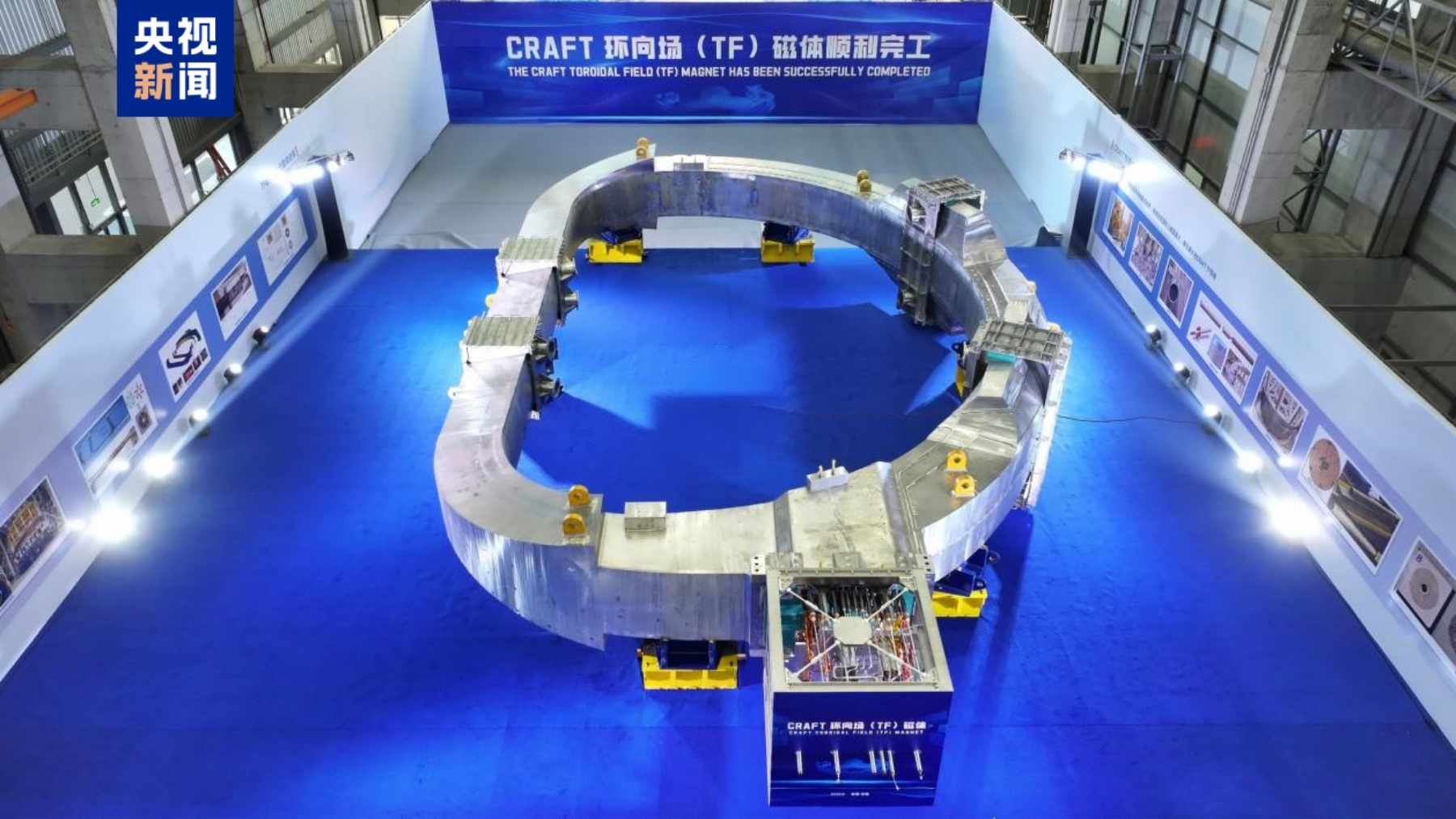
On June 27, the Institute of Plasma Physics at the Chinese Academy of Sciences announced in Hefei that a toroidal field superconducting magnet built for its fusion program had passed development acceptance and full-parameter testing. At 582 metric tons, it is the largest superconducting magnet ever built for a fusion device, period.
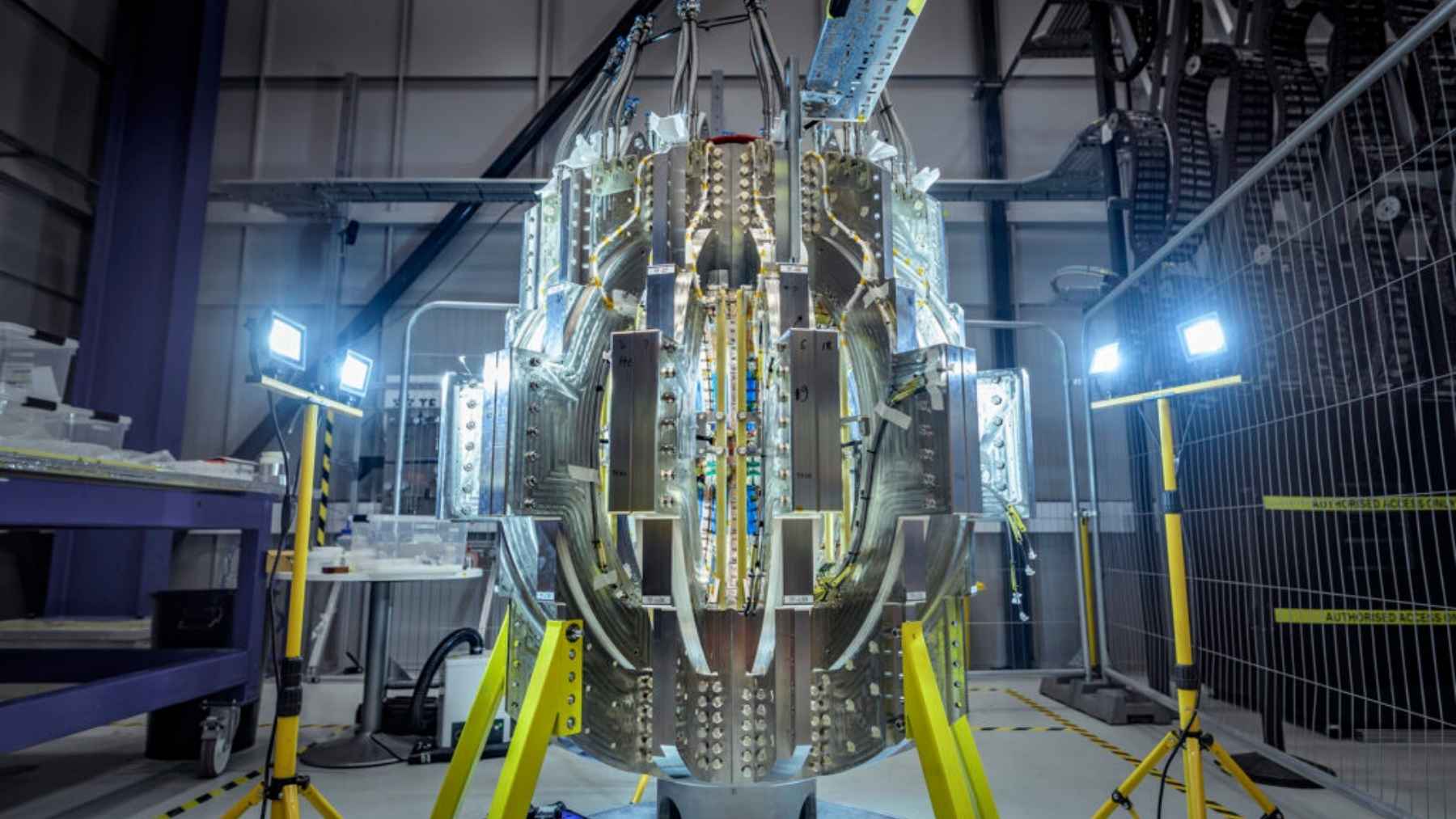
A toroidal field magnet has the least glamorous and most important job in a tokamak. The fuel is a plasma cloud running north of 100 million degrees Celsius, and for reference, the Sun’s core sits around 15 million. No material survives contact with that, so the magnet’s field pens the cloud in mid-air, away from anything meltable.
The new coil was built under CRAFT, the Comprehensive Research Facility for Fusion Technology, China’s dedicated campus for proving out reactor-grade hardware before any reactor gets built. And the expert panel that signed off wasn’t grading a concept. The physical magnet went through testing at full operating parameters first.
Bigger than ITER’s coils on every axis that counts
The numbers first. The coil is D-shaped, 69 feet long, 39 feet wide and 11 feet thick (21 by 12 by 3.3 meters), and it weighs 582 metric tons. That’s roughly 300 Ford F-150s fused into a single ring, if you want the automotive translation.
Set against the equivalent coil at ITER, the Chinese magnet has 1.3 times the volume and stores three times the energy, by the institute’s own comparison. Field strength is rated at 6.5 tesla with a targeted 60-year service life, per figures reported by Newsweek. Your hospital MRI, the machine that makes you surrender your belt and keys, runs at 1.5 to 3 tesla.
And this is one coil, not the finished product. Wu Yu, a researcher at the institute, says 16 of them will eventually be assembled into the complete magnet system of a future reactor, according to Interesting Engineering. Sixteen of these, standing in a circle, is what the full magnetic donut looks like.
Every piece of it was made in China, and that’s the actual point
Records are nice, but the announcement buried the strategic part in a single line: 100% domestic production. Per state agency Xinhua, every critical technology in the program was developed at home, from the superconducting cable to the cryogenic steel carrying the load.
That steel is its own superlative. The coil’s 400-metric-ton structural case, made of ultra-low-temperature austenitic steel, was delivered by Shanghai Electric back in October 2025, and World Nuclear News reported it was already the world’s largest toroidal field coil box, roughly twice the weight of ITER’s comparable component.
Compare that with how ITER gets its magnets. The coils in France arrive through a procurement web spanning Japan, Europe and the United States, with central solenoid modules shipped across the Atlantic from San Diego. China just demonstrated it can run the entire chain, wire to winding, inside its own borders.
The toroidal coil didn’t sit on the test stand alone, either. The same announcement covered a high-temperature superconducting central solenoid, the igniter magnet that kicks off and drives the plasma current. It ran at a stable 60 kiloamperes while holding 6.03 megajoules of energy, per CGTN, performance the institute describes as world-leading.
France finished a giant magnet of its own the same week
Here’s what makes the timing almost cinematic. Four days before Hefei’s announcement, on June 23, crews at ITER lifted the sixth and final module of the project’s central solenoid into place, completing a stack more than a decade in the making. The ITER Organization describes the finished magnet as having force “strong enough to raise an aircraft carrier out of the water.”
ITER’s solenoid is a 59-foot tower of six modules weighing roughly 1,000 tons combined, and it is a genuine engineering landmark. It’s also headed into a machine that, under ITER’s revised schedule, won’t begin research operations until 2034 or burn real deuterium-tritium fuel until 2039. We got into that slip when a compact tokamak outside Boston hit 75% complete while chasing net energy in 2027.
China’s clock reads differently. CRAFT is a component campus rather than a reactor, but the BEST tokamak is rising right next door, with civil works underway since 2023 and a stated target of first deuterium plasma in 2027, according to World Nuclear News.
So inside one week of summer 2026, Europe and the US finished stacking a magnet for a machine that fires in the 2030s, and China finished testing the biggest fusion magnet ever made for machines it wants running before this decade is out.
Hefei is quietly becoming fusion’s company town
Zoom out and the geography is the story. Hefei already hosts EAST, the world’s first fully superconducting tokamak, operating since 2006. In January 2025 that machine held a plasma for 1,066 seconds, just shy of 18 minutes.
CRAFT itself is in its final construction phase, one campus with around 20 specialized test stands covering magnets, heating systems, blankets and tritium handling. The plan is to de-risk every major component before anyone commits to a full reactor build.
The funding matches the ambition. Beijing put at least $6.5 billion into commercial fusion projects between 2023 and September 2025, per Special Competitive Studies Project estimates cited by Newsweek, and fusion made the priority list in the country’s latest five-year plan.
None of this makes the giant-magnet route the only path, to be fair. Japan’s JT-60SA, the largest tokamak operating anywhere, is working through its own upgrade commissioning, and a Canadian outfit skips superconducting magnets entirely by crushing its plasma inside a collapsing lithium wall. The field is crowded. What China just proved is that on the biggest, most conventional road, it can out-build everyone.
The honest caveats: one prototype coil passing acceptance is not a torus. Fifteen more would have to be wound, cased and tested before that 16-coil ring exists anywhere outside a rendering, and a magnet on its own generates exactly zero watts of fusion power.
But every serious fusion roadmap on Earth runs through a coil like this one. ITER needed 35 countries and two decades to get its magnets built and delivered to France. China wound a bigger one by itself, tested it at full tilt, and announced it four days after ITER’s freshly stacked solenoid settled in to wait its turn for the tokamak pit.
Image Credit: CMG
 @randynamen ROOKIE3 months ago