
Cement is the most-used building material on Earth after water, and for thousands of years we have made it basically one way: cook limestone in a kiln, drive the carbon out of the rock, grind down what is left, and mix the powder with water and sand.
It works. It is also one of the dirtiest things humanity does at scale, responsible for somewhere around 8 percent of all the carbon dioxide we put into the atmosphere.
A company in Research Triangle Park, North Carolina, has spent the last decade betting it can skip the fire entirely. Instead of baking a brick, it grows one, feeding bacteria a steady diet of calcium and water until they glue loose sand into solid stone at room temperature, in under three days.
It is basically sandstone, made in a hurry
The company is Biomason, founded in 2012 by architect Ginger Krieg Dosier, and the trick is a strain of bacteria called Sporosarcina pasteurii — a common, unmodified soil microbe that building scientists have written up as the engine behind the company’s bricks.
Feed it calcium and water and it does what coral and seashells do: it precipitates calcium carbonate, the same mineral that makes up limestone, chalk and the shell on your kitchen counter. Inside a mold full of sand, that calcium carbonate crystallizes around each grain and locks the whole thing together. There is no furnace, no clinker, no 2,600-degree flame. The reaction runs at room temperature.
What you end up with is, structurally, sandstone — sand cemented into rock by calcium carbonate, which is exactly how nature makes the real thing, only over a few hundred thousand years instead of a long weekend. Biomason’s version sets in under three days, against the roughly 28 days conventional concrete needs to reach full strength.
In one PBS NewsHour demonstration, a researcher squirted calcium into a beaker of primed bacteria and the crystals formed almost on contact. Scale that up, pour it into brick molds, let it harden in a shipping container for a couple of days, and you have a building material that was grown rather than baked.
Skip the kiln, skip most of the carbon
To see why anyone bothers, you have to look at where cement’s pollution actually comes from.
Roughly half of it is the fossil fuel burned to keep the kiln hot — those kilns run between 2,500 and 2,800 degrees Fahrenheit, hot enough to melt steel — and the other half is chemistry you cannot avoid: heating limestone splits it into lime and carbon dioxide, and the CO2 goes straight up the stack.
The energy it takes to bake a single ton of cement, PBS NewsHour notes, could power the average American home for more than a month.
Grow the cement instead and the kiln disappears, which kills the fuel half of the equation outright. Biomason goes further, arguing that because its process uses carbon as a building block rather than driving it off as exhaust, it cuts cradle-to-gate emissions by more than 90 percent versus ordinary Portland cement; its lead investor, the European fund 2150, puts the figure as high as 95 percent.
The company says every kilogram of its biocement used in place of conventional cement keeps roughly a kilogram of CO2 out of the air.
Those are the company’s numbers, and the full carbon accounting for biologically grown cement is still something researchers argue about — the shipping, quarrying and electricity do not vanish. But the single biggest source, the furnace, genuinely does.
That matters because concrete is how we build everything big. Denmark is right now sinking 73,500-ton concrete boxes into the Baltic Sea to assemble the world’s longest immersed tunnel, one prefab element at a time, and every one of them leans on cement. Shave the carbon off the binder and you change the math on projects that size.
You can already buy it — as tiles
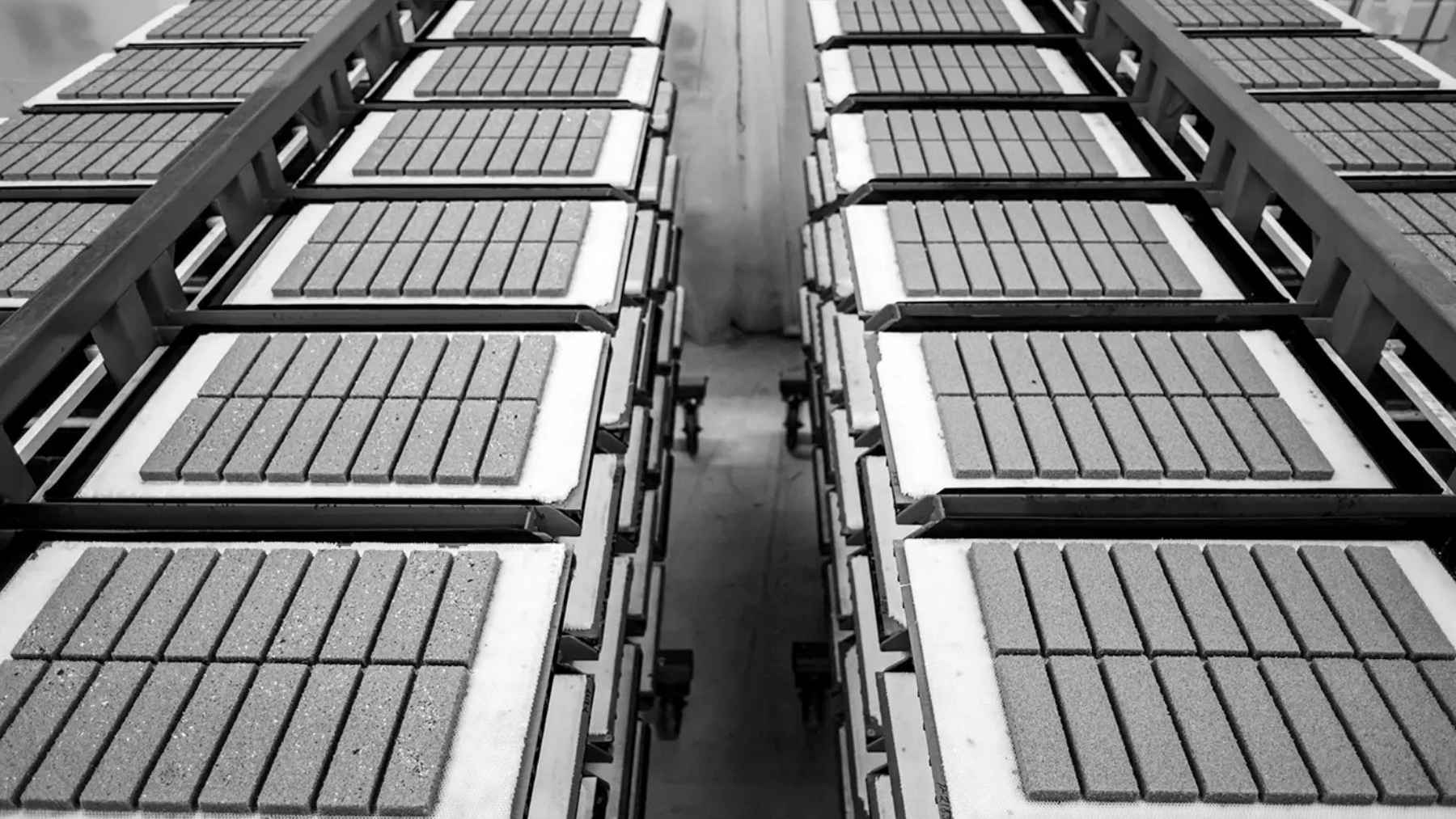
This is not a lab curiosity that lives only in renderings. Biomason already sells a precast product called bioLITH, a tile built from a mix that is mostly recycled granite with bacteria doing the binding, and it has put biocement into floors and surfaces across North America and Europe.
The Swedish fashion giant H&M Group signed on for tiles. In Denmark, Biomason teamed up with IBF, the country’s largest precast concrete maker, to stand up a factory in Ikast that has been turning out biocement products since 2023, using the same mixers and presses a normal block plant already owns.
The money has followed. A $65 million Series C round was led by 2150, with backing from Novo Holdings and, tellingly, Martin Marietta — one of the biggest aggregates and building-materials companies in the United States, the kind of incumbent you would expect to be threatened by this, not investing in it.
Co-founder Ginger Krieg Dosier told the North Carolina Biotechnology Center the company is “on a direct flight to revolutionize the cement industry,” and it has set itself the goal of erasing a quarter of the concrete industry’s global carbon emissions by 2030.
If you have followed how a hemp-and-lime wall finally cleared the US residential building code, this is the harder, load-bearing cousin of that same fight to clean up what we build with.
The Pentagon wants cement that grows itself
The most science-fiction part of Biomason’s work is not on a job site — it is inside a Defense Department research program.
Through DARPA’s Biological Technologies Office, the company has worked on something called Engineered Living Marine Cement, which swaps the calcium-and-water diet for self-sustaining marine microbes that pull what they need straight out of seawater and can, in theory, repair themselves when they crack, according to the Institution of Mechanical Engineers.
The target uses are things like breakwaters and shoreline stabilization, where ordinary concrete is in a constant fight with saltwater.
A second effort, named Medusa, points at a problem every military engineer knows: you cannot land a helicopter on loose sand. Instead of trucking concrete out to a remote site, the idea is to stabilize the dirt that is already there with the right bacteria, growing a hard landing surface more or less on demand.
It is the same biology as the bricks, aimed at a place where the alternative is a convoy of cement trucks that might not be able to get there at all.
It is a long way from your foundation
Now the cold water. What Biomason ships today is tile, pavers and cladding — surfaces, not the structural columns and beams holding up a tower. The company is pushing toward ready-mix concrete and bigger structural roles, but that is the climb in front of it, not a box it has checked.
Grown cement is also not cheap or fast at the scale Portland cement runs at, and the supply chain for it is young. Nobody is paving an interstate with bacteria next year.
What has changed is that Biomason is no longer out there alone. The field has gotten crowded fast: at the University of Colorado Boulder, Wil Srubar’s lab has been growing living building materials seeded with cyanobacteria, and a team at Aarhus University recently went so far as to lace cement with electricity-conducting bacteria and turn a block into a working supercapacitor — a wall that stores power.
Most of that is still lab-stage. Biomason’s distinction is that it has been quietly selling the proof for ten years while everyone else debated whether grown cement was even possible.
The interesting thing about biocement was never that it is going to replace every bag of Portland cement on the planet, because it is not, at least not soon. It is that the dirtiest, most stubborn step in the whole process — the kiln, hot enough to melt steel, burning fuel around the clock — finally has a plausible biological way around it.
A handful of bacteria, some sand and a few days at room temperature will not build your house tomorrow. But the part of cement nobody could figure out how to clean up turns out to be the part you can just grow your way past.